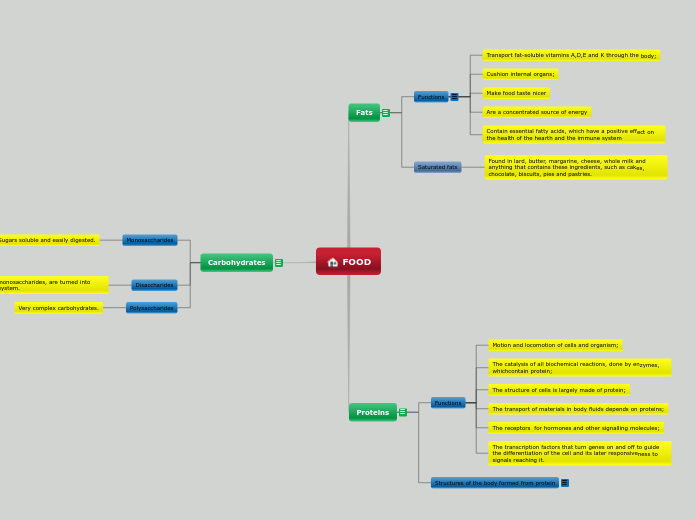
Fats and their compounds are known as lipids. They contain the elements Carbon and Hydrogen. Amongst the various foods, fats provide the body with maximum energy(9kcal/g), approximately twice that for an equal amount of protein or carbohydrates.
Functions
Unsaturated fats are usually liquid at room temperature and generally come from vegetable sources. They are healthier alternatives to saturated fats.
Transport fat-soluble vitamins A,D,E and K through the body;
Cushion internal organs;
Make food taste nicer
Are a concentrated source of energy
Contain essential fatty acids, which have a positive effect on the health of the hearth and the immune system
Saturated fats
Found in lard, butter, margarine, cheese, whole milk and anything that contains these ingredients, such as cakes, chocolate, biscuits, pies and pastries.
They contain Carbon, Hydrogen, Oxygen, Nitrogen and sometimes Sulphur. Proteins consist of smaller units called amino acids, which can link together in many combinations to form chains. Some amino-acid chains are created by our body, but those called essential amino acids must come from our diet. Although all animal and plant cells contain some protein, the amount and the quality of the protein varies a lot.
Functions
Motion and locomotion of cells and organism;
The catalysis of all biochemical reactions, done by enzymes, whichcontain protein;
The structure of cells is largely made of protein;
The transport of materials in body fluids depends on proteins;
The receptors for hormones and other signalling molecules;
The transcription factors that turn genes on and off to guide the differentiation of the cell and its later responsiveness to signals reaching it.
Structures of the body formed from protein
Hair and nails are made of keratins which are long protein chains containing a high percentage (15%-17%)of the amino acid cysteine. Collagen is the most common protein in the body and comprises approximately 20-30% of all body proteins. It is found in tendons, ligaments, and many tissues that serve structural or mechanical functions. Collagen consists ofamino-acid squences that coil into a triple helical structure to form very strong fibres. Tooth enameln and bones consit of a protein matrix (mostly collagen) with dispersed crystals of minerals such as apatite, which is a phosphate of ccalcium. Muscle tissue consists of approximately 65% actin and myosin, which are the contractile proteins that enable muscle movement.
They contain the elements Carbon, Hydrogen and Oxygen. The first part of the name "carbo-" means that they contain Carbon; the second part of of the name "-hydr-" means that they contain Hydrogen; and the third part of the name "-ate-" means that they contain Oxygen.
Monosaccharides
Sugars soluble and easily digested.
GLUCOSE
Which is carried around the body in blood and is used by our tissues as a source of energy.
GALACTOSE
A sugar in milk.
FRUCTOSE
A sugar found in honey.
Disaccharides
Sugars composed of wo monosaccharides, are turned into glucose by the digestive system.
SUCROSE
Or cane sugar = glucose + fructose
Polysaccharides
Very complex carbohydrates.