Archea
Archaebacteria
Unicellular microorganisms with no cell nucleus or other organelles, that in habit extreme environments, to avoid competition with other organisms.
Prokayotes
No nuclear membrane
No membrane organelle
Monera
Thermophiles
Thrives in high temperature weather)
Halophiles
Salt-loving
Methanogens
Produce methane as metabolic by product
microscopic
Reproduces through binary fission
Single plasmid
Conjugation
Dna transfar
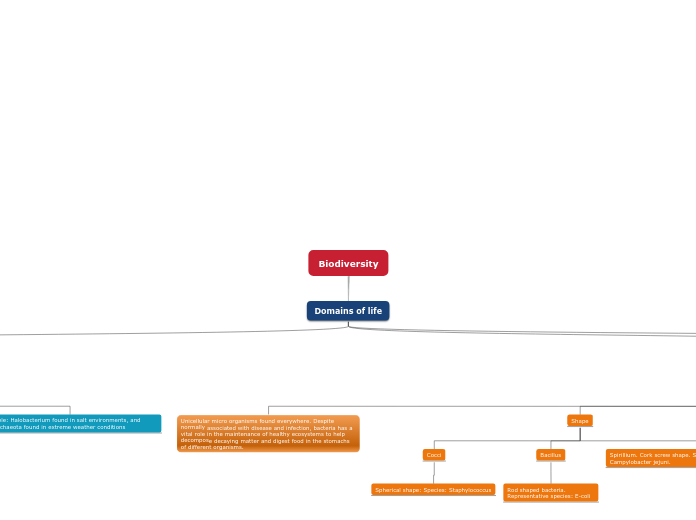
Example: Halobacterium found in salt environments, and crenarchaeota found in extreme weather conditions
Bacteria
Eubacteria
Unicellular micro organisms found everywhere. Despite normally associated with disease and infection, bacteria has a vital role in the maintenance of healthy ecosystems to help decompose decaying matter and digest food in the stomachs of different organisms.
Shape
Cocci
Spherical shape: Species: Staphylococcus
Bacillus
Rod shaped bacteria. Representative species: E-coli
Spirillium. Cork screw shape. Species representation includes Campylobacter jejuni.
Unicellular
Prokaryotic
Reproduces through Binary fission
Microscopic
Conjugation
Both autotrophic and heterotrophic
Cell walls made of peptidoglycan
metbolize remains of plants and animals
Subtopic
Examples: Proteobacteria, chlamydias, spirochetes, and cyanobacteria
Eukarya
Eukaryotes
Most unicellular, some multicellular
Binary fission and conjugation
Live in fresh salt water, damp areas, and animal fluids
Animal like:
Unicellular
Protozoa
Heterotrophs
Obtains nutrients by consuming other organisms
Phyla
Zoomastigina
Move by flagella
Sarcodina
Move by pseudopods
Amoeba
Ciliophora
Move by cilia
Paramecium
Sporozoa
DO not move
Plasmodium
Plant Like:
Algae
Multicellular and unicellular
Green
Contains chlorophyll
Carries out photosynthesis
Autotrophs
Make their own food from raw materials and energy.
Fungus like:
Decomposers
Feed on dead and decaying matter
Slime molds
Water molds
Heterotrophs
Found everywhere
Heterotrophic
Obtains nutrients by consuming other organisms and ingest and digest their food
Unicellular and multicellular
Do no photosynthesize
Cell wall made of cell wall is made of glucans, chitin and glycoproteins
Decomposers
Feed on dead and decaying matter
Yeast, truffles, Mushrooms, shelf fungi, Parasite fungi
Absorb their food
Membrane bound organelles and and nucleus
Phyla
Chytridiomycota
Reproduce both sexually and asexually
feed on decaying organisms
Zygomycota
Reproduce sexually
Known to cause serious infections, that occur as a result of injury. One disease is zygomycosis.
Ascomycota
Reproduce Asexually
Decomposers
Basidiomycota
Reproduce Sexually
Help plants obtain nutrients from soil, and later receive sugars produced through photosynthesis.
Multicellular
Autotrophic
Makes its own food by synthesizing organic nutrients from inorganic materials, using energy from sunlight or a chemical source
Chloroplast/ Chlorophyll pigment
Angiosperms
Vascular plants with stems, roots, and leaves.
Gymnosperms
Seed producing plants0o9l
Photosynthetic
Roots
Kingdom produces oxygen for earths atmosphere
Plant kingdom
Crptogamae
Thallophyta
Bryophyto
Pteridophyta
Phanerogamae
Angiosperms
Gymnosperms
Plant kingdom
Non-vascular plants
Vascular plants
Seedless vascular plants
Seed producing vascular plants
Gymnosperms
Angiosperms
Multicellular
Heterotrophs
Obtains nutrients by consuming other organisms and ingest and digest their food
Reproduce Sexually
Digestive system
Movement
Nervous system
No cell wall
Organ system
Mobile
Symmetry of body
Body cavities
Segmentation
number of germ layers
Ectoderm
Mesoderm
Endoderm
Levels of orgaization
Animalia(Kingdom)
Tissue and organ system
Bilateral(Symmetry)
Annelida: Leech
Arthropoda:Largest phylum with invertebrate animals with
Exoskeletons. Examples include, scorpions, spiders, lobsters
Mollusca: Snails, Squid, octopus, Clams etc
Echinodermata: all marine Sea organisms with spiny skin such as sea urchins
Nematoda:unsegmented, cylindrical worms such as hookworms
Radial(Symmetry)
Ctenophora:no brain or central nervous system:Comb jellies
Coelenterata/cnidaria: Found in aquatic and mostly marine environments: Sea pens
Cellular level
Porifera