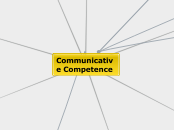
Communicative Competence
Discourse Analysis
http://www.slideshare.net/poppleopogus/discourse-analysis-presentation-nov-21-serl?qid=c4ff2f45-94cd-46d7-8efc-c75a691b739e&v=qf1&b=&from_search=2http://www.slideshare.net/guestfca522/how-to-do-a-discourse-analysis?related=1http://www.slideshare.net/nojtoj/discourse-analysis-32742545?related=2The analysis of the relationship between forms and functions of language is commonly called discourse analysis, which encompasses the notion that language is more than a sentence-level phenomenon.
aMain topic
Defining Communicative Competence
Communicative competence is that aspect of our competence that enables us to convey and interpret messages and to negotiate meanings interpersonally within specific contexts. (Dell Hymes)
Learner Language
The most obvious approach to analyzing interlanguage is to study the speech and writing of learners, or what has come to be called learner lan¬guage (Lightbown & Spada 1993; C.James 1990). Production data is pub¬licly observable and is presumably reflective of a learner's underlying competence—production competence, that is. Comprehension of a second language is more difficult to study since it is not directly observable and must be inferred from overt verbal and nonverbal responses, by artificial instruments, or by the intuition of the teacher or researcher.It follows that the study of the speech and writing of learners is largely the study of the errors of learners. "Correct" production yields little infor¬mation about the actual linguistic system of learners, only information about the target language system that learners have already acquired. Therefore, our focus in the rest of this chapter will be on the significance of errors in learners' developing systems, otherwise known as error analysis
STYLES AND REGISTERS
Another important issue in describing communicative competence is the way we use language in different styles depending on the context of a communicative act in terms of subject matter, audience, occasion, shared experience, and purpose of communication. A style is not a social or regional dialect, but a variety of language used for a specific purpose. Styles vary considerably within a single language user's idiolect.
Cross-Linguistic Influence
http://www.slideshare.net/auroramariscalg/linguistic-factors-presentation?qid=97122b2f-5298-471a-916d-535f6ae36731&v=default&b=&from_search=6The so-called weak version of the САН is what remains today under the label cross-linguistic influence (CLI), suggesting that we all recognize the significant role that prior experience plays in any learning act, and that the influence of the native language as prior experience must not be overlooked. The difference between today's emphasis on influence nth ' than prediction, is an important one. Aside from phonology, which remains the most reliable linguistic category for predicting learner performance, as illustrated at the beginning of the chapter, other aspects of language present more of a gamble. Syntactic, lexical, and semantic interference show far more variation among learners than psychomotor-based pronunciation interference. Even presumably simple grammatical categories like word order, tense, or aspect have been shown to contain a good deal of variation. For example, one might expect a French speaker who is beginning to learn English to say "I am in New York since January"; however, to predict such an utterance from every French learner of English is to go too far.
aLanguage Functions
ERROR ANALYSIS
http://www.slideshare.net/ahmedhussein192/error-analysis-22882508?related=2http://www.slideshare.net/asimano/introduction-to-error-analysis?related=3http://www.slideshare.net/ahmedqadoury/error-analysis-revised-17890727?related=4
discourse competence
Discourse competence, the complement of grammatical competence in many ways. It is the ability we have to connect sentences in stretches of discourse and to form a meaningful whole out of a series of utterances. Discourse means everything from simple spoken conversation to lengthy written texts (articles, books, and the like). While grammatical competence focuses on sentence-level grammar, discourse compe-tence is concerned with intersentential relationships.
interactional
The interactional function of language serves to ensure social maintenance. "Phatic communion," Malinowski's term referring to the communicative contact between and among human beings that simply allows them to establish social contact and to keep channels of communication open, is part of the interactional function of language. Successful interactional communication requires knowledge of slang, jargon, jokes, folklore, cultural mores, polite¬ ness and formality expectations, and other keys to social exchange.
PRAGMATICS
Implicit in the above discussions of language functions, discourse analysis, and conversation rules is the importance of pragmatics in conveying and interpreting meaning. Pragmatic constraints on language comprehension and production may be loosely thought of as the effect of context on strings of linguistic events. Consider the following conversation:[Phone rings, a ten-year-old child picks up the phone]Stefanie: Hello.Voice: Hi, Stef, is your Mom there?Stefanie: Just a minute, [cups the phone, and yells] Mom! Phone!Mom: [from upstairs] I'm in the tub!Stefanie: [returning to the phone] She can't talk now. Wanna leave a message? Voice: Oh, [pause] I'll call back later. Bye.
Grammatical competence
1. Grammatical competence is that aspect of communicative competence that encompasses "knowledge of lexical items and of rules of morphology, syntax, sentence-grammar semantics, and phonology" (Canale & Swain 1980: 29). It is the competence that we associate with mastering the linguistic code of a language, the "linguistic" competence of Hymes and Paulston, referred to above.
Sociocultural Factors
http://www.slideshare.net/qowimganteng/sociocultural-factors-in-language-teaching-and-learninghttp://www.slideshare.net/drrubrico/sociocultural-factors-in-sla
apersonal
The personal function allows a speaker to express feelings, emo¬tions, personality, "gut-level" reactions. A person's individuality is usually characterized by his or her use of the personal function of communication. In the personal nature of language, cognition, affect, and culture all interact
regulatory
The regulatory function of language is the control of events. While such control is sometimes difficult to distinguish from the instrumental function, regulatory functions of language are not so much the "unleashing" of certain power as the maintenance of control. "I pronounce you guilty and sentence you to three years in prison" serves an instrumental function, but the sentence "Upon good behavior, you will be eligible for parole in ten months" serves more of a regulatory function. The regulations of encounters among people—approval, disapproval, behavior control, setting laws and rules—are all regulatory features of language.
representational
The representational function is the use of language to make statements, convey facts and knowledge, explain, or report—that is, to "represent" reality as one sees it. "The sun is hot," "The presi¬dent gave a speech last night," or even "The world is flat" all serve representational functions, although the last representation may be highly disputed.
Sociolinguistic competence
3. Sociolinguistic competence is the knowledge of the sociocultural rules of language and of discourse. This type of competence "requires an understanding of the social context in which language is used: the roles of the participants, the information they share, and the function of the interaction. Only in a full context ofthis kind can judgments be made on the appropriateness of a par¬ticular utterance" (Savignon 1983:37)
ainstrumental
The instrumental function serves to manipulate the environ¬ment, to cause certain events to happen. Sentences like "This court finds you guilty," "On your mark, get set, go!" or "Don't touch the stove" have an instrumental function; they are communicative acts that have a specific perlocutionary force; they bring about a particular condition
Casual
Casual conversations are between friends or colleagues or some times members of a family; in this context words need not beguarded and social barriers are moderately low
deliberative style
A deliberative style is also used in addressing audiences, usuallyaudiences too large to permit effective interchange between speaker and hearers, although the forms are normally not as polished as those in an oratorical style. A typical university classroom lecture is often carried out in a deliberative style.
Conversation Analysis
Very early in life, children learn the first and essential rule of conversation: attention getting. If you wish linguistic production to be functional and to accomplish its intended purpose, you must of course have the attention of your audience. The attention-getting conventions within each language—both verbal and nonverbal—need to be carefully assimilated by learners. Without knowledge and use of such conventions, second language learners may be reluctant to participate in a conversation because of their own inhibitions, or they may become obnoxious in securing attention in ways that "turn off" their hearer to the topic they wish to discuss.Once speakers have secured the hearer's attention, their task becomes one of topic nomination. Rules for nominating topics in conversation, which involve both verbal and nonverbal cues, are highly contextually constrained. It is odd that only in recent years have language curricula included explicit instruction on how to secure the attention of an audience. Typical classroom activities in English include teaching students verbal gambits like "Excuse me," "Say," "Oh, sir," "Well, I'd like to ask you something" and nonverbal signals such as eye contact, gestures, and proxemics (see a discussion of these categories later in this chapter).Once a topic is nominated, participants in a conversation then embark on topic development, using conventions of turn-taking to accomplish various functions of language. Allwright (1980) showed how students of English as a second language failed to use appropriate turn-taking signals in their interactions with each other and with the teacher. Turn-taking is another culturally oriented sets of rules that require finely tuned perceptions in order to communicate effectively. Aside from turn-taking itself, topic development, or maintenance of a conversation, involves clarifica¬tion, shifting, avoidance, and interruption. Topic clarification mani¬fests itself in various forms of heuristic functions. In the case of conversations between second language learners and native speakers, topic clarification often involves seeking or giving repair of linguistic forms that contain errors. Repair, as we saw in Chapter 8, involves a con¬tinuum of possibilities ranging from indirect signals to outright correction. It is what Canale and Swain (1980) labeled "strategic competence," and comprises a part of what Bachman (1990) included in strategic compe¬tence. Topic shifting and avoidance may be effected through both verbal and nonverbal signals. Interruptions, a form of attention getting, are a typ¬ical feature of all conversations. Rules governing appropriate, acceptable interruption vary widely across cultures and languages.Topic termination is an art that even native speakers of a language have difficulty in mastering at times. We commonly experience situations in which a conversation has ensued for some time and neither participant seems to know how to terminate it. Usually, in American English, conversa¬tions are terminated by various interactional functions—a glance at a watch, a polite smile, or a "Well, I have to be going now." Each language has verbal and nonverbal signals for termination. It is important for teachers to be acutely aware of the rules of conversation in the second language and to aid learners to both perceive those rules and follow them in their own conversations.
oratorical style
An oratorical style is used in public speaking before a large audience; wording is carefully planned in advance, intonation is some what exaggerated, and numerous rhetorical devices are appropriate
(CALP)
cognitive/academic language proficiency (CALP) is that dimension of proficiency in which the learner manipulates or reflects upon the surface features of language outside of the immediate interpersonal context. It is what learners often use in classroom exercises and tests that focus on form.
consultative
A consultative style is typically a dialogue, though formal enough that words are chosen with some care. Business transactions, doctor-patient conversations, and the like are usually consultative in nature
heuristic
The heuristic function involves language used to acquire knowledge, to learn about the environment. Heuristic functions are often conveyed in the form of questions that will lead to answers. Children typically make good use of the heuristic function in their incessant "why" questions about the world around them. Inquiry is a heuristic method of eliciting representations of reality from others
imaginative
The imaginative function serves to create imaginary systems or ideas. Telling fairy tales, joking, or writing a novel are all uses of the imaginative function. Poetry, tongue twisters, puns, and other instances of the pleasurable uses of language also fall into the imaginative function. Through the imaginative dimensions of lan¬guage we are free to go beyond the real world to soar to the heights of the beauty of language itself, and through that language to create impossible dreams if we so desire
strategic competence
Strategic competence, a construct that is exceedingly complex. Canale and Swain (1980: 30) described strategic competence as "the verbal and nonverbal communica-tion strategies that may be called into action to compensate for breakdowns in communication due to performance variables or due to insufficient competence." Savignon (1983:40) paraphrases this as "the strategies that one uses to compensate for imperfect knowledge of rules—or limiting factors in their application such as fatigue, distraction, and inattention." In short, it is the compe¬tence underlying our ability to make repairs, to cope with imper¬fect knowledge, and to sustain communication through "paraphrase, circumlocution, repetition, hesitation, avoidance, and guessing, as well as shifts in register and style"
aintimate
An intimate style is one characterized by complete absence of social inhibitions. Talk with family, loved ones, and very close friends, where the inner self is revealed, is usually in an intimate style
(BICS)
basic interpersonal communicative skills (BICS) is the communicative capacity that all children acquire in order to be able to function in daily interpersonal exchanges.