when selection favors individuals with more extreme variation and eliminates the rest
Directional Selection
when there is preference by one sex, for certain characteristics of individuals, of the other sex
Sexual Selection
when selection eliminates intermediate types, environment can favour
more than one phenotype
Disruptive Selection
Divergent Evolution
an evolutionary pattern in which geographically isolated species evolve similar phenotypes due to similar selective pressures
Convergent Evolution
an evolutionary pattern in which one species evolves in response to the evolutionary changes occurring in another species
Co-evolution
evolutionary pattern in which a common ancestral species evolves into multiple new species that are distinct but closely related
Adaptive
Radiation
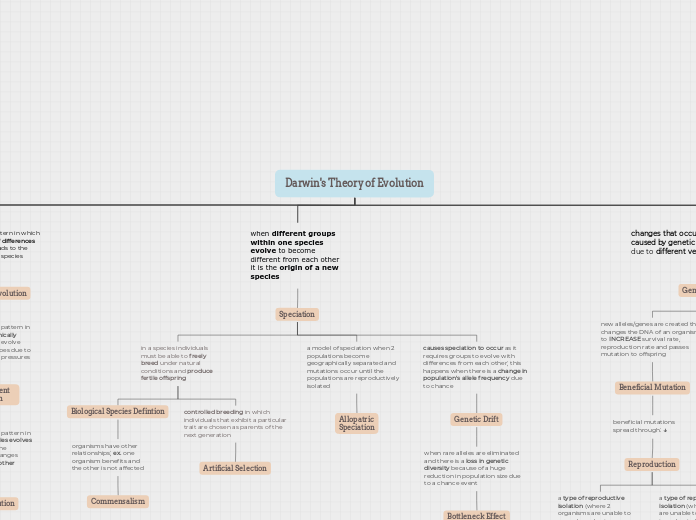
Speciation
in a species individuals must be able to freely breed under natural conditions and produce fertile offspring
Biological Species Defintion
organisms have other relationships; ex. one organism benefits and
the other is not affected
Commensalism
controlled breeding in which
individuals that exhibit a particular trait are chosen as parents of the next generation
Artificial Selection
a model of speciation when 2 populations become geographically separated and mutations occur until the populations are reproductively isolated
Allopatric
Speciation
causes speciation to occur as it requires groups to evolve with differences from each other; this happens when there is a change in population's allele frequency due to chance
Genetic Drift
when rare alleles are eliminated and there is a loss in genetic diversity because of a huge reduction in population size due to a chance event
Bottleneck Effect
when loss of genetic diversity of the original population is caused by small + random sample of a population that colonizes an area
Founder Effect
Gene Pool
new alleles/genes are created that changes the DNA of an organism to INCREASE survival rate, reproduction rate and passes mutation to offspring
Beneficial Mutation
beneficial mutations spread through: ↓
Reproduction
a type of reproductive isolation (where 2 organisms are unable to reproduce due to a physical/ behavioral barrier) that happens before the zygote is formed
Prezygotic
Isolation
a type of reproductive isolation (where 2 organisms are unable to reproduce due to a physical/ behavioral barrier) that happens after the zygote is formed
Postzygotic
Isolation
after the zygote has been formed a hybrid organism is born but dies in early development
Hybrid Inviability
new alleles/genes are created that changes the DNA of an organism to DECREASE survival rate, reproduction rate and eliminates the mutation
Harmful Mutation
a species that shares a common ancestor has similar structures that
suggests a common evolutionary origin
Homologous Features
a type of homologous structure that is the remnants of structures that may have had important functions in an ancestral species but have no clear function in modern descendants
Vestigial Features
a species that has evolved independently to have features with the same function which suggests a distant evolutionary relationship
Analogous Features