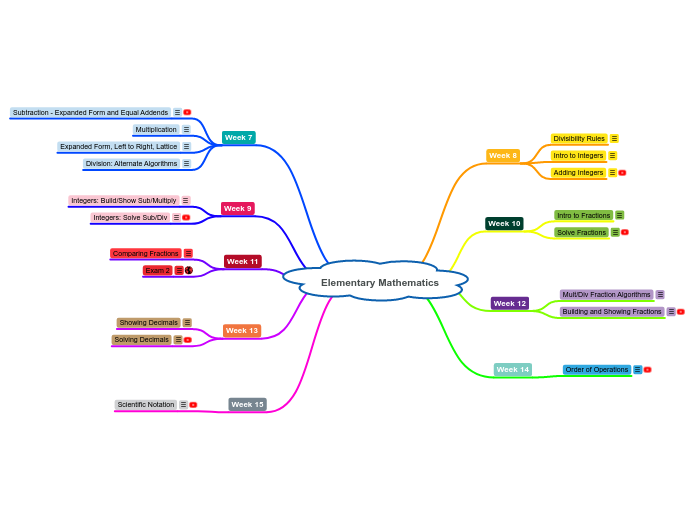
Divisibility Rules
Divisibility Rules:2: Even #'s 3: The sum of digits is divisible by 34: If the last 2 digits are divisible by 45: Last digit is 5 or 06: If 2 and 3 work then 6 works8: If the last 3 digits are divisible by 8 then yes9: The sum of the digits is divisible by 910: The last digit is 0
Intro to Integers
Integer: any number with a positive or negative valueWe can build using different color tiles. One color can show positives while the other shows negatives. We can show by using + and - to draw out problems5-(-2)+++++--=3
Adding Integers
Hectors Model: uses + and - to represent and help remember the values of integers. It shows whether to subtract or add. Add common integers together based on variables.
Intro to Fractions
Numerator: tells us the # of thingsDenominator: tells us the size of the piecesBigger numbers will be smaller pieces. Imagine cutting a pie into more pieces. Or cutting up the same whole into more and more pieces.
Solve Fractions
Remember that you can always subtract/add whole values.We need the same denominator to compare fractions with the same size of pieces. Do this by finding common denominators.
Mult/Div Fraction Algorithms
We can multiply fractions straight across and then simplify.Also we can break numerators and denominators in factors.(8/10) (3/4)= (2x4/2x5) (3/4) and then use Funky 1 method to cross out the 4s and 2s.To divide we need to know Keep, Change, Flip. and we can then continue to solve with the Funky 1 method.
Building and Showing Fractions
We can build with base ten blocks. We separate numbers by colors. We need to have the same denominator when adding or subtracting fractions so that we can have the same size pieces.We can draw circle pies, or we can draw bars.*See video
aOrder of Operations
Instead of focusing on PEMDAS we can encourage students to learn Grouping, Exponents, D/M (L to R), S/A (L to R). First group by the addition or subtraction marks. -5^2 is the same as writing 0-5^2They would both equal -25
aSubtraction - Expanded Form and Equal Addends
Spiraling Content: it is important to bring up old contexts from lessons to implement more practice. Expand each number by place value.532+622:500+30+2300+20+2------------800+50+4 =854
Multiplication
Creates groups of numbersOrder of teaching Multiplication:First: 1,2,10, 5Second: 3, 9, x'sThird: 4,6,7,8
Expanded Form, Left to Right, Lattice
Multiplication Alternative Algorithms:Expanded Form:Multiply: 35x283528----600+100240+40----------840+140 =980Left to Right:Multiply: 47x534753-----2000_350__21_120-------=2491
Division: Alternate Algorithms
15/5= 15 divided into 5 groups Show: (...) (...) (...) (...) (...)There are 3 in each group. 15/5= 3
Integers: Build/Show Sub/Multiply
Think of how to say each integer problem:4-7 = 4 positive take away 7 positive-3 - 5 = 3 negative take away 5 positiveMultiplication:5(-3) = 5 groups of 3 negativeBuild: (---) (---) (---) (---) (---)=-15
Integers: Solve Sub/Div
Show subtraction:5-3 = 5 positives take away 3 positives+++++ = left with 2 positivesMultiplicationL3(-3) = 3 groups of 2 negatives(--)(--)(--) =-6
Comparing Fractions
Finding the greater than or less than between fractions:Anchor Factors: (1/2). If the numerator multiplied by 2 is greater than the denominator then it is bigger than half of the whole.The smaller the denominator, the bigger the piece.If we have the same number pf pieces then we look at which has the bigger size.If the size of the pieces are the same then we see which has a bigger numerator.
Exam 2
Exam 2 was during this week. Review all subjects.
aShowing Decimals
Use base ten blocks or shapes to show hundreths, tenths, and one (Unit).Then we can see how .2 is actually 2 tenths.
Solving Decimals
We can first estimate the outcome from the whole numbers and then check. Teach to line up whole numbers. We can also multiply the number without the decimal and then add it in later based on our estimate.
aScientific Notation
Different from standard form but shows the same number. This is usually used in science. Rules:The first number is always between 1-10, Always multiply by 10, Positive exponents for big numbers and negative exponents for small numbers. EX:2,040,000,000 = 2.04 x 10^9
a