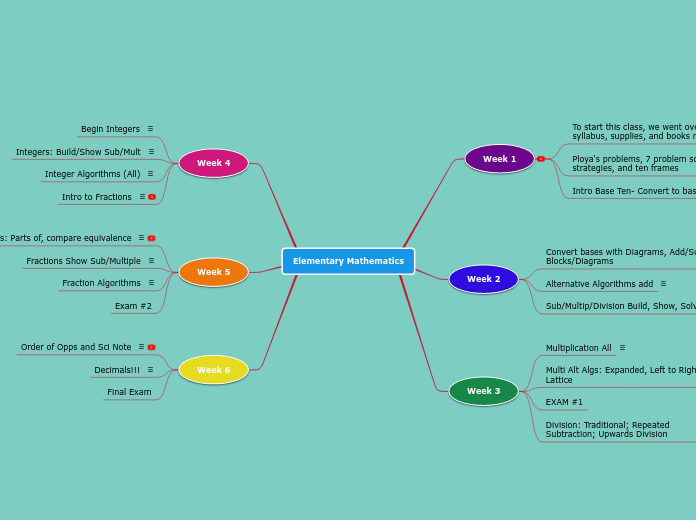
To start this class, we went over the syllabus, supplies, and books needed.
Ploya's problems, 7 problem solving strategies, and ten frames
Watched a couple of videos about Ploya's problem solving and ten frames. using the 7 problem solving strategies: Looking for a pattern; examine a related problem; examine a simpler case; make a table; identify a subgoal; make a diagram; work backward; use guess and check; and write an equation
Intro Base Ten- Convert to bases Diagrams
Intro to bases and base 10. Flats, Longs, Units.How to draw base 10: a Flat looks like a large square(100); a Long looks like a single line(10); a Units is a tiny cube(1).
Convert bases with Diagrams, Add/Sub Blocks/Diagrams
In this section we worked on converting one base to another using flats (100), longs (10), and cubes (ones).Bases in any other number, not including 10;eg. In base 4, a Flat is only worth 4x4=16; a Long is only worth 4; a Unit is only worth 1.You draw 32seven as three longs (7x3) and two units (2) but it really is 21+2=23. Converting eg. 80 to base eight... IIIIIIII to ⏹ II= 120eight Adding bases eg. 10three + 11three... I + I . = II . 21three Subtracting bases 43eight -12eight... IIII... - I.. = 31eight
Alternative Algorithms add
Traditional vs Alternative AlgorithmsKey aspects for alternative algorithms: Based on place value, grow with students, efficientAlternative Algorithms: AddExpanded Form: 243+44= 200+40+340+4 =200+80+7= 287Left to Right: is similar to Expanded form except you write vertically and add in each place value.Scratch: count vertically starting in the ones place down to the base # then scratch out the number and write the left over next to it. Then all the scratches move to the next place value and start again.Friendly #s: find the numbers that add to 10 and bump up the number you're moving to and bump down the one you're taking away from.Partial Sums/Trading off: taking parts of a number to add it to another to make a number with a zero (50)Lattice: make a rectangle under the equation and cut the rectangle in parts depending on how many place values there are and diagonally cut each of those in half. Add vertically with placing the tens place # in the top and the ones place in the bottom.
Sub/Multip/Division Build, Show, Solve
Alternative Algorithms: Subraction Expanded Form: 189-65= (100+80+9)-(60+5)=100+20+4=124 Equal Addends: adding the same amount to the top # and bottom # to make one of the numbers with a zero (20) and then subtract. Multiplication: What is Multiplication?: finding the area of a rectangle Timed Tests?: hurt the students' self image Order to teach Times Tables: 1s, 2s, 5s, 10s, 11s then 9s, Doubles, 3s then 4s, 6s, 7s, 8s. 3(4) vs 4 (3): 3 tables with 4 chairs VS 4 tables with 3 chairs Finger trick doesn't work. Show them that the answers relate to the question. Sum of the digits = 9. Tens digit is one less than the # being multiplied by 9.Students need to learn the factors
Multiplication All
MultiplicationWhat is the best way to say the problem? 5(4): 5 of groups of 4Groups: usually drawn with circles/squaresArrays: 3(4) is 3 rows with 4 columns (squares/lines)Base Ten Blocks: 13(12): using base ten blocks put one number on the left going vertical(13) and the second number going horizontal(12) then fill in the part underneath to fill=156.Diagrams: Instead of using actual base 10 blocks you can write/draw it in using an elbow. Alternative Algorithms Area Model: using a box cut for every place value of the multiplication problem expanded form and multiply the intersecting numbers.
Multi Alt Algs: Expanded, Left to Right, Lattice
Multiplication: Alt Algorithms (con't) Expanded Form: expand for place values and then multiply up then across Left to Right: multiply starting with the left side similar to expanded up and across then add Lattice: draw the lattice box with diagonal cuts and write one # on the top and the second number on the right then multiply across working right to left.
EXAM #1
Division: Traditional; Repeated Subtraction; Upwards Division
Video notesDivision Traditional: Students have a hard time figuring out where each number goes and is NOT big # on the outside. Place Value is not defined. r= remainder in decimals/fractions too confusing for young students. set up: 6/14 the 6 is inside and the 14 is on the outside.Repeated Subtraction: figure out the highest the student knows of the factors and write it on the side then subtract and keep repeating. Remainder goes in the numerator and the outside number is the denominator. PRO: students can start with what they have/know and be motivated to do faster. CONS: write it wrong and difficulty what to do with the remainder. Upwards division: Write the equation how you say it just vertically (like a fraction). Writing the numbers spaced out to be able to write other numbers in between. Figure out how many times the denominator can go into the numerator; write in answer spot. Then multiply it to subtract from the first digit then divide again for the next digit. Remainder is the numerator and the denominator stays the same. CON: student needs to be good at math facts.
Begin Integers
Integers: Building integers red is always negative and positives are always on top and negatives are always on bottom. *start with first digit and zero(pair) bank depends on which side. Zero bank is always ZERO.Addition: -Build/draw: 4+2 is 4 positives plus 2 positives & -4 +2 is (zero bank) take away 4 negatives plus 2 positives= ++ ---- (first two are zero bank leaving two negatives.) Algorithm for Addition: showing/writing out each integer as positives/negatives and then circling zero bank and what's left over is the answer.
Integers: Build/Show Sub/Mult
Integers: subtraction: Start with zero bank if needed! Positives on top/Negatives on bottom! The way you say integers while subtracting is 6 positives take away 2 positives= 4 positives. ++++ ++ Build: -5-(-1)= ---- - =-4 Show: 4-(-1)= ++++ + - (add zero pair then take away neg.)Integers: Multiplication: -2(3) is said (zero bank) take away 2 groups of 3 positives. Build: +- +- +- +- +- +- +- Take away 2 groups of 3 positives and circle zero bank. Show: -2(4) start with enough zero pairs then take away 2 groups of 4 positives and circle the zero pairs. =-8++++ ++++ +---- ---- -
Integer Algorithms (All)
Integers: Adding Algorithm-1+(-9) small group(-1)/large group(-9)**DIFFERENT symbols SUBTRACT**SAME symbols ADD**write 2 symbols for the larger "pile" and 1 symbol for smaller "pile"-45+(-200)=-200 has the larger pile so you write -- above it and -45 is the smaller pile so you write -. Circle one symbol from each and follow rule (different symbols: subtract/same symbols: add). 200+45=245 and the symbol outside of the circle determines what the answer is: -245++ -16+(-3)different symbols you subtract 16-3=13 and the symbol left over is + so the answer is positive 13.Subtraction Algorithm: **DIFFERENT symbols SUBTRACT**SAME symbols ADD**write 2 symbols for the larger "pile" and 1 symbol for smaller "pile"*Adding opposites -7-(-3)=-4 7 negatives take away 3 negatives-7+3=-4 take away 7 negatives plus 3 positives*same answer by adding opposites**KEEP CHANGE CHANGE-57-20-57+(-20)-- ADD - means you're adding 57+20=77 and the symbol leftover is negative meaning answer is -77-75-(-40)-75+(+40)-- SUB - means your subtracting 75-40=35 and the symbol leftover is negative. Answer is -77Multiplication/Division Algorithm: (neg & neg does NOT equal a positive) NEGATIVE TIMES NEGATIVE DOES EQUAL POSITIVE**SAME SIGNS= POSITIVE**DIFF SIGNS= NEGATIVE-25(3)= -75 taking away 25 groups of 3 positivesdiff-50(-40)= +2,000same18/(-3)= -6diff
Intro to Fractions
Fractions: Strips/rectangles/circle shaped fractionsIt's hard for students to know what piece of a fraction is if they only see 1 item. (except in a circle fraction). With Circle fractions it gets harder to draw as the denominator gets bigger. Rectangles are easier.Inquiry based lesson helps students normalize getting the wrong answer. Socratic method is asking questions.Set model: **being specific. Naming the attributes of the items (color, shape)1/2 is yellow1/2 is grayyellow is 1/3 of the gray1/3 is pink2/3 are orangeorange is 2/3 of the pink wholeLength model: comparing lengths/sizesMarker is 1/3 longer than yellow2/3 of the yellow are shorter than markergreen is 1/3 the length of the orangeArea model: comparing the area of fractions (on top of each other)black is 1/3 of the blueyellow is 1/2 of the blueCircle fractions you have to be careful how it is laid out. If comparing length (1/2, 1/4, 1/4) the 1/4s are longer than the 1/2Area model and Length model go together
Fractions: Parts of, compare equivalence
Fractions Parts of... Numerator tells us ... # of shapes Denominator tells us ... smaller the #, the bigger the shape. How many pieces the shape is cut into. It's inversely proportionalCompare: >,<,= "the one that looks like an "L" is less than"Anchor Fractions like 1/2 are great to be a base to help out which is greater/less than.5/11 7/15 both are almost half; 5 is 6 away from 11 and 7 is 8 away from 15. The 8 pieces missing are smaller than the 6 pieces missing; SO you have more left from 7/15 than 5/11. Figure out which is less away from 1/2 as the anchor fraction too.Butterfly method has NO understanding of fractions; just a shortcut to find the answer. Students need to compare sizes! # of pieces and size of pieces.2 * 2= 4 _______________ 2/2 = 1 infinite # of fractions 3 * 2 =6 2/3*6/6=12/18 which = 2/3Show: 2/3 + 3/4 = 1 and 5/12Cut the first box into thirds and shade 2.Cut the second box into fourths and shade 3.Then make both boxes cut into equal pieces as the other. Then cut third box into the equal pieces and shade for all shaded pieces. Add more boxes as needed and cut into equal pieces.
Fractions Show Sub/Multiple
Build: Add: You have to convert or place on top of original fraction, pieces of all the same color(fraction) to be able to add the fractions together. Sub: You have to convert or place on top of original fraction, pieces of all the same color(fraction) to be able to take away the fractions. Multiply: Circle the group(s) and with fractions you will need to add a second circle to show the fraction of the circled area. You will still need to convert to fractions of the same size in order to only have part of the fraction in the second circle.Show: Add: Use 3 boxes to solve Sub: Use 2 boxes to solve (circle the take away fraction) Multiply: Use 1 box to solve and draw both fractions on it. The double shaded area is the answer.Solve: Whole # + Fraction: just combine to find the answer. Whole # - Fraction: NO need to put a 1 under the whole number for adding/subtracting! Take 1 whole away from the whole # and turn it into a mixed number (eg. 17 and 11/11) with the same denominator as the fraction then subtract.Add Same Size Pieces (aka: Common Denominator): 3/7 + 5/7=8/7 No adding denominators because 8/14 is half as big as 8/7.
Fraction Algorithms
Solving Fractions: Add/Sub/Multi/Div AlgorithmsAdding whole numbers to fractions: you just combine the two for your answer.Subtracting whole number from a fraction: you will need to make the whole number into a mixed number with the same denominator as the fraction.Subtracting mixed number by mixed number: you subtract whole numbers first then multiply to get same denominator, then subtract.Adding mixed numbers with mixed numbers: you add whole numbers together then work on finding the same denominator; then add.Multiplying fraction by fraction: work with numerator to denominator to find factors for Funky 1 to simplify, then multiply across.Mixed number multiplied by mixed number: Do the backwards "C" to multiply denominator by whole number then add to numerator. Then funky 1.Dividing fraction by fraction: use KEEP, CHANGE, FLIP (multiply by the reciprocal), then funky 1.
Exam #2
Order of Opps and Sci Note
Order of OperationsGroupsExponentsD/M from L->RS/A from L->R*Groups are separated by addition/subtraction signs.*Parenthesis placement is important; any time substituting need to use parenthesis. C. A = π r 2 r = 10 π = 3.14Scientific Notation: Decimals need to be between 1-10. Exponents are positive and negative. Negative exponents =fractions and are less than 1. Positive exponents =more than 1.**Don't say move left or right. Say move over.
Decimals!!!
Decimals:Building: Flats=Wholes; Longs=Tenths; Units=HundredthsShowing:*Adding decimals you draw one or two boxes. Wholes can be drawn as a regular square with no cuts.*Subtracting decimals use 1 box and cut into the same size pieces.*Multiplying decimals use one box and the double shaded area is the answer.Solving: Line up whole numbers/place values; add zeros as needed.Multiplying decimals you will need to estimate the answer, then multiply, then place decimal based on estimation answer.**equations that don't work with estimation are ones that estimate to be (0)(0)=0
Final Exam