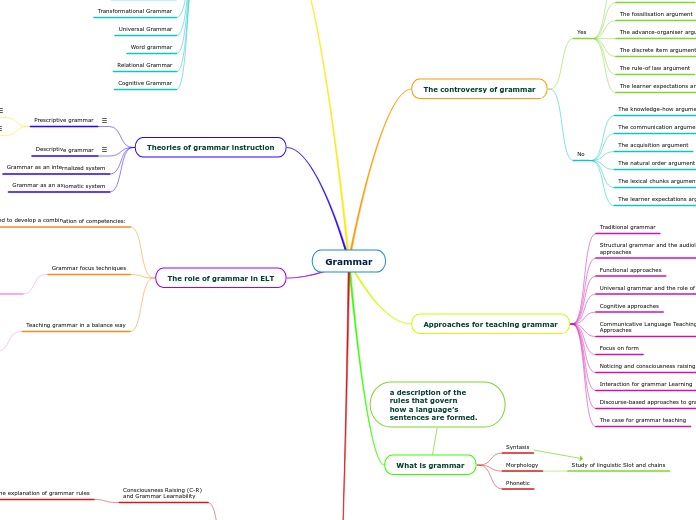
Yes
Sentence-machine argument
The fine-tuning argument
The fossilisation argument
The advance-organiser argument
The discrete item argument
The rule-of law argument
The learner expectations argument
No
The knowledge-how argument.
The communication argument
The acquisition argument
The natural order argument
The lexical chunks argument
The learner expectations argument
Traditional grammar
Structural grammar and the audiolingual and direct approaches
Functional approaches
Universal grammar and the role of syntax
Cognitive approaches
Communicative Language Teaching and Humanistic
Approaches
Focus on form
Noticing and consciousness raising
Interaction for grammar Learning
Discourse-based approaches to grammar instruction
The case for grammar teaching
Syntasis
Morphology
Study of linguistic Slot and chains
Phonetic
Comparative Grammar
Generative Grammar
Mental Grammar
Pedagogical Grammar
Why Pedagogical Grammar?
Instructional Time
Learner Independence
Fossilization
Expert Guidance
Performance Grammar
Reference Grammar
Theoretical Grammar
Traditional Grammar
Transformational Grammar
Universal Grammar
Word grammar
Relational Grammar
Cognitive Grammar
Prescriptive grammar
EXAMPLESTheoretical and Traditional grammar.
Disadvantages
- Facilitates communication among dialects of a language.- Makes it easier to teach a language if it is codified (although notperfectly).- Eases learners’ writing and speaking processes because they have a ‘standard’ to aim.
Advantages
• It provides the ‘correct/wrong’ grammar of a language.• Considers standard use of the language as correct.• Rejects the changes languages experience through the speakers’ use.
Descriptive grammar
• Analyses, besides syntax and morphology, phonetics and phonology, as well as semantics and/or lexis.• Considers the actual use of language first and then formulates rules.• Accounts for nonstandard forms and structures of a language.• Describes the use of native speakers of a language.
Grammar as an internalized system
Grammar as an axiomatic system
Learners need to develop a combination of competencies:
- organizational competence (grammatical and discourse)
- pragmatic competence (functional and sociolinguistics)
- strategic competence
- psychomotor skills
Grammar focus techniques
- taught in context to
achieve communicative goals
- development of accuracy within fluent, communicative language
- not too much linguistic terminology
- motivating as possible, through games and other fun activities
Teaching grammar in a balance way
- practice forms in communicative tasks
- Intermediate to advanced
levels than beginning levels
- input-based (comprehension) and
output-based (production)
- Deductive and inductive approaches
can be useful in context
age, proficient level, educational background,
language skills, style (register), needs and goals
Consciousness Raising (C-R)
and Grammar Learnability
The explanation of grammar rules
The grammar of structure
The grammar of orientation
The grammar of class
Lexical phrase
Collocation
Frequent words
Text structure
Metaphor
Skills
Basic Principles for Grammar Teaching
The E-Factor: Efficiency = economy, ease, and efficacy
The A-factor: Appropriacy
Teaching Grammar Techniques
Charts
Objects (relia)
Maps and drawings
Dialogues
Other written texts
The explanation of grammar rules
Prescriptive rule:
Descriptive rule
Pedagogic rules