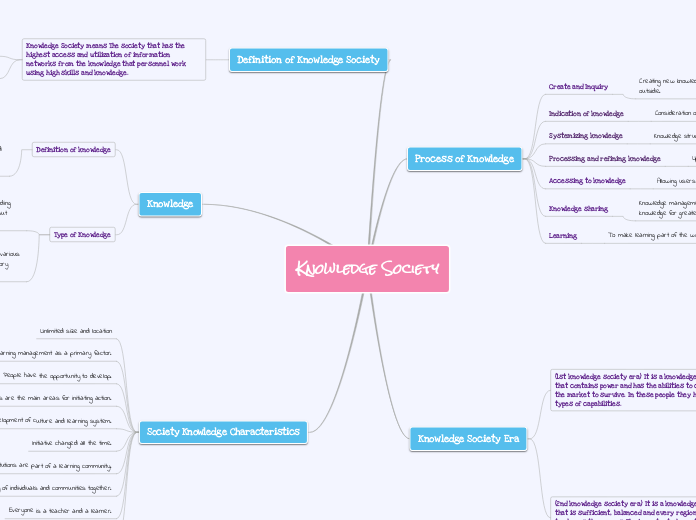
Knowledge Society means The society that has the highest access and utilization of information networks from the knowledge that personnel work using high skills and knowledge.
1. Knowledges exchange
2. Creativity and Innovation
Definition of knowledge
Understanding of certain issues, including the ability to apply for certain goals. It is based on a process that translates data and information. It’s is a mixture of work experience and emerging new experiences that are ready to be use for decision-making and certain kind of action.
Type of Knowledge
1. Tacit Knowledge is a knowledge that gained from the experience and expertise of each person in understanding various things. It is a knowledge that can be explained but cannot be easily translated into words to written form.
2. Explicit Knowledge is a knowledge that is obvious or recorded. It can be controlled and transferred through various methods such as databases, experts system and theory report.
Unlimited size and location
Focus on learning management as a primary factor.
People have the opportunity to develop.
Social institutions are the main areas for initiating action.
Development of culture and learning system.
Initiative changed all the time.
Educational institutions are part of a learning community.
Responsibility of individuals and communities together.
Everyone is a teacher and a learner.
Population is the core group
Create and Inquiry
Creating new knowledge and seeking knowledge form the outside.
Indication of knowledge
Consideration of how to achieve the organization's goals.
Systemizing knowledge
Knowledge structure for systematic knowledge retention.
Processing and refining knowledge
Updating content successfully and appropriately.
Accessing to knowledge
Allowing users to access knowledge easily and conveniently.
Knowledge sharing
Knowledge management in organizations, sharing, exchanging knowledge for greater efficiency.
Learning
To make learning part of the work.
(1st knowledge society era) It is a knowledge society that contains power and has the abilities to compete the market to survive. In these people they have 5 types of capabilities.
1. (Knowledge Access) Accessing to the knowledges in various ways for example internet.
2. (Knowledge Validation) Assessing the accuracy of the knowledge.
3. (Knowledge Valuation) Valuation and interpretation that when the knowledge are used will it be worth it?
4. (Knowledge Optimization) Making the knowledge easier to use to make the rules.
5. (Knowledge Dissemination) distributing the knowledges.
(2nd knowledge society era) It is a knowledge society that is sufficient, balanced and every region has a role to play as the owners. The important characteristics of the 2nd era are..
1. Having the accumulation of knowledge within the society.
2. There is a knowledge transfer within the society.
3. Creating new knowledge within the society.
4. Applying knowledges to the society.