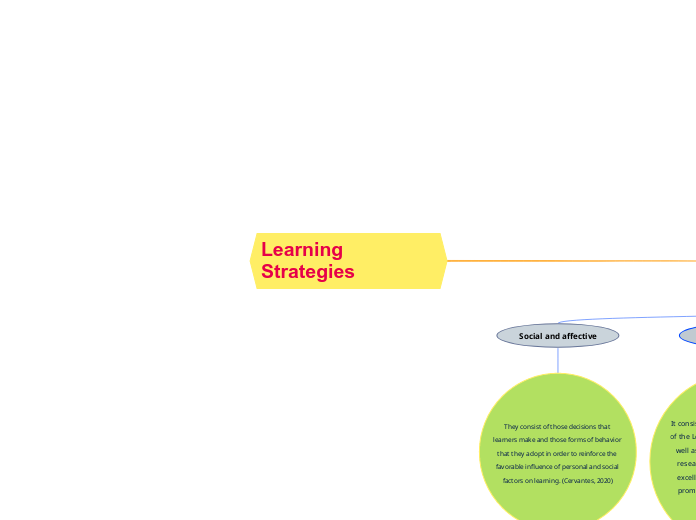
Social and affective
They consist of those decisions that learners make and those forms of behavior that they adopt in order to reinforce the favorable influence of personal and social factors on learning. (Cervantes, 2020)
The characteristics with which it must comply are the following:
-Strategies must be functional and meaningful.
-Instruction should demonstrate what strategies can be used, how they can be applied, and when and why they are useful.
-There must be a connection between the strategy taught and the student's perceptions of the context of the task.
-Students must believe that the strategies are useful and necessary. (Raphl, 2020)
Awareness-raising
It consists of publicizing the basic lines of the Learning Communities project, as well as the scientific contributions of research that show those actions of excellence that have been shown to promote school success. (Mendoza, 2019)
It has the following characteristics:
-Motivation, without which any attempt would fail to acquire new knowledge.
-Emotions that influence learning, particularly anxiety.
-Attitudes, that is, behaviors of acceptance or rejection of school contents, of the agents of the educational process, of classmates, etc. (Mendoza, 2019)
Meta-cognitive
Metacognitive strategies refer to planning, control and students' evaluation of their own cognition. They are a set of strategies that allow the knowledge of mental processes, as well as the control and regulation of the same with the objective of achieving certain goals of learning. (Redalyc, 2019)
It has as characteristic:
Form a special type of knowledge on the part of the learner, referred to the learning task, referred to learning strategies and referred to the subject of learning. In other words, knowing what learning consists of, knowing how to learn best, and knowing what one is like, one's emotions, feelings, attitudes, and aptitudes. (Cervantes, 2019)
Direct or cognitive
It is a mental process that involves a set of activities, techniques, there are many organized steps, plans and routines that are planned according to the needs of the students, the objectives that are required and the nature of the knowledge, to store, recover, understand the language. , assimilation, storage in memory, recovery and use to make effective the learning process and the resolution of problems in a foreign language. (Zavala, 2018)
It has the following characteristics:
Mastery of cognitive strategies allows students to plan and organize their own learning activities.
Although the use of a strategy requires mastery of its component techniques, a cognitive strategy cannot simply be reduced to a series of techniques.
But in addition to these essential components there are other psychological processes necessary for learning to learn. (Scrib, 2019)