They are different strategies that teachers use within the teaching-learning process to be able to impart their knowledge in an optimal and beneficial way.
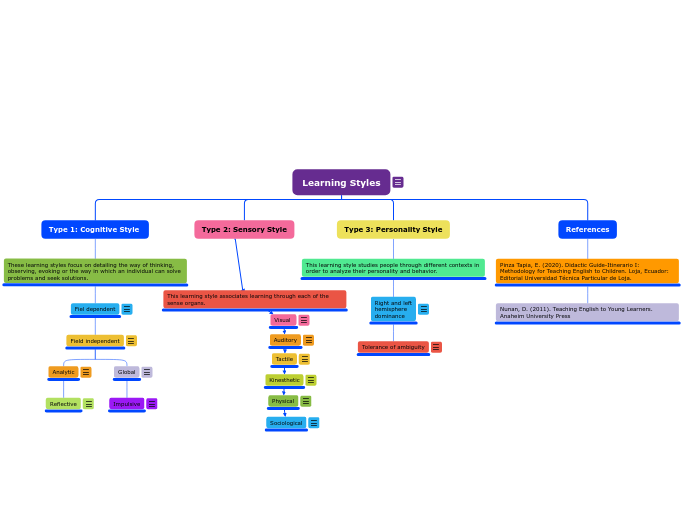
These learning styles focus on detailing the way of thinking, observing, evoking or the way in which an individual can solve problems and seek solutions.
Fiel dependent
Information is taught according to the context.Fluent languaje learners.
Field independent
Students learn step-by-step through sequential instruction.Accurate language learners.
Analytic
It is taught through individual works.
Reflective
Students seek information in order to be able to answer a question.
Global
It is taught through group works.
Impulsive
Students are risk takers.
This learning style associates learning through each of the sense organs.
Visual
Students acquire new information through pictures, graphics, among others.
Auditory
Learners acquire new information through listening.
Tactile
Students learn through manipulative resources
Kinesthetic
Learning is associated with movement.
Physical
Each classroom must be in good condition for student learning.
Sociological
The social environment is an influence for better learning.Relationships between classmates.Relationship between teacher and student.
This learning style studies people through different contexts in order to analyze their personality and behavior.
Right and left
hemisphere
dominance
The left side of the brain will allow the student to be more observant, critical, evaluative, among others.The right side of the brain will allow the student to be more impulsive and participative.
Tolerance of ambiguity
Uncertainty plays a big role in this learning style, as students feel comfortable in real situations.
Pinza Tapia, E. (2020). Didactic Guide-Itinerario I: Methodology for Teaching English to Children. Loja, Ecuador: Editorial Universidad Técnica Particular de Loja.
Nunan, D. (2011). Teaching English to Young Learners. Anaheim University Press