LISTENING
What is Listening?
Listening is extremely important for the communication process. Many of the problems we experience with people are primarily attributable to ineffective listening or lack of listening. Good listening skills are the foundation of effective human relations. Good listeners can be good negotiators and can handle crisis situations successfully.
Effective listening is the process of analyzing the sounds, organizing them into recognizable patterns, interpreting the patterns and understanding the message by inferring the meaning.
Listening is not to be confused with hearing. Hearing is a physiological process which involves receiving the sound waves by the eardrum and transferring them to the brain. Listening is more than hearing. It involves the process of interpretation and inference.
As an English Language teacher you may have students with unidentified additional learning needs in your classroom. Often these learning difficulties are ‘invisible’, not easy to recognise in class, or hidden behind other issues such as poor behaviour, and an apparent lack of motivation.
Identifying ‘invisible’ learning difficulties
Difficulties which have not been identified by any formal assessment can surface in a variety of ways. They may first appear in an English Language class because the focus is on activities that require students to communicate and interact with other students, using all four skills of listening, reading, writing and speaking.
Although it is not the teacher’s job to diagnose learning difficulties, it’s important to know how to recognise when a student might be struggling because of a learning difficulty.
General indicators
Indicators that students might be experiencing difficulties greater than expected for their age and level include:
having problems understanding and following instructions
finding it difficult to concentrate and being easily distracted
having difficulty with tasks which require fine or gross motor skills
being able to speak much more fluently than they can write
finding it difficult to start tasks or never managing to finish them
avoiding doing tasks
having problems participating in whole-class or group activities
appearing not to listen, or not responding to questions or instructions
having problems making friends and maintaining relationships.
These indicators reflect three main issues : Behavioural, Communication, Social Ski
Objectives of Listening
The objectives of learning may be one or more of the following:
To learn
To increase one’s understanding
To advise or counsel
To relieve one’s boredom
Topic principal
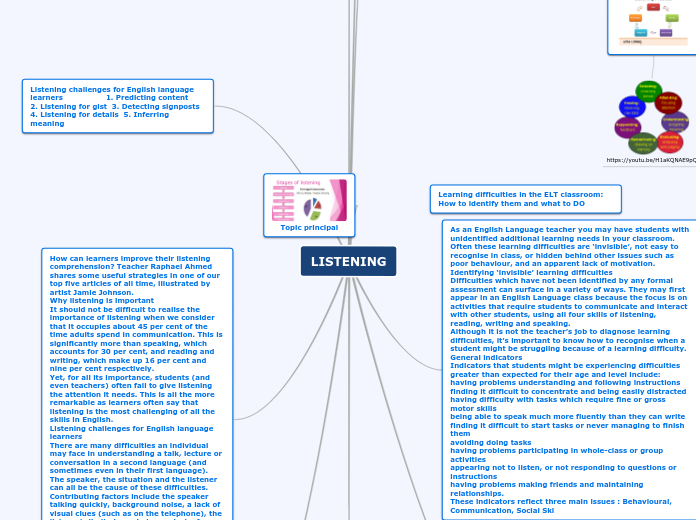
Listening challenges for English language learners 1. Predicting content 2. Listening for gist 3. Detecting signposts 4. Listening for details 5. Inferring meaning
Topic principal
How can learners improve their listening comprehension? Teacher Raphael Ahmed shares some useful strategies in one of our top five articles of all time, illustrated by artist Jamie Johnson.
Why listening is important
It should not be difficult to realise the importance of listening when we consider that it occupies about 45 per cent of the time adults spend in communication. This is significantly more than speaking, which accounts for 30 per cent, and reading and writing, which make up 16 per cent and nine per cent respectively.
Yet, for all its importance, students (and even teachers) often fail to give listening the attention it needs. This is all the more remarkable as learners often say that listening is the most challenging of all the skills in English.
Listening challenges for English language learners
There are many difficulties an individual may face in understanding a talk, lecture or conversation in a second language (and sometimes even in their first language). The speaker, the situation and the listener can all be the cause of these difficulties.
Contributing factors include the speaker talking quickly, background noise, a lack of visual clues (such as on the telephone), the listener’s limited vocabulary, a lack of knowledge of the topic, and an inability to distinguish individual sounds.
While the challenges posed by the speaker or the situation may be out of the listener’s hands, there are a few skills or 'strategies' that English learners can use to help them along.
Topic principal
Topic principal