Lactobacillus
Lactic Acid Bacteria (LAB)
Milk to curd (and also improves nutritional value by increasing Vitamin B12
Checks for disease-causing microbes in labs
Saccharomyces cerevisiae
Baker's yeast
Brewer's yeast
Toddy (South Indian drink)
Made from fermented sap from palm trees
Cheese
Swiss cheese
Propionibacterium sharmanii - Production of large amount og CO2
Roquefort cheese
Specific fungi gives it a particular flavour
Fermentors
Brewer's yeast
Fermented malted cereals and fruit juices
with distillation of fermented broth
brandy
whiskey
rum
without distillation
wine
beer
Antibiotics
Penicillin
Alexander Fleming
Discovered Penicillin while working on Staphylococci
Full potential established by
Ernst Chain
Howard Florey
Commercially used- WWII - to treat wounded soldiers
Treats
Plague
Whooping cough
Diphtheria
Leprosy
Acid producers
Aspergillus niger of citric acid
(Fungus)
Acetobacter aceti of acetic acid
(Bacteria)
Clostridium butylicum of butyric acid
(Bacteria)
Lactobacillus of lactic acid
(Bacteria)
Brewer's yeast
Ethanol
Lipases - detergent formulation remove oily stains
Pectinases and Proteases clarify bottled fruit juices
Streptokinase (from Streptococcus)
Genetically engineered - clot buster
Cyclosporin A (immunosuppressive agent)
produced by Trichoderma polysporum
(Fungus)
Statins - Monascus purpureus
(Yeast)
Blood-cholesterol lowering agent
Bacteria
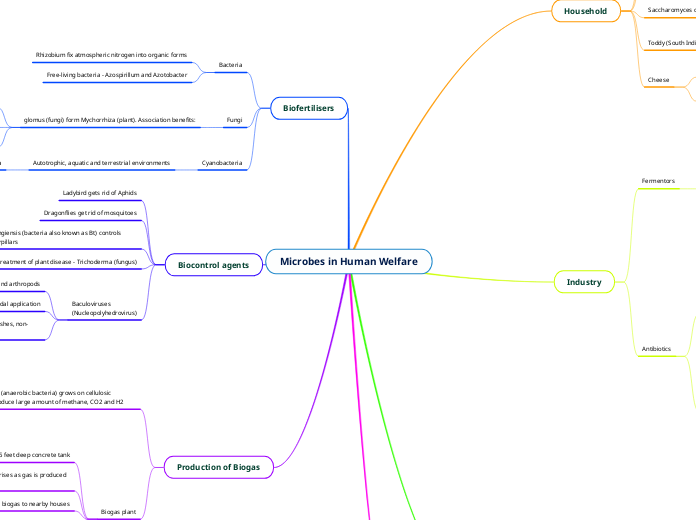
Rhizobium fix atmospheric nitrogen into organic forms
Free-living bacteria - Azospirillum and Azotobacter
Fungi
glomus (fungi) form Mychorrhiza (plant). Association benefits:
resistance to root-borne pathogens
tolerance to salinity and drought
increase in plant growth and development
Cyanobacteria
Autotrophic, aquatic and terrestrial environments
Examples: Anabaena, Nostoc, Oscillatoria
Ladybird gets rid of Aphids
Dragonflies get rid of mosquitoes
Bacillus thuringiensis (bacteria also known as Bt) controls butterfly caterpillars
treatment of plant disease - Trichoderma (fungus)
free-living species common in root ecosystems
Baculoviruses
(Nucleopolyhedrovirus)
attack insects and arthropods
species-specific, narrow spectrum insecticidal application
no negative impact on plants, mammals, birds, fishes, non-target insects
Methanogens (anaerobic bacteria) grows on cellulosic material & produce large amount of methane, CO2 and H2
Methanobacterium - found in:
Anaerobic sludge during sewage treatment
Pumen of cattle
Help in breakdown of cellulose
Nutrition of cattle
Dung is rich in Methanobacterium
Dung generates biogas
Biogas plant
10-15 feet deep concrete tank
Biowaste - collected in it & a slurry of dung is fed
Floating cover placed over slurry that rises as gas is produced due to microbial activity
Outlet connected to a pipe to supply biogas to nearby houses
Spent slurry removed from another outlet. Used as fertiliser
Technology developed by efforts of:
Indian Agriculture Research Institute (IARI)
Khadi & Villiage Industries Commission (KVIC)
Primary treatment
Floating debris are removed by sequential filteration
Grit removed by sedimentation. It is called PRIMARY SLUDGE. Things on top are called EFFLUENTS
Secondary treatment / Biological treatment
Effluent is passed into large aeration tanks
Tanks are constantly agitated and air is pumped in for growth of microbes into FLOCS
Microbes consume organic matter and reduce biochemical oxygen demand (BOD)
BOD is passed into settling tanks and FLOCS are allowed to sediment - ACTIVATED SLUDGE
Small mark of activated sludge is pumped back into aeration tank to serve as inoculum
Major part goes into ANAERBOIC SLUDGE DIGESTORS
Anaerobic bacteria digest bacteria and fungi and release a mix of gases (Methane, hydrogen sulphide, CO2 - BIOGAS)
Effluent is released into natural water bodies
Ganga Action Plan / Yamuna Action Plan