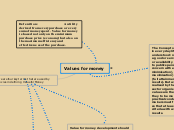
There are four key terms that are used by agencies in defining Value for Money
Value for money development should be economic
Value for money development should be efficient
Value for money development should be effective
Value for money development should be equitable
Inputs have been procured at the least cost for the relevant level of quality. For example, in evaluating a training course being delivered in Australia the slightly higher costs for accommodation and flights may be justified given the experience that the cohort requires their own cooking facilities and that flights need to be flexible because participants often change and this leads to more cost in the long run
Efficiency is generally defined as considering the value of outputs in relation to the total cost of inputs (at the relevant level of quality). Some define efficiency as the value of outcomes in relation to the total cost of inputs. To take the more often used definition, in an education evaluation the costs of developing a curriculum (including the costs of the curriculum specialists, graphics designers, and delivery) may be considered not worth the cost due to the cultural mismatch of the content produced.
Achieving program outcomes in relation to the total cost of inputs (sometimes equity considerations are factored in here). For example, a advocacy program that worked with landless migrants may be highly effective because it achieved shared land title for the community. The advocacy campaigners worked in concert with local advocates – so the inputs were strategic and limited keeping the costs down.
Ensuring that benefits are distributed fairly. For example, a small business incentive program that did not reach the most remote and vulnerable parts of the population may be evaluated as inequitable.
Defenition: A utility derived from every purchase or every sum of money spent. Value for money is based not only on the minimum purchase price (economy) but also on the maximum efficiency and effectiveness of the purchase.
The Concept of Value for Money in everyday life is easily understood: not paying more for a good or service than its quality or availability justify. In relation to public spending it implies a concern with economy (cost minimisation), efficiency (output maximisation) and effectiveness (full attainment of the intended results). But what values are realised by the activities of public sector organisations? Whose values are they and how are they to be measured? The practical conclusion is that policy makers must frame precise aims so that at least there are some criteria with which to compare results.