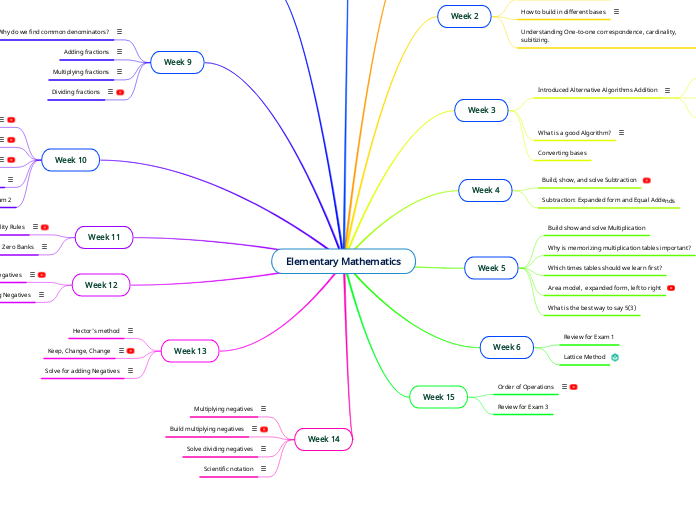
Introduced the Syllabus, supplies, and book needed for class
Introduced syllabus and required supplies
Explained how to turn in homework
Explained how to turn in assignments Make sure to include reflection is comment section and check answer key.
Jessie's story while juggling
Told us the story about Jessie while also jugglingThe purpose of Jessie's story is to teach us that we cannot judge a book by its cover.The juggling was also to teach us that we need to practice no matter how many times we might fail.
introduced five and ten frames
Introduced five and ten frames Base 10: Flats=100, Longs=10, units=1
aHow to build in different bases
How to build in different bases
Understanding One-to-one correspondence, cardinality, subitizing.
Explained One-to one correspondence, subitizing, cardinality One-to-one: When a student comprehend that each item corresponds with one. Cardinality: The students will count the group and may recount it until they recognize how many are in the group.Subitizing: The ability to recognize the group with needing to count them one by one.
Introduced Alternative Algorithms Addition
Introduced alternative algorithms Expanded form, lattice, scratch Left to right Trading off/friendly numbers What is a good algorithm?Expandable, efficient, based in solid math Converting bases
Expanded form, Lattice, scratch
Left to right
Trading off/friendly numbers
What is a good Algorithm?
A good Algorithm It has to be efficient Mathematically sound it also has to be expandable
Converting bases
Build, show, and solve Subtraction
Subtraction: Expanded form and Equal Addends
Build show and solve Multiplication
Why is memorizing multiplication tables important?
Which times tables should we learn first?
Area model, expanded form, left to right
What is the best way to say 5(3)
Review for Exam 1
Lattice Method
Order of Operations
Group of numbers Exponents M/D multiplication/divisionA/S Adding/Subtraction Groups are identified by the signs of Adding and subtracting.EX) 2+5(3)-42+ 6-2/22*4+3 2+15-16 +4 +317-16 1+4 5+3=8
aReview for Exam 3
Exam 1
Intro to Division
What are remainders?Remainders are the numerators to the divisors.Remainders tell us that it is part of a fraction What are divisors?Divisors are the number that is being divided
Repeated Subtraction
Repeated subtraction is an easier way to explain where the remainder goes. We first write the fraction how we traditionally do when we do long division but instead of writing the answer on the top we write the answer on the side.
aUpwards Divison
Upwards division is helpful because there is no way for students to confuse where the remainder goes. It is mathematically sound efficient When doing upwards division we write the problem in fraction form and find out how many times the denominator goes into the numerator.
aFall Break
Intro to Fractions
When adding and subtracting we are using whole size piecesWhen Multiplying we are only taking parts of the groupsNumber of groups -->(1/2)(4)<-- Number of what is inside the group.
aWhy do we find common denominators?
We find common denominators so that we know the factors and it becomes easier down the line. Why do we find common denominators when adding/subtracting?
Adding fractions
When adding fractions instead of trying to find the GCF for the denominator we find "what is missing" and multiply it by the fraction.One it has been multiplied on both side we add normally.It is a good algorithm Efficient Expandable
Multiplying fractions
Numerator tells us the number of pieces Denominator tells us the size of each pieceWhen comparing fractions and determining which is less than, greater than or equal to, we apply what we know about fractions.When multiplying fractions we want to find the factors of each numerator/denominator.Once we find the factors we cross out the same factors that are in the numerator and denominator because they then equal 1 and we then multiple what is left giving us our answer When dealing with a mixed number we must turn the fraction into a improper fraction which is by multiplying the denominator by the whole number then adding the numerator. That answer will give you the numerator which will stay the same and the denominator will stay the same.
Dividing fractions
When dividing fractions we have to remember to Keep, Change, Flip. We first keep the same first fraction we then change the division symbol into a multiplication and we then flip the second fraction and we use the same method for multiplying fractions.
aShow adding Fractions
Adding Fractions We draw one rectangle for the first fraction and shade in how many pieces are in the group we draw a second rectangle for the second fraction and shade in how many pieces are in that group We draw a third rectangle to show how many are in the new group which we shade in from the first and second rectangle giving us a new answer.
aShow subtracting fractions
Subtracting Fractions When subtracting it is a very similar process to adding but instead of shading in more pieces in the third rectangle we take away.In the third rectangle we take away the ones we shade in from the first fraction which then gives us our answer.
aShow Multiplying fractions
Multiplying fractions When multiplying it is very similar to adding and subtracting it is the same process except on the third rectangle we only count what was double shaded.
aShow decimals
When showing decimals we show it by drawing a rectangle and shading in what the decimal tells us. The process is very much the same as showing the fractions but instead of being in a fraction it is in a decimal and we use a 10x10 model to show the smaller pieces.
Review for Exam 2
Divisibility Rules
Divisibility rules- if a large number is divisible by a smaller number 2- Ends in a even number (254) 3- sum of the digits is divisible by 3 (7461)4- Last 2 digits divisible by 4 (5716)5- ends in 5 or 0 (275,130)6- if 2 and 3 work (270)8- Last 3 digits divisible by 8 (74,648)9- sum divisible by 9 (49,167)10- Ends in a 0 (7190)
aZero Banks
Zero banks are helpful because it shows students we can take away from zero. Ex) 0-(-1) =1 ++-- Subtraction won't always need a zero bank Addition won't ever need a zero bank
Show adding Negatives
Ex) 5+(-2)<--- 5 positives plus 2 negatives ++ +++ _ _ You are left with 3 positives because the two positive and negatives cancel each other out.
aShow subtracting Negatives
Ex) 4- (-2) <--- 4 positives minus 2 negatives ++ ++++-- we add a zero bank and take away the two negatives because we didn't have any before and we are left with 6 positives.
Hector's method
If the signs are the SAME we add.If the signs are DIFFERENT we subtract.EX) -47+ 93 =+46 - + +Hector's method does not always work, for instance hector's method could not work on a subtraction equation. Hector's method is useful when we are dealing with big numbers. Instead of drawing 47 negatives we can draw one negative and two positives to represent the 93.
Keep, Change, Change
The Hector method works for adding negatives but not when subtracting. We must do the Keep, Change, Change method. Ex) -20 - 10 -20 + -10 -- - =-30When subtracting negatives we must always remember to KCC.
aSolve for adding Negatives
If the signs are the SAME we add.If the signs are DIFFERENT we subtract.Ex) -25 +(-20) = -45 -- Add - We are adding because the signs are the same. 35+ (-60) + Sub -- = -25
Multiplying negatives
Ex) -2 (3) <----- Take away 2 groups of 3 positives We say take away because we have a zero in front of -2.So it would be 0-2(3) Ex)-2(-3) <--- Take away 2 groups of 3 negatives
Build multiplying negatives
When Subtracting and multiplying we NEED zero banks. Not always but majority of the time. We start off with zero banks when multiplying negatives.
aSolve dividing negatives
When multiplying/Dividing when the signs are the SAME = +When the signs are DIFFERENT= -EX) 30/-5= - 6-4/-2 = + 2 100/20 = +5
Scientific notation
Always has to be x10 and also has to be one digit to be scientific notation.Ex) 4.21x10⁻⁷Standard Form:If it a negative exponent it will be a small number meaning decimal If it is a positive exponent it will be a big number meaning no decimal. 0.0002572.57x10-4