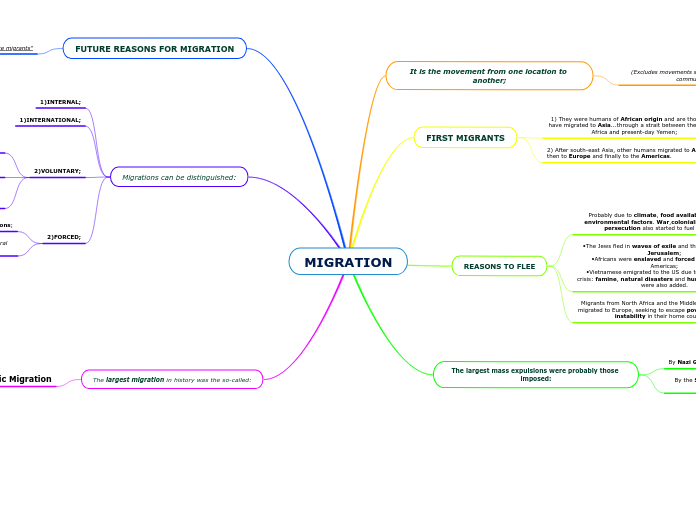
MIGRATION
It is the movement from one location to another;
(Excludes movements such as nomadism, migrant work, commuting and tourism)
FIRST MIGRANTS
1) They were humans of African origin and are thought to have migrated to Asia...through a strait between the Horn of Africa and present-day Yemen;
2) After south-east Asia, other humans migrated to Australia, then to Europe and finally to the Americas.
REASONS TO FLEE
Probably due to climate, food availability and other environmental factors. War,colonialism,slavery and persecution also started to fuel migration.
•The Jews fled in waves of exile and the destruction of Jerusalem;
•Africans were enslaved and forced to move to the Americas;
•Vietnamese emigrated to the US due to a humanitarian crisis: famine, natural disasters and human rights abuses were also added.
Migrants from North Africa and the Middle East increasingly migrated to Europe, seeking to escape poverty and political instability in their home countries;
This has depleted Europe's resources, fuelling xenophobia and frustration even in the welcoming states.
The largest mass expulsions were probably those imposed:
By Nazi Germany, which deported 7-8 million people;
By the Soviet Union, which forcibly expelled 9-10 million people;
FUTURE REASONS FOR MIGRATION
"Climate migrants"
-homes by floods
-droughts
-water scarcity
Migrations can be distinguished:
1)INTERNAL;
1)INTERNATIONAL;
2)VOLUNTARY;
Due to better economic or housing opportunities (both internal and external);
Intermediate are migrations due to wars, famine or natural disasters.
After World War II, the largest voluntary migrations involved groups from developing countries moving to industrialised nations.
2)FORCED;
Due to political reasons;
Intermediate are migrations due to wars, famine or natural disasters.
The largest migration in history was the so-called:
Great Atlantic Migration
In the 1840s with mass movements from Ireland and Germany;
In the 1880s there was a second and larger wave that developed from eastern and southern Europe.