
CLIL Principles
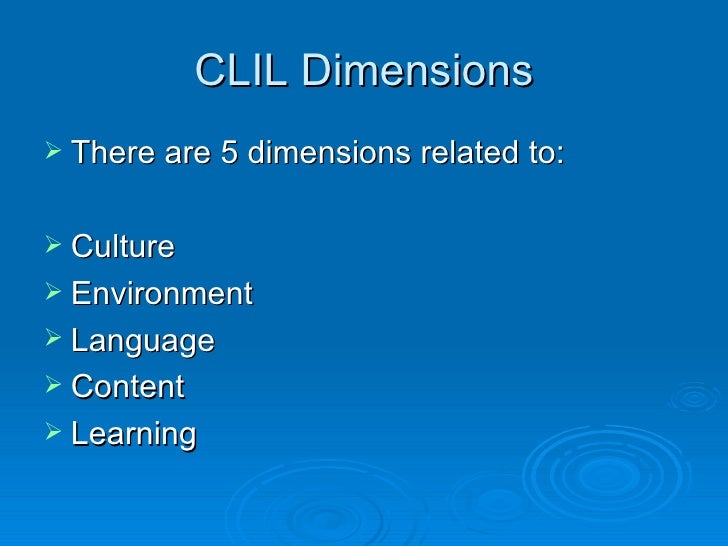
CLIL Dimensions
The Culture Dimension
Build intercultural knowledge & understanding
Develop intercultural communication skills
Learn about specific neighboring countries/regions
and/or minority groups
Introduce the wider cultural context
The Environment Dimension
Prepare for internationalization, specifically EU
integration
Access International Certification
Enhance school profile
The Language Dimension
Improve overall target language competence
Develop oral communication skills
Deepen awareness of both mother tongue and
target language
Develop plurilingual interests and attitudes
Introduce a target language
The Content Dimension
Provide opportunities to study content through
different perspectives
Access subject-specific target language
terminology
Prepare for future studies and/or working life
The Learning Dimension
Complement individual learning strategies
Diversify methods & forms of classroom
practice
Increase learner motivation

4C's
Culture
Exposure to alternative perspectives and shared
understandings.
Cognition
Developing thinking skills which link concept
formation, understanding and language
Content
Exposure to alternative perspectives and shared
understandings.
Communication
Using language to learn - whilst learning to use
language.

What's CLIL?

“CLIL refers to situations where subjects, or parts of subjects, are taught
through a foreign language with dual-focussed aims, namely the learning
of content, and the simultaneous learning of a foreign language'. (Marsh,
David 1994)
Why
- A tool for the promotion of foreign languages.
- A tool for the promotion of minority languages.
- Language acquistion is most effective: communicative
approach.
- Susbtantive basis for language learning: acquisition of new
language structures.
- Second language learning is an integral part of social and
cognitive development in school settings.
- It respects the specificity of language use.
KNOWLEDGE
THEORIES
SUPPORTING CLIL
The new Bloom's Taxonomi

KNOWLEDGE DIMENSIONS
Multiple Intelligences
Scaffolding
Foreign Language Acquisition Theories