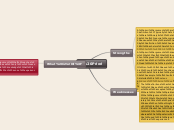
A Priori
Strengths
A priori arguments are based on definition. Typically a priori arguments are Analytic, statements which do not require empirical verification because they are true or false by definition. An example is ‘All bachelors are unmarried men’ or ‘1+2=3’. Analytic statements can be either true or false. To get to the conclusion of an a priori argument you use deductive reasoning which is a form of reasoning where the reasoning logically follows the premises to one conclusion.
A priori arguments draw strength from the fact that they are based on agreed upon and fixed definitions and all thee arguments must lead to a single in controversial conclusion. This is a priori arguments strength over a posteriori as there is always one defining conclusion.
It isn’t based on evidence which could be controversial and cannot be distorted by our senses. An example of our sense being distorted is colour-blindness, being deaf, poor eyesight etc. It suffers from none of these problems which could be used to discredit it.
Weaknesses
The definitions an a priori argument is based on may be wrong or not accepted by all. Also if there is a problem or flaw in the argument no matter where it is the whole argument fails completely. Also a priori arguments are based on nothing new and won’t tell us anything real. This is flaw as it cannot be related to life or new experiences, whereas a posteriori arguments can be used to argue about new and real experiences.
What is it?
A type of argument that reaches a conclusion based only on reason. It refers to knowledge that is not dependent on sense experience.