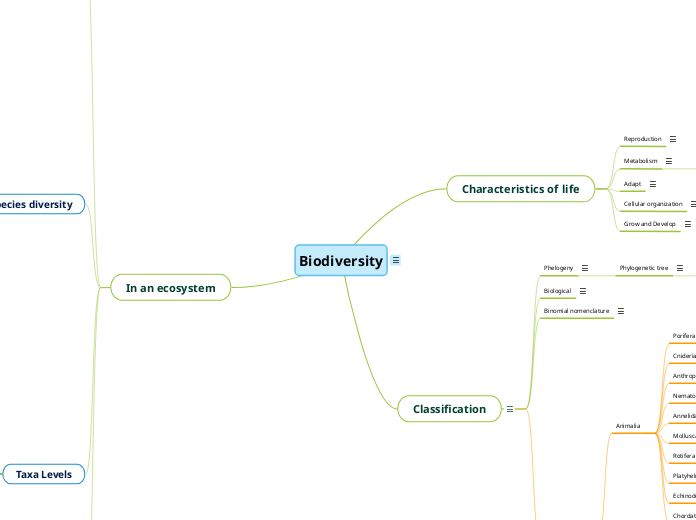
Biodiversity

r

The various different species in thier behaviors, habitats, ecological niches, abundance in an ecosystem.

In an ecosystem

Structural diversity

r

The diversity of physical landscapes and its importance.

Support diversity

r

A larger strutural divseristy supports a larger biodiversity. More diversity of species the more sustainable and health of ecosyetem. It's adaptibility to viruses and diseases will greatly lower.

Impact on humans

r

Tourism and forestrySources of natural medicationDisruption to biochemical cyclesThreatens food supplies

Species diversity

Interaction between species

Food Supply

r

Predators prey on their preys for foodex. Cayote eating a rabbitHerbivores eating an plantBoneworms feed on the bones of a dead whale

Protection

r

Species protect another when needed the other organism for sheltor.ex. Hermit crabs us the shell of dead snails for sheltor and protection.

Transportation

r

Species move from on place to another through the help of another species.Get carries by another speciesex. Flower mites are stuck on a dog and carries to another destination where they can reproduce.

Reproduction

r

Species depend on eachother fro reproductionSheltor to reproduceSpecial cases: Trillium seeds need ants to germinate

Hygiene

r

Some species help maintain the health of other speciesMutual relationshipCoral reefs have cleaning stations that help fishes clean external parasites

Digestion

r

Species can help break down food in our digestive tracts.ex. Bacteria

Roles of Humans

r

Humans played a huge role in the diversity of species

Impacts

Extinction of speices

r

Vocanic activ

Affects on humans

r

Less medication or potential new medicationsAffects our food chain

Climate change

Kindoms

Animalia

r

EukaryotesMulticellularLive in terrestrial or aquatic environmentsNo cell wall or cytoplasmHeterotroph: Not make own food

Plantae

r

Cell wall: Made of celluloseHave chloroplastAre autotrophsEukaryotes -> multicellularStationary

Protista

r

Eukaryotic , have nucleus and membrane bounded organellesLocomotion: Have cillia, flagella to move

Importance

r

Major producers in the aquatic ecosystem

Fungi

r

StationaryMajor decomposersHeterotrophsHave different cells compared to plants: Hyphae composed of cytoplasm and many nuclei

Eubacteria

r

Most diverse kingdomProkaryotes: Single celledLack nucleous: Have DNA

Shapes

Coccus

Bacilli

Spirilla

Archaea

r

Prokaryotes: Single celledLive in extreme environments: Ex. Digestion tractsUnique genetic information

Virus

r

A discussion of rather living or non-living:Need a host cell to reproduceAdapt to environmentDon't grow or make their own/or use energyHave genetic information

Bacteriophage

r

A type of bacteria that attacks bateria

Diseases

r

HIV, HPV, Covid 19

Taxa Levels

Kingdom

Phylum

Family

Order

Class

Genus

Species

Diseases

Bacteria

Horizontal gene transfer

r

When a genetic information is transfered or given from a bacteria to another.

Walkerton Water crisis

r

When the E.coli gets a toxic strand of genetic information from another bacteria. E.Coli only spreads the toxins when it is killed.

Antibiotic resistence

r

Causes antibiotic resistance.

Mutation

r

when a bacteria picks up genetic information from their surrounding.

Virus

prions

r

When proteins change, causing holes in the brain.

CJD

r

Eating infected cows, causing humans to get CJD.

Characteristics of life

Reproduction

r

Species can reproduce under natural circumstances

Metabolism

r

They can use energy for maintanence and growth.

Excrete waste

Adapt

r

Living things adapt to the environment.

Cellular organization

r

Cells are organized at levels:Tissue: Organized cells to perfrom a taskOrgan: Organized tissues to perform a taskOrgan system: A group of organs performing a taskOrganism

Grow and Develop

r

Living things gorw through cell division and cell enlargement.

Classification

r

Classification allows scientists to better understand a species and can better communicate with other scientists on this species more effectvily.

Phelogeny

r

The modern way of classifying species according to their ancestrial relationships.It can better distinguish species that looks very similar

Phylogenetic tree

r

A family tree used to show the connections and relationships between and among species.

Clade

r

An ancestor and all their descendents

Biological

r

The classification of species according to apprearence, behavior etc.

Binomial nomenclature

r

Genus name + Species name

Phyla

Animalia

Porifera

Cnideria

Anthropoda

Nematoda

Annelida

Mollusca

Rotifera

Platyhelminthes

Echinodermata

Chordata

Plantae

Bryophyta

Lycophytes

Gymnosperms

Angiosperms

Fungi

Protista