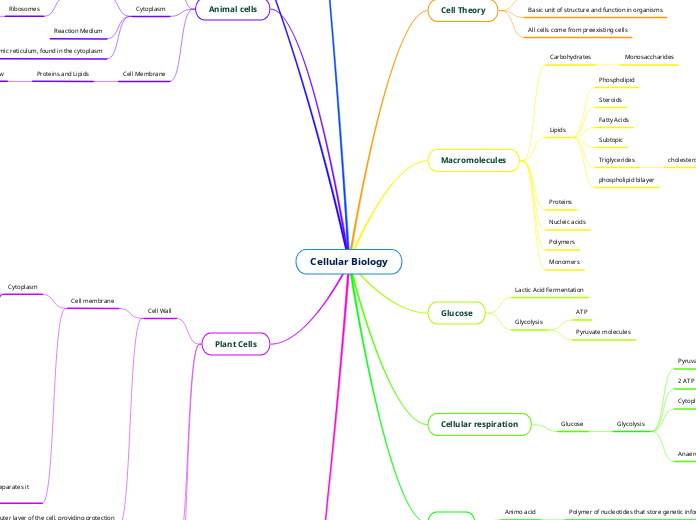
All living things are composed of one or more cells
Basic unit of structure and function in organisms
All cells come from preexisting cells
Carbohydrates
Monosaccharides
Lipids
Phospholipid
Steroids
Fatty Acids
Subtopic
Triglycerides
cholesterol
phospholipid bilayer
Proteins
Nucleic acids
Polymers
Monomers
Lactic Acid Fermentation
Glycolysis
ATP
Pyruvate molecules
Glucose
Glycolysis
Pyruvate
Anaerobic processes
Fermination
Lactic Acids
2 ATP
Cytoplasm
Anaerobic Respiration
Kerbs cycle
1 ATP
1 FADH
Electron transport chain
36 ATP
4 NADH
Mitochondrion
Animo acid
Polymer of nucleotides that store genetic information of a cell
Nucleic acid
Monomer that serves as the main element of proteins.
Plant Cells
Cell Wall
Cell Membrane
Chloroplast
Photosynthesis
Eukaryotic Cells
Organelles
Mitochondria
Anaerobic respiration (with oxygen)
Ribosome
Nucleus
The nucleolus is a region found within the cell nucleus
Producing and assembling the cell's ribosomes.
channel proteins
Animal Cells
Eukaryotic Cells
Cell Membrane
Phospholipids
Hydrophilic (water loving)
Hydrophobic (water fearing)
Glycolipids and glycoprotiens happen on the cell membrane
Cell Wall
cellulose microfibrils
Single celled organisms
Bacteria
prokaryotic cells
Phagocytosis happens when a bacterial cell has bound to molecules what are called receptors.
PInocytosis, a process by which liquid droplets are ingested by living cells.
flow of energy through living things within an ecosystem.
Nucleus
Chromosomes
DNA
Control of cell activities
Transcription
Cytoplasm
organelles
Mitochondria
Respiration
ATP Production
Non Living Granules
Foods and materials storage
Ribosomes
Translation of genetic code
Reaction Medium
Smooth endoplasmic reticulum, found in the cytoplasm
Cell Membrane
Proteins and Lipids
Control of material of flow
Cell Wall
Cell membrane
Cytoplasm
Nucleus
Nuclear membrane.
Ribosome
Endoplasmic Reticulum
Rough endoplasmic reticulum
Golgi body
mitochondria
Lysosome
Vacuoles
Chloroplast
Green pigment that traps sunlight and turns it into sugars.
Stores toxic waste, and useful things like water.
Digestive center of a cell that produces many different types of enzyme, and breaks down particles.
Power house of the cell converts the energy stored in food into energy molecules that the cell can use.
membrane covered sacs that prepare proteins for export from the cell.
The rough endoplasmic reticulum is covered with ribosomes.
Helps move proteins within the cell as well as export them outside of the cell.
Round structures that produce proteins.
This is the membrane that keeps the nucleus and cytoplasm separated from each other.
This is the main control centre of the cell, the nucleus is separated from the cytoplasm.
Thick water based solution that organelles are found in.
Cytoskeleton, is also found in the cytoplasm
The cytosol is A component of the cytoplasm
Alcohol fermentation
anaerobic respiration (without oxygen)
A protective layer that surrounds every cell and separates it from its external environment.
Rigid outer layer of the cell, providing protection
In the light dependent reactions the energy from sunlight is absorbed by chlorophyll. Creating energy.
In the light independent reactions chemical energy harvested during the light dependent reactions drives the assembly of sugar molecules from carbon dioxide.
Does not use energy
Passive transport
Goes through cell membrane
Simple diffusion
Move molecules
Channels made of protein
Channel protein
Facilitated diffusion
Osmosis
Moves water
No energy used
Moves small molecules
Diffusion
Moves substance
That uses energy
Active transport
Subtopic
Exocytosis
Endocytosis
Requires energy
Goes through cell membrane
Move molecules
Channels made of protein
Using a protein
Protein pump
No protein
Into cell
Endocytosis
Out of cell
Exocytosis