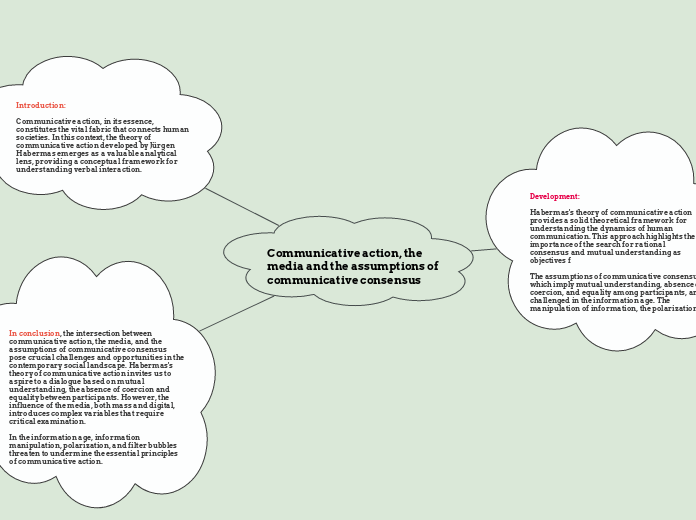
Communicative action, the media and the assumptions of communicative consensus
Development:
Habermas's theory of communicative action provides a solid theoretical framework for understanding the dynamics of human communication. This approach highlights the importance of the search for rational consensus and mutual understanding as objectives f
The assumptions of communicative consensus, which imply mutual understanding, absence of coercion, and equality among participants, are challenged in the information age. The manipulation of information, the polarization.
Agregar texto
Agregar texto
Introduction:
Communicative action, in its essence, constitutes the vital fabric that connects human societies. In this context, the theory of communicative action developed by Jürgen Habermas emerges as a valuable analytical lens, providing a conceptual framework for understanding verbal interaction.
Agregar texto
Agregar texto
In conclusion, the intersection between communicative action, the media, and the assumptions of communicative consensus pose crucial challenges and opportunities in the contemporary social landscape. Habermas's theory of communicative action invites us to aspire to a dialogue based on mutual understanding, the absence of coercion and equality between participants. However, the influence of the media, both mass and digital, introduces complex variables that require critical examination.
In the information age, information manipulation, polarization, and filter bubbles threaten to undermine the essential principles of communicative action.
Agregar texto
Agregar texto