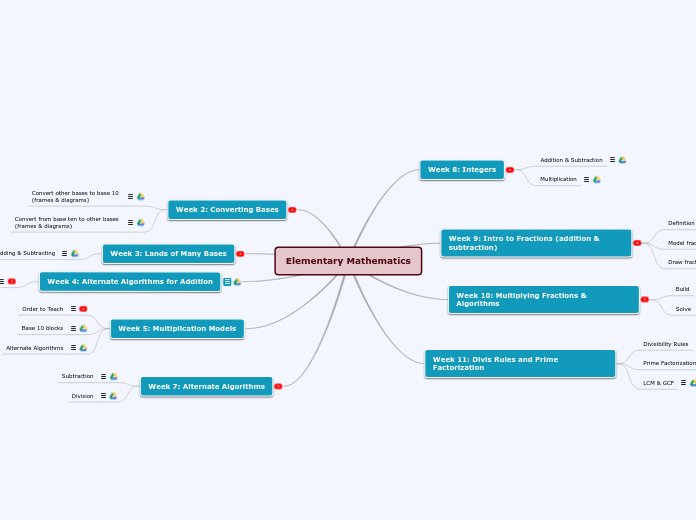
Addition & Subtraction
KCC (keep change change)whichever # is bigger, put 2 signs above it wether its + or - and put the opposite sign above the smaller numberif you have 3 of the same sign then you add the #'sif you do not have 3 of the same sign then subtract the #'swhatever sign you have more of will be in-front of your answer
Multiplication
if the #'s have different signs then the answer will be negativeif the #'s have the same sign then the answer will be positive
Definition of numerator & denominator
numerator: # of piecedenominator: size of piecebigger denominator means smaller size piece
Model fractions
linearset area
Draw fractions
we need to find common denominators when adding & subtracting because all of our pieces need to be the same size
Build
# out of ( ) is how many groups there are# in ( ) is how many pieces there are
Solve
"common denominators"means "same size piece"
Divisibility Rules
2: even #'s (ones digit is 2,4,6,8,0) or (ends in an even #) EX: 723: sum of digits is divisible by 3 EX: 432--> 4+3+2 = 94: last 2 digits are divisible by 4 EX: 71539 --> 7+1+5+3+9--> 3+9 = 125: any # ending in a 5 or 0 EX: 20, 456: even # & sum of digits has to be divisible by 3 EX: 528 --> 8 is even, 5+2+8 = 158: last 3 digits is divisible by 8 EX: 5240--> 2409: sum of digits is divisible by 9 EX: 4374--> 4+3+7+4 =1810: any # ending in 0 EX: 43750
Prime Factorization
A prime # is a # that has exactly 2 #'s, 1 & the #If its not prime its called a compositeComposite: more than 2 factors
LCM & GCF
Factor: smaller than the # we start withMultiple: bigger than # we start with
Convert other bases to base 10
(frames & diagrams)
the big # needs to be bigger than the sub #anything to the 0 power is 1
Convert from base ten to other bases
(frames & diagrams)
way to remember:|||________eaving base 10(big L)
Adding & Subtracting
show by drawing (FLU)
expandedleft to rightscratchlatticefriendly #'strade off
friendly numbers
make one of the #'s end in 0 by adding or subtracting the necessary #'s to each problemwhatever you do to one number do the opposite to the other number
Order to Teach
first: teach onessecond: teach 2'sthird: teach 10'sfourth: teach 5'sfifth: teach 3'ssixth: teach doubles (4x4) (8x8)seventh: teach 9's
Base 10 blocks
use 10# not in ( ) goes on left side# in ( ) goes on topbig square = 100long rectangle = 10small square = 1
Alternate Algorithms
ArraysExpanded FormLattice
Subtraction
Base Ten Blockssaying "take away" is best because it's an action!Trade offyou can do whatever you want as long as you do the same thing to both #'s
Division
TraditionalRepeated Subtractiondoes not force student to use anything they do not knowonly need to use #'s up to 10Upwards Division