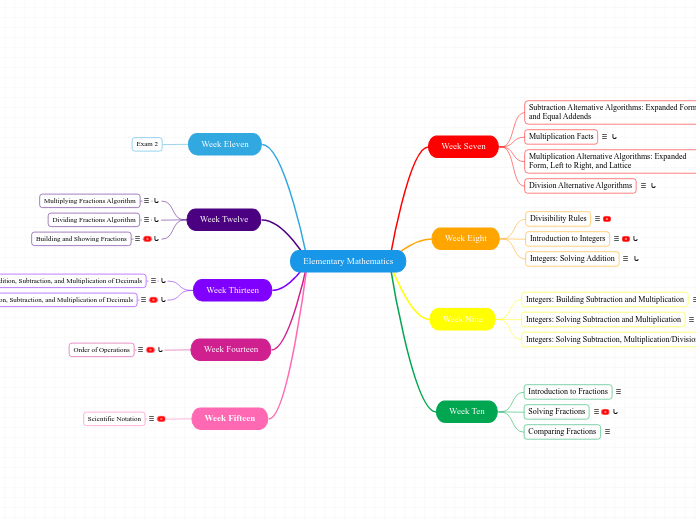
Subtraction Alternative Algorithms: Expanded Form and Equal Addends
Expanded form is an alternative subtraction algorithm. Expand the place values (ones, tenths, hundredths) and subtract from the same place value. Then, add each place value for the answer. See attached examples.Equal addends is an alternative subtraction algorithm. Equal addends adds the same number to the each number in the equation. Then, subtract the numbers. See attached examples.
dMultiplication Facts
Multiplication Strategies:- Timed tests are ineffective if they measure success. Timed tests are effective if they measure growth or progress.- Progress charts are used to measure a student's progress. See attached example.- Flashcards are effective and increase a student's automaticity.Designing your own flashcards:- Red flashcards are multiples of 1, 2, 10, and 5- Yellow flashcards are multiples of doubles, 3, and 9- Blue flashcards are multiples of 4, 6, 7, and 8Introduce the students to the red flashcards. Then, once the students have mastered the red flashcards, introduce the yellow flashcards. Repeat this process for the blue flashcards.- Tricks such as the 8 or 9's trick are ineffective. See attached examples.What order should the multiplication facts be taught?1, 2, 10, 5, 3, 9, doubles, 4, 6, 7, and 8See attached example of the times table.
dMultiplication Alternative Algorithms: Expanded Form, Left to Right, and Lattice
Expanded form is an alternative multiplication algorithm. Expand the place values (ones, tenths, hundredths) and multiply each place value by the other place values. Then, add the multiplied place values for the answer. See attached examples.Left to Right is an alternative multiplication algorithm. Multiply starting with the left side and add for the answer. See attached examples.Lattice is an alternative multiplication algorithm. Draw a lattice box with diagonal lines. Write one number on the top of the box and write the other number on the right side of the box. Multiply from left to right and add the numbers diagonally. See attached examples.
adDivision Alternative Algorithms
Long Division is not an effective way to teach division because students have to estimate what multiple of the divisor goes into the dividend. In addition, students have difficulty setting up the equation because they think that the small number is the divisor and the big number is the dividend.15 ÷ 3 is written as 3⟌15Repeated Subtraction is an alternative division algorithm. In repeated subtraction the equation is set up the same way as long division. The answer is on the right column. See attached examples.Upwards Division is an alternative division algorithm. In upwards division the equation is set up as a fraction. See attached examples.
dDivisibility Rules
Divisibility Rules for 2, 3, 4, 5, 6, 8, 9, 10These numbers will divide evenly into another number if:2: The number is an even number (the number ends in 0, 2, 4, 6, or 8).Example: 24,736 Counter Example: 42,517 3: The sum of the digits is divisible by 3. Example: 1,425 1+4+2+5=12Counter Example: 32,561 3+2+5+6+1=174: The last two digits of the number are divisible by 4.Example: 24,736 Counter Example: 52,3105: The number ends in 0 or 5.Example: 24,705 Counter Example: 52,0316: If the number is divisible by 2 and 3.Example: 342 3+4+2=9Counter Example: 2,145 2+1+4+5=128 (23): The last three digits of the number are divisible by 8.Example: 5,648 Counter Example: 8829: The sum of the digits is divisible by 9.Example: 2,736 2+7+3+6=18Counter Example: 3,651 3+6+5+1=1510: The number ends in 0.Example: 70,360 Counter Example: 20, 725
aIntroduction to Integers
See attached examples for how to build integers using 2-color counters.See attached examples for how to build addition using 2-color counters.See attached examples for how to show integers using positives and negatives.
adIntegers: Solving Addition
Hector's Method:In addition, if the bigger number is positive, draw 2 positives above the number. If the bigger number is negative, draw 2 negatives above the number. If the smaller number is positive, draw 1 positive above the number. If the smaller number is negative, draw 1 negative above the number. Circle one positive or negative from the bigger number and one positive or negative from the smaller number. If the circle has one positive and one negative, subtract the bigger number from the smaller number. If the bigger number is positive the answer will be positive. If the bigger number is negative the answer will be negative. If the circle has two positives or two negatives, add the bigger number to the smaller number. If the bigger and smaller number are positive the answer will be positive. If the bigger and smaller number are negative the answer will be negative. See attached examples for how show addition using Hector's method.
dIntegers: Building Subtraction and Multiplication
- A zero pair is a positive and negative that cancel each other out.- A zero bank is used in subtraction and multiplication and is a bank of zero pairs.- When building subtraction or multiplication the positive goes on the top and the negative goes on the bottom.- The negative is red.- If you drew additional zero pairs, circle the zero pairs.What is the best way for students to say or "think" of subtraction problems?9-4 | 9 positives takeaway positive 41-(-5) | 1 positives takeaway 5 negatives-2-4 | 2 negatives takeaway 4 positives-2-(-3) | 2 negatives takeaway 3 negativesWhat is the best way for students to say or "think" of multiplication problems?3(2) | 3 groups of 2 positives5(-2) | 5 groups of 2 negatives-3(4) | Takeaway 3 groups of 4 negatives-6(-1) | Takeaway 6 groups of 1 negativeSee attached examples for how to build subtraction and multiplication using 2-color counters.
adIntegers: Solving Subtraction and Multiplication
When solving integers start with a zero bank if needed. Showing integers is similar to building integers as you will see in the examples attached.- When building subtraction or multiplication the positive goes on the top and the negative goes on the bottom.- The positive is a green or blue plus sign- The negative is a red minus sign.Note: If you drew additional zero pairs, circle the zero pairs.See attached examples for how to show subtraction and multiplication.
dIntegers: Solving Subtraction, Multiplication/Division
Subtraction:In subtraction use KCC (Keep Change Change).KCC (Keep Change Change)Keep the sign of the first numberChange the minus sign to the plus signChange the sign of the first numberExamples:45-12 KCC→ 45+(-12)34-(-56) KCC → 34+ 56Then, use Hector's Method to solve the equation (Hector's Method is explained in Integers: Solving Addition. See attached examples.Multiplication/Division Rules:- Negative x negative = positive; -3(-6)=18- Negative x positive = negative; -2(5)=-10- Positive x positive = negative; 4(-5)=-20- Positive x positive = positive; 3(7)=14
dIntroduction to Fractions
When is 6 bigger than 10? 6 what? 10 what? 6 cars and 10 shoes? Context matters!Is 25 big or small? 25 atoms? 25 planets? Context matters!What do the parts of a fraction tell us?7 The numerator tells us the number of pieces 8 The denominator tells us the size of the piecesDenominator: _ - The size of the pieces are different5 - The size of the pieces are inversely related to the size of__ the denominator10Numerator:6 - How many of each size piece we have4
Solving Fractions
See attached examples of how to add fractions.
adComparing Fractions
Comparing Fractions:7/13 > 11/23 Reasoning: 2 x 7 =14 > 11 x 2=22Anchor Fractions→ 1/22/9 < 2/7 Reasoning: Same number of pieces/Size of each piece14/15 > 9/10 Reasoning: Missing one small piece4/13 < 5/13 Reasoning: More of the same size piece13/16 < 25/28 Reasoning: Missing 3 small pieces4 9/10 < 6 1/18 Reasoning: Whole number comparison7/16 > 3/8 Reasoning: Multiply to make the same size
Exam 2
Multiplying Fractions Algorithm
Multiplying Fractions AlgorithmBreak the fractions down into factors. Factors are whole numbers that are common in both the numerator and denominator.Find the funky ones. A funky one is any numerator or denominator that are the same numbers.Circle the numbers that are not funky ones.Multiply the fractions.Simplify.- If the fraction has a whole number use the Backwards "C" to convert it into an improper fraction.Backwards "C": Multiply the whole number by the denominator. Add the product of the whole number and denominator to the numerator. Then, put the sum over the denominator.For example:2 7/9 = 25/9See attached examples for multiplying fractions algorithm.
dDividing Fractions Algorithm
Dividing Fractions AlgorithmUse the Backwards "C" to convert fractions with whole numbers to improper fractions.Use KCF: Keep, change, flip. Keep the first fraction, change the sign from division to multiplication. Flip or invert the second fraction.Solve using the multiplying fractions algorithm to multiply the two fractions.See attached examples for dividing fractions algorithm.
dBuilding and Showing Fractions
Introduction to Fractions Numerator = Number of piecesDenominator Size of piecesColor rods are useful for teaching students subtracting and adding fractions because students can build addition problems with manipulatives.Fractions are a comparisonLinear model: Compares how the length to the total lengthFor example: 🀱🀱 2/4 blue or 2/4 red Set model: Comparing the number of pieces you have to the total number of pieces.For example: ☐ ☐ ☐ ☐ ☐ ☐ ☐ ☐ ☐ 2/7 red or 4/7 green or 4/7 not blueArea model:Ө 1/2 area is blueSee attached examples for how to show addition, subtraction, and multiplication of fractions.
adShow Addition, Subtraction, and Multiplication of Decimals
☐ = Ones| = Tenths☐ = HundredthsEnunciate the ths in the tenths and hundredths for students because they have difficulty pronouncing the tenths and hundredths.When we show how to add, subtract, and multiply decimals we use diagrams similar to the diagrams we used for fractions (Refer to Week 12 Building and Showing Fractions).The . means that the students are starting a decimal or a tenth of a whole.See attached examples for how to show addition, subtraction, and multiplication of decimals.Note: When multiplying decimals the first number is the columns and the second number is the rows. For example in the equation (0.2)(0.5), 0.2 is shaded in the columns and 0.5 is shaded in the rows.
dSolving Addition, Subtraction, and Multiplication of Decimals
How do you solve addition and subtraction of decimals?Two Step Process:Estimate the answer. Line up the whole numbers. See attached examples. How do you solve multiplication of decimals?Three Step Process:Estimate the answer. Multiply without the decimals.Place the decimal closest to the estimate. The three step process does not work when the decimals are less than 1. In those problems use the method of counting the examples. See attached examples for both methods.Note: Do not tell students to count decimals.
adOrder of Operations
Order of Operations is the order by which we are required to do mathematics.Do NOT use PEMDAS to teach students order of operations.Order of Operations:GroupingExponentsD/M - Division/MultiplicationS/A - Subtraction/Addition- Groups can be identified by addition and subtraction signs.- Divide/Multiply from left to right- Subtract/Add from left to right(-4)2= 16 because 0(-4)2= 16-(4)2= -16 because 0-(4)2= -16-42= -16 because 0-42= -16-(-4)2= -16 because 0-(-4)2= -16See attached examples forGED/MS/A
adScientific Notation
The Scientific Notation:|[Between 1-10]| x 10Positive or negative exponent- The number has to be between 1-10 (the number can be negative or positive)- The number is multiplied by 10- There is a positive or negative exponentStandard Notation: Is the number we normally write such as 4,256 or 0.036Why do we need scientific notation? We use scientific notation for really, really small or large numbers. - A number bigger than 1 tells us that the exponent in scientific notation is positive- A number between 0 and 1 tells us that the exponent in scientific notation is negative- A positive exponent tells us that the number written in standard form is large.- A negative exponent tells us that the number written in standard from is smallExamples of Changing Numbers to Standard Form4.36 x 10-4 Negative exponent = A small number0.0004368.68 x 106 Positive exponent = A large number 8,680,000-6.42 x 10⁻⁶ Negative exponent = A small number-0.00000642-1.2 x 10³ Positive exponent = A large number -1,200Examples of Changing Number to Scientific Notation0.000542 Small number = A negative exponent5.24 x 10-4 3,670,000,000 Large number = A positive exponent3.67 x 109-0.0082 Small number = A negative exponent-8.2 x 10⁻³ -68,000,000 Large number = A positive exponent-6.8 x 10⁷
a