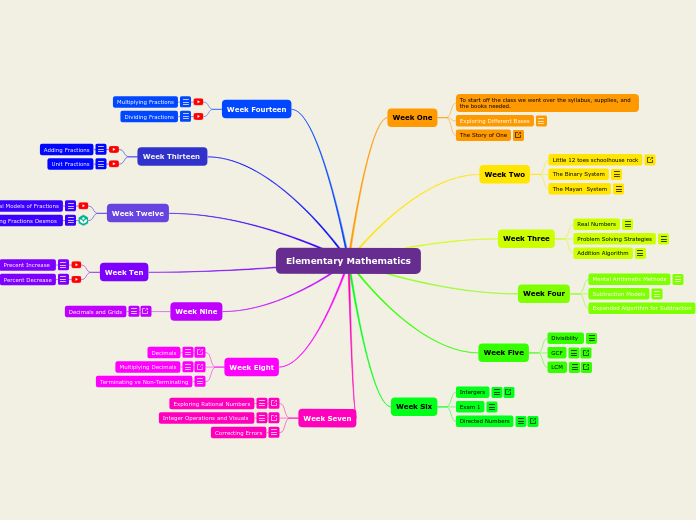
To start off the class we went over the syllabus, supplies, and the books needed.
Exploring Different Bases
Intro to base 10: units, longs, flatsThe binary systemExpandform within the bases
The Story of One
Little 12 toes schoolhouse rock
The Binary System
The Binary system is a two base system which works in similar way to our decimal system.
The Mayan System
The Mayans counted in lots of 20 instead of 10. The place value was shown by putting one place value above the other. example: 52 is written as oo ____ ____ oo
Real Numbers
Commutative Property of Addition and Multiplication: a+b = b+a or a X b = b x aAssociative Property of Addition and Multiplication: (a+b) + c = a+ (b+c). or (a x b) x c = a x (b x c)Identity Property of Addition and Multiplication: a+0=a or a x 1= a
Problem Solving Strategies
Understanding the problemDevise a planCarry out the planLook back (reflect)
Addition Algorithm
Standard Algorithm, Partial Sums, Lattice, Column Addition, Opposite Change
Mental Arithmetic Methods
Some methods include:Left-to-Right approach- add the hundreds, then add the tens, then the onesCompensation- round up to make the addition easier then subtract the amount you compensatedUsing Compatible numbers- group together numbers whose sums are easy to calculate
Subtraction Models
Developing Algorithms for Subtraction:Students can use base-ten blocks for modeling the subtraction. Which is a great example of the take-away method
Expanded Algorithm for Subtraction
Start with the biggest number and continue to take away as much as possible moving left to right.Example: 245-18 = ? 245-10=235 235-5=230 230-3= 227 245-18=227
Divisiblity
Divisibility Rules:2- a number must be even. 3- the sum of the digits is divisible by 34- the number formed by the last two digits must be divisible by 45- the last digit must be 5 or 06- the number must be divisible by 39- the sum of its digits is divisible by 910- if the last digit is a zero11- the sum of the digits in odd-numbered places will be equal to the sum of the digits in even-numbered places or will differ by a multiple of 11
GCF
The greatest common factor (GCF) aka the greatest common divisor (GCD) of two whole numbers a and b, not both 0 is the greatest common whole number that divides both a and b. Different Methods include: colored rodsprime facotizationintersection of sets
aLCM
Least common multiple (LCM) or smallest common multiple of two integers a and b, usually denoted by lcm. the smallest positive integer that is divisible by both a and b
aIntergers
An integer is a whole positive or negative number. An integer can NEVER be a fraction or decimal. When teaching integers be sure to include:absolute value- the value of a number a, written |a|, is the distance on the number line from 0 to a
aExam 1
have students use practice materials beforehand
Directed Numbers
Directed numbers are numbers with both size and direction, one direction is positive and the other is negative.An example includes:Temperature is typically described in a number of degrees either above zero (positive values) or below zero (negative values).
aMultiplying Fractions
How to multiply fractions:Step 1: Multiply the numerators from each fraction by each other (the numbers on top). The result is the numerator of the answer.Step 2: Multiply the denominators of each fraction by each other (the numbers on the bottom). ... Step 3: Simplify or reduce the answer.ex. 2/5 x 6/7 2x6= 12 5x7=35 = 12/35ex. 1/4 x 2/3 1x2= 2 4x3= 12 = 2/12 or 1/6
Dividing Fractions
How to divide fractions:Step 1: Flip (or invert) the divisor into a reciprocal.Step 2: Change the division sign to a multiplication symbol and multiply.Step 3: Simplify your answer if possible.Important tool is keep change flip!ex. (8/5) / 5 (8/5) / (5/1) -> (8/5) x (1/5) = 8/25ex. (1/4) / (5/4) (1/4) x (4/5) = 4/40 or 1/5
Adding Fractions
To add fractions there are Three Simple Steps:Step 1: Make sure the bottom numbers (the denominators) are the same. Step 2: Add the top numbers (the numerators), put that answer over the denominator. Step 3: Simplify the fraction (if possible)ex. 1/4 + 9/12 3/12 + 9/12 *find the common denominator (used multiplication) = 12/12 or 1ex. 3/5 + 12/15 3/5 + 4/5 *find common denominator (used division) =7/5 or 1 2/5
Unit Fractions
A unit fraction is a ration number written as af reaction where the numerator is one and the demoniator is a positive integer. Such as 1/2, 1/3, 1/4, 1/5 1/6, 1/7, etc.Using unit fractions students can build understandings of what fractions can fit into another. ex. If I had 1/2 I can make 1/3 and 1/6 fit into it, or 1/4 and 1/6 and 1/12, or 1/5 and 1/7 and 1/6, or 1/8 and 1/9 and 1/10 and 1/11 and 1/12 all can fit into 1/2.
Pictorial Models of Fractions
Different pictoral ways to show fractions can include:Cuisenaire Rods Drawing pictures whether it be a pie or blocks (area models)Number lines Cuisenaire Rods can be used by themselves or on a number line and in my opinion the best way for students to visualize fractions. The website https://mathigon.org/polypad#fractions is a great resource not only do they have rods but other forms of pictorial resources for fractions, algebra, geometry, and probability.
aComparing Fractions Desmos
Using desmos in calss is a great exercise to see that the kids know and to see their exact train of thought when preforming the task. In this particular desoms studetmns were to show different fractions within different shapes. Some examples include cutting a rectangle into four equal pieces, shade in a quarter of a triangle.The video I included is a great example of some of the problems that were included in the desmos activity.
Precent Increase
Percent increase is how much a percentage has gone up over time. In order to reach this number, you need to find the difference between the original value and the final value, subtracting to find the exact total of the decrease. ex. The salary of a person increases from $700 to $1050 after a year.The initial value=700The final value=1050[(1050-700)/700] x 100= (350/700) x 100= 50%
Percent Decrease
Percent decrease is the difference between starting and ending values. It shows a loss of value from the original expressed as a percentage regardless of units. The amount of decrease is the original amount minus the final amount. ex. The price of pencils went from $12 to $9. What was the percent decrease?New value= 9Old value= 12[(12-9)/12] x 100=25%
Decimals and Grids
Using grids is a great way to show decimals to visual learners. If a flat is filled in its whole number anything that is partly shaded is the remainder aka decimal.
aDecimals
Decimals...place value: . tenths, hundreths, thousandths, ten thousandths, hundred thousands, millionshow to say a decimal: 1.25 = one hundred AND twenty-five hundredths
aMultiplying Decimals
To multiply decimals, first multiply as if there is no decimal. next, count the number of digits after the decimal in each factor. Finally put the same number of digits behind the decimal in the product.
aTerminating vs Non-Terminating
Terminating vs Non-TerminatingA terminating decimal has a finite number of digits after the decimal point. ie. 3.786 and .25A non-terminating decimal does not have a finite number of digits. ie. .08888888888888888
Exploring Rational Numbers
What are examples of rational numbers?Real- any number on the positive, or negative number line Natural- counting numbers {1,2,3,4} zero is not includedRational- any number that can be written as a fraction of two integers (a/b)Irrational- a number that cannot be written as a fraction (pi,e..)Imaginary numbersIntegers- whole numbers, positive or negative
aInteger Operations and Visuals
Going over different integer operations. The main one includes the order of operations. Another one includes the number line.The order of operations: (PEMDAS) Parentheses, exponents, multiplication, and division (from left to right), addition ad subtraction (from left to right). i.e. 2(8+2) - 3= 2(10) - 3= 20-3= =17
aCorrecting Errors
Going over questions that the majority of the class struggled on and asking further questions.