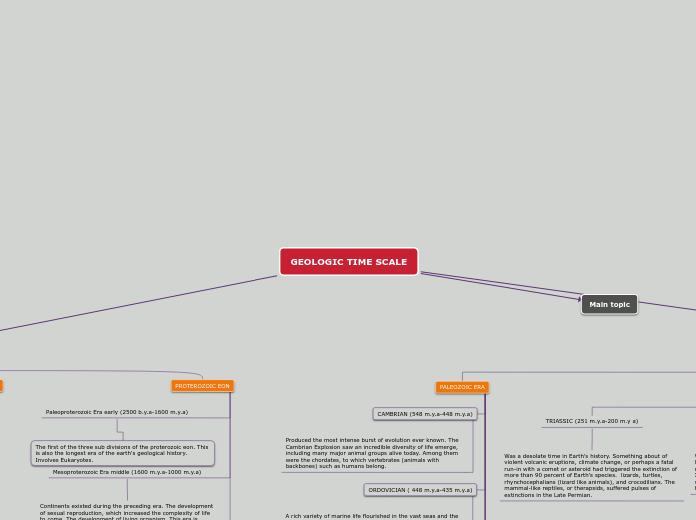
HADEAN EON
4.6 BILLION YEARS-4 BILLION YEARS
The hadean eon,named after the greek God and ruler of the underworld hades. The planet was cracked by volcanic activity,cosmic bombardments,ranging storm and temperatures that very hot enough too melt rocks. (HELL)
ARCHEAN EON
4 BILLION YEARS-2.5 BILLION YEARS
During the archean eon the Earth's crust had cooled enough to allow the formation of continents and the beginning of life on Earth.
PROTEROZOIC EON
Paleoproterozoic Era early (2500 b.y.a-1600 m.y.a)
The first of the three sub divisions of the proterozoic eon. This is also the longest era of the earth's geological history. Involves Eukaryotes.
Mesoproterozoic Era middle (1600 m.y.a-1000 m.y.a)
Continents existed during the preceding era. The development of sexual reproduction, which increased the complexity of life to come. The development of living organism. This era is marked by the further development of continental plates and plate tectonics.
Neoproterozoic Era late (1000 m.y.a-541 m.y.a)
The most severe glaciation known in the geologic record occurred during the Cryogenian, when ice sheets reached the equator and formed a possible “Snowball Earth”. the start of multicelled life at the first appearance of hard-shelled animals called trilobites and archeocyathids.
PALEOZOIC ERA
CAMBRIAN (548 m.y.a-448 m.y.a)
Produced the most intense burst of evolution ever known. The Cambrian Explosion saw an incredible diversity of life emerge, including many major animal groups alive today. Among them were the chordates, to which vertebrates (animals with backbones) such as humans belong.
ORDOVICIAN ( 448 m.y.a-435 m.y.a)
A rich variety of marine life flourished in the vast seas and the first primitive plants began to appear on land—before the second largest mass extinction of all time ended the period. All of the major animal groups of the Ordovician oceans survived, including trilobites, brachiopods, corals, crinoids and graptolites, but each lost important members. Widespread families of trilobites disappeared and graptolites came close to total extinction.
SILURIAN (435 m.y.a-416 m.y,a)
Many biologically significant events occurred. In the oceans, there was a widespread radiation of crinoids, a continued proliferation and expansion of the brachiopods, and the oldest known fossils of coral reefs. Animals lived in silurian period are ryozoans, crinoids, clams, cephalopod, jelly, sea scorpion (Pterygotus), brachiopod, jawless fish (Birkenia), gastropod shell, brittle star, trilobite, bivalve mollusk, sponges, sea star.
DEVONIAN (416 m.y.a-359 m.y.a)
The Devonian Period was a time of extensive reef building in the shallow water that surrounded each continent and separated Gondwana from Euramerica. Reef ecosystems contained numerous brachiopods, still numerous trilobites, tabulate and horn corals. animals lived in the Devonian period
The first tetrapods, land-living vertebrates, appeared during the Devonian, as did the first terrestrial arthropods, including wingless insects and the earliest arachnids. In the oceans, brachiopods flourished. Crinoids and other echinoderms, tabulate and rugose corals, and ammonites were also common.
MISSISSIPIAN ( 359 m.y.a-318 m.y.a)
Epoch opens in slow mass extinction; life soon recovers.
Euramerica & Gondwana continue to merge; much.
Vast forests and swamps form as sea levels fluctuate.
Climate hot & humid but glaciated at the poles.
Oxygen level 40% above today - abundant wildfires.
Much of the world's coal formed in the Carboniferous.
PENNYSYLVANIAN (318 m.y.a-299 m.y.a)
During the Pennsylvanian Period, widespread swamps laid down the thick beds of dead plant material that today constitute most of the world's coal. Common Pennsylvanian marine fossils found in Kentucky include corals (Cnidaria), brachiopods, trilobites, snails (gastropods), clams (pelecypods), squid-like animals (cephalopods), crinoids (Echinodermata), fish teeth (Pisces), and microscopic animals like ostracodes and conodonts.
PERMIAN (299 m.y.a-251 m.y.a)
Pangaea. During the Permian Period, all the world's landmasses were joined into a single continent that spread from pole to pole.
Rise of Amniotes.
Greatest Mass Extinction of All Time. There were many animals, including Edaphosaurus, Dimetrodon, and other pelycosaurs; Eryops, Diplocaulus, archosaurs, amphibians, fish, and lots of invertebrates (like insects, worms, etc.). An extinct, sail-backed, meat-eating animal from the Permian period (pre-dating the dinosaurs).
MESOZOIC ERA
TRIASSIC (251 m.y.a-200 m.y a)
Was a desolate time in Earth's history. Something about of violent volcanic eruptions, climate change, or perhaps a fatal run-in with a comet or asteroid had triggered the extinction of more than 90 percent of Earth's species. lizards, turtles, rhynchocephalians (lizard like animals), and crocodilians. The mammal-like reptiles, or therapsids, suffered pulses of extinctions in the Late Permian.
JURASSIC (200 m.y.a-145 m.y.a)
Was characterized by a warm, wet climate that gave rise to lush vegetation and abundant life. There are many smaller and medium-sized dinosaurs that lived during this time, like Xiaosaurus, Dryosaurus, Kentrosaurus, and Stegosaurus, would have browsed on low-lying plants, like seed ferns, ferns, horsetails, club mosses, and low-lying conifers.
CRETACEOUS ( 145 m.y.a-66 m.y.a)
The last period of the Mesozoic Era, following the Jurassic and ending with the extinction of the dinosaurs (except birds).
CENOZOIC ERA
TERTIARY
PALEOCENE (66 m.y.a-55 m.y.a)
Mammals became more diverse during the Paleocene and many evolved larger body size, adopting ecological roles similar to the now-extinct dinosaurs.
Eocene (55 m.y.a-34 m.y.a)
The replacement of older mammalian orders by modern ones. Hoofed animals first appeared, including the famous Eohippus (dawn horse) and ancestral rhinoceroses and tapirs. Early bats, rabbits, beavers, rats, mice, carnivorous mammals, and whales also evolved during the Eocene Epoch.
OLIGANCE (34 m.y.a-23 m.y.a)
Oligocene included a global expansion of grasslands, and a regression of tropical broad leaf forests to the equatorial belt. Early forms of amphicyonids, canids, camels, tayassuids, protoceratids, and anthracotheres appeared, as did caprimulgiformes, birds that possess gaping mouths for catching insects. Diurnal raptors, such as falcons, eagles, and hawks, along with seven to ten families of rodents also first appeared during the Oligocene.
MIOCENE (24 m.y.a-5.3 m.y.a)
The vegetation began to shift from closed broad-leaved forests to more open, drier forests as well as grasslands and deserts. all the modern groups of whales had appeared, as had the early seals and walruses. Birds such as herons, rails, ducks, eagles, hawks, crows, sparrows, pheasants, owls, and partridges were present in Europe, where the uplifting of the Alps continued through Miocene time.
PLIOCENE (5.3 m.y.a-2.6 m.y.a)
Was a time of global cooling after the warmer Miocene. The cooling and drying of the global environment may have contributed to the enormous spread of grasslands and savannas during this time. South American mammals found in North American Pliocene sediments include giant sloths, armadillos, and porcupines.
QUATERNARY
Pleistocene(2.6 m.y.a-11.7 m.y.a)
The growth of large ice sheets, ice caps, and long valley glaciers was among the most significant events of the Pleistocene. Although smaller in size, the Scandinavian Ice Sheet was similar to the Laurentide in character.
The effects in mountainous terrain were even more dramatic. In addition to the woolly mammoth, mammals such as saber-toothed cats (Smilodon), giant ground sloths (Megatherium) and mastodons roamed the Earth during this period.
HALOCENE (11.7 m.y.a - present)
Known as the ''Age of Man'', but that hasn't necessarily been a great thing. During this period, the climate has seen some warming and cooling, including the Little Ice Age, large mammals have gone extinct, and humans have possibly caused the Holocene extinction event and added to global warming.