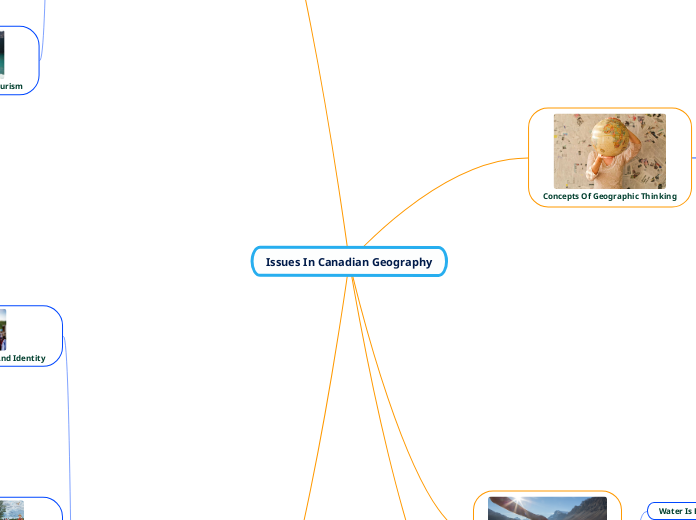
Issues In Canadian Geography
Concepts Of Geographic Thinking
Spatial Significance
Patterns And Trends
Interrelationships
Geographical Perspectives
Geographical perspectives are perspectives of different parties of a situation that a geographer takes into account to see how each party is impacted and how they feel. The 4 perspectives that there are social, economic, environmental and political. For example, a situation can be can you shoot a gull? A geographer has to find out what each party's opinion on the topic is. People from social might not care as much as someone from the environmental side.
Interrelationships are about how humans and the environment connect and impact each other. A geographer has to figure out how something a human will do will negatively or positively impact the environment and wildlife. An example of this can be the situation in Laos. In Laos, they have a market for edible bugs. Bugs are a great source of protein and food that can be produced in Laos since the climate in Laos is great for these bugs. These bugs can reduce hunger among people in Laos causing a positive interrelationship.
Patterns and trends are patterns and trends that occur in humans or the environment where a geographer got to understand and analyze these trends to find their impact. An example of a trend is how our world population. A geographer has to determine where this trend is going and how will it impact what is going to happen. Also, they have to determine what is the cause of these trends to occur.
Spatial significance is about determining how important a region or location is and the impact it can have on both the environment and humans. For example, a village in Thailand called Panyee had a group of kids want to practice soccer. However, their natural environment provided a difficult time to learn. Even so, they practiced under these conditions and became even better players as the flooding, winds, and different terrain forced them to have better footwork, balance and skill.
Liveability
Geographers have to figure out how liveable is a place or community. The characteristics that may determine this can be culture, education, prosperity, transportation, health, housing, healthy foods and recreation. A good community with livability is Glenwood park. Glenwood park has safe, convenient and walkable shops nearby. Everything is close and walkable along with lots of safety. Houses promote healthy styles with less driving and encourage more social connections with people around them.
Managing Canada's Water
Water Is Everywhere
Water is the one essencial all life needs. Besides drinking we basically use water for nearly everything else. Water is all around you. From our food to our clothing and even our smartphones needed water to make them. There are a lot of hidden water that people don't see.
Water Issues In The World
Water Cycle
Demography And Immigration
The Physical Diversity Of Canada
Rocks And Landform Regions
Canada consists of many rocks and regions across the land. With how big Canada is there are many landforms from the lowlands to the Appalachians, cordillera, the Canadian shield and interior planes. In addition, Canada is home to all 3 rocks igneous, metamorphic and sedimentary as they all come from the different land forms Canada has.
Western Cordillera
Appalachians
St. Lawrence Lowlands
Interior Planes
Canadian Shield
Exploring Canadian Tourism
With so much land mass and a variety of landforms, there are so many tourism opportunities in Canada. However, a lot of tourism comes from the natural beauty of Canada. There are many national parks such as Banff and Prince Edward Island national park where the views there are stunning. Also, the activities at these parks are not limited to rock climbing, swimming, canoeing, hiking, camping, sightseeing and fishing are some activities that can be done at these parks.
From personal experience, I can say that these national parks are absolutely beautiful having been to some. There are just lots to do at these parks that allow you to connect more with nature and its beauty.
Cape Breton Highlands National Park
Nahanni National Park
Indigenous Issues
Indigenous Land Concept And Identity
Indigenous people believe in peace as everything around them is spiritually connected. They are connected to the land and they treat and respect the land well. They plan to keep nature at its best for the following generations. They have great relationships with everything around them.
"We didn't inherit the Earth from our parents. We are borrowing it for our children." -Chief Seattle, 1786-1866
Impact Of Residential Schools
Residential schools were put in place to "kill the Indian in the child" as the government and catholic church committed cultural genocide towards the Indigenous people. Indigenous children were forced to attend these schools that not only converted children but also abused and killed them. This pain and suffering would go on for over a century and would continue to cause suffering for generations in the future.
"We should never forget... It's part of who we are as a nation. And this nation must never forget what it once did to its most vulnerable people." -Senator Murray Sinclair
The Unfair Treatment Toward Indigenous People
Even as the first people in Canada they were treated as the poorest out of everyone. From rigged treaties to residential schools, Indigenous people had so much taken away from them. Their land, rights and freedoms. They were forced into tiny reserves with poor conditions and unfertile land. They were an afterthought to the government and continued to be disrespected and abused for decades and decades.
"Racism systematically has impaired the ability to receive the right care." -Lea Bill, Pelican Lake First Nation
Trying to recover
The prime Minister has done things to try and help the Indigenous communities through orange shirt day, land acknowledgements, public apologies, recognition, support among the reserves, and more education on their history along with a healing process.