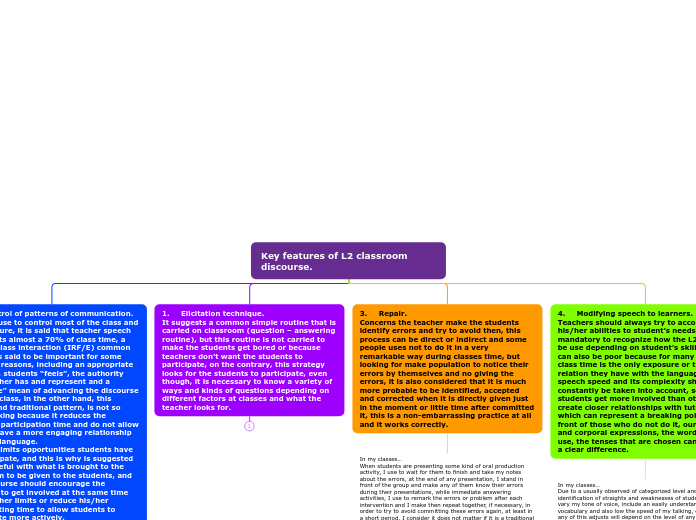
1. Control of patterns of communication. Teacher use to control most of the class and its structure, it is said that teacher speech represents almost a 70% of class time, a specific class interaction (IRF/E) common pattern is said to be important for some different reasons, including an appropriate behavior, students “feels”, the authority that teacher has and represent and a “effective” mean of advancing the discourse during a class, in the other hand, this typical and traditional pattern, is not so good looking because it reduces the students participation time and do not allow then to have a more engaging relationship with the language. Teacher limits opportunities students have to participate, and this is why is suggested to be careful with what is brought to the classroom to be given to the students, and this of course should encourage the students to get involved at the same time that teacher limits or reduce his/her participating time to allow students to participate more actively.
In my classes… I have to say that this feature reflects me and at the same time allows me to understand some things as a poor participation from students, it is not easy to find a very active class during a L2 lesson, but it is important to mention that, I can say I fix this mold or model, but the low participation is also carried to the poor knowledge students have acquired time ago, as well as a lack of self-confidence.
1. Elicitation technique. It suggests a common simple routine that is carried on classroom (question – answering routine), but this routine is not carried to make the students get bored or because teachers don’t want the students to participate, on the contrary, this strategy looks for the students to participate, even though, it is necessary to know a variety of ways and kinds of questions depending on different factors at classes and what the teacher looks for.
1
3. Repair. Concerns the teacher make the students identify errors and try to avoid then, this process can be direct or indirect and some people uses not to do it in a very remarkable way during classes time, but looking for make population to notice their errors by themselves and no giving the errors, it is also considered that it is much more probable to be identified, accepted and corrected when it is directly given just in the moment or little time after committed it, this is a non-embarrassing practice at all and it works correctly.
In my classes… When students are presenting some kind of oral production activity, I use to wait for them to finish and take my notes about the errors, at the end of any presentation, I stand in front of the group and make any of them know their errors during their presentations, while immediate answering activities, I use to remark the errors or problem after each intervention and I make then repeat together, if necessary, in order to try to avoid committing these errors again, at least in a short period. I consider it does not matter if it is a traditional or old practice, is completely necessary to make them recognize their own errors directly and help them to repair it.
4. Modifying speech to learners. Teachers should always try to accommodate his/her abilities to student’s needs, it is mandatory to recognize how the L2 should be use depending on student’s skills which can also be poor because for many of them, class time is the only exposure or the only relation they have with the language, speech speed and its complexity should constantly be taken into account, some students get more involved than others and create closer relationships with tutors, which can represent a breaking point in front of those who do not do it, our facial and corporal expressions, the words we use, the tenses that are chosen can remark a clear difference.
In my classes… Due to a usually observed of categorized level and identification of straights and weaknesses of students, I use vary my tone of voice, include an easily understandable vocabulary and also low the speed of my talking, of course, any of this adjusts will depend on the level of any group I work with and the needs of the different population involved in the process.