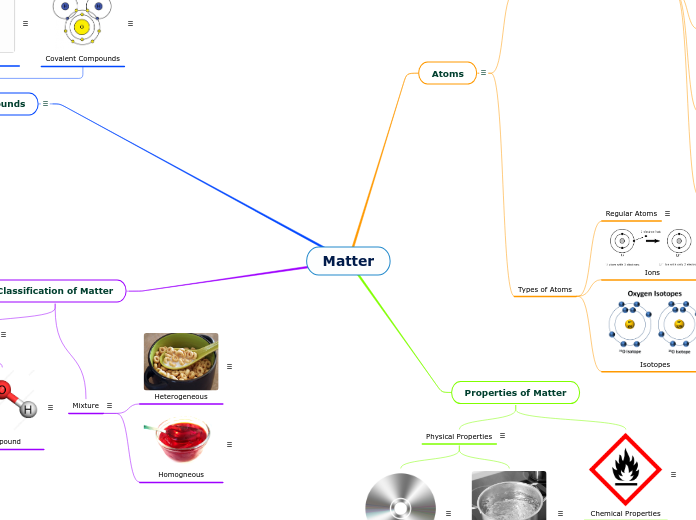
Matter
Atoms
The atom has been through many changes during its discovery.The atomic theory and model has been modified five times since it was first created by John Dalton in 1803.There are also different types of atoms which all start out as regular atoms but are prone to change. Atoms can become ions and isotopes.
Evolution of the Atomic Theory and Models
Solid Sphere Model, John Dalton
John Dalton (1766-1844) revolutionized the atomic theory created during ancient Greece by theorizing that:1. All atoms are indivisible.2. All atoms of any given element are the same.3. Atoms of different elements are different.4. Compounds (such as water/h2o) are created by combining atoms of different elements.His theory was slightly wrong in the fact that atoms are indivisible, they are composed of smaller particles which are later discovered and called "Subatomic Particles".His model composed of only a sphere as he believed that atoms were tiny solid balls.
Plum Pudding Model, J.J Thompson
J. J. Thompson (1856-1940) built upon the foundation set by John Dalton and created another model which he called the "Plum Pudding Model".He discovered that atoms were divisible into a smaller component called an "electron" which was scattered through a sphere-shaped cloud of positive charge. He also proposed that there was a positively charged particle in an atom.He used a cathode ray tube which is a tube of glass filled with gas. He sent electricity into the tube which a negatively charged metal plate projected through a positively charged plate to the end of the tube creating a glowing spot when met with a coating on the end of the tube. This made Thompson curious to find out what the stream was made of which led to his discovery of electrons.
Nuclear Model, Ernest Rutherford
Ernest Rutherford (1871-1937) discovered the positive subatomic particle named the "Proton".His experiment used a radioactive substance that emits positive particles into a positively charged sheet of gold foil. Most of the particles went through the sheet but some were deflected at weird angles.Rutherford concluded that atoms are mostly empty spaces with all of the positive charge concentrated in the middle of the atom which he called the nucleus. The nucleus was composed of a positively charged subatomic particle called a "Proton". The only problem with this theory was that it didn't explain why electrons orbit around the nucleus.
Planetary Model, Niels Bohr
and James Chadwick
Niels Bohr (1885-1962) was a Danish physicist who proposed that electrons orbit around the nucleus in layers which he called shells. James Chadwick (1891-1974) was Bohr's coworker who discovered neutrons or subatomic particles with no charge.Bohr improved Rutherford's model while studying the properties of electrons. The shells are actually energy levels in which electrons sit. Each of the shells can only have a fixed number of electrons.Chadwick discovered that atoms are not only made of particles with a positive and negative charge but also particles with no charge at all. He called these particles "Neutrons". Each neutron in an atom has the same mass as each proton in the same atom.These neutrons are located in the nucleus with the protons. At this point, the three subatomic particles still used today have been discovered; Electrons (negative charge), protons (positive charge) and neutrons (neutral or no charge).
Quantum Mechanical Model, Erwin Schrodinger
Erwin Schrodinger (1887-1961) was an Austrian-Irish physicist who discovered the most accurate and modern model of the atom. This was called the Quantum Model or Quantum Mechanical Model.Schrodinger stated that electrons do not move in fixed sets but instead in random movements which he called the Cloud of Probability. It is impossible to know exactly where an electron is so you have something called an orbital where you are likely to find electrons.These electrons have specific energy levels but they surround the nucleus in a cloud-ish form.This atomic model is still used today.
Types of Atoms
Regular Atoms
Regular atoms have no charge since the number of electrons and protons balance out (for example, a hydrogen atom has one electron and one proton). Atoms always have a set number of electrons, protons and neutrons. If the number of electrons changes, the atom becomes an ion. If the number of neutrons changes, the atom becomes an isotope.
Ions
Ions are atoms that have gained or lost electrons but have the same number of protons and neutrons. They also have the same atomic mass. The only thing different is that these atoms have either a positive charge (if they lost electrons) or a negative charge (if they gained electrons). Atoms would want to gain or lose electrons to create a complete valence orbit (the outermost shell). Whether the atom gains or loses an electron depends on the number of valence electrons (electrons in the outermost orbit) it has. If the atom has less than 4 valence electrons, it will lose the electrons, if it has more than 4 it will gain, an atom with exacly 4 can do either.
Isotopes
Isotopes are atoms that differ in their number of neutrons. This means that the atomic mass is also different. Atomic masses on the periodic table are decimals because they are averages of the atomic masses of all the isotopes for that element.
Properties of Matter
Physical Properties
Physical properties are a set of properties that can be observed without any chemical change. A physical property is a characteristic that doesn't have anything to do with the chemical composition of the substance. There are two types of physical properties; quantitative and qualitiative.
Qualitative Properties
Qualitative properties are properties that are described using information given by our senses (sensory information). This includes odour, lustre (shininess), colour and texture.
Quantitative Properties
Quantitative properties are properties that are described using measurements like g/cm cubed. These properties can be melting and boiling points, density, solubility and conductivity.
Chemical Properties
Chemical properties are properties that depend on the chemical composition of the substance. This means that the properties depend on what elements the substance is composed of. These properties include toxicity, flammability, reactivity, combustibility, oxidation, corrosion, etc.
Compounds
A compound is a molecule that is made up of atoms of different elements. Compounds classify as pure substances. There are two main types of compounds; ionic compounds and covalent compounds.
Ionic Compounds
Ionic compounds are compounds that are composed of a metal ion and a non-metal ion. This is because non-metals have a positive charge and metals have a negative charge so they attract. An example of an ionic compound is Sodium Sulfide (Na2S) which is composed of sodium (a metal) and sulfur (a non-metal).
Covalent Compounds
Covalent compounds are made of two non-metals or a non-metal and a metalloid. Instead of a bond being created from the ions being attracted due to opposite charges, the bond is created from the two (or more) atoms sharing valence electrons to create full valence orbits for each other. The shared electrons are then considered to belong to both atoms.
Classification of Matter
Pure Substance
Matter with an unchanging chemical composition. Requires chemical methods to seperate components.
Elements
A substance composed of one single type of atom, these substances can be atoms or a collection of atoms called a molecule for example H2 (2 hydrogen atoms) is a molecule.
Compound
Made of multiple (2 or more) types of atoms. Can be a molecule (e.g. water) or an ionic salt (NaCl aka table salt).
Mixture
Matter with two or more pure substances which keep their original properties/identities and can be seperated using physical methods.

Heterogeneous
Mixtures in which the seperate components are clearly distinguishable. For example in a bowl of cereal, the milk and cereal is clearly distinguishable.

Homogneous
A mixture in which the components are indistinguishable, another name for this type of mixture is a solution.