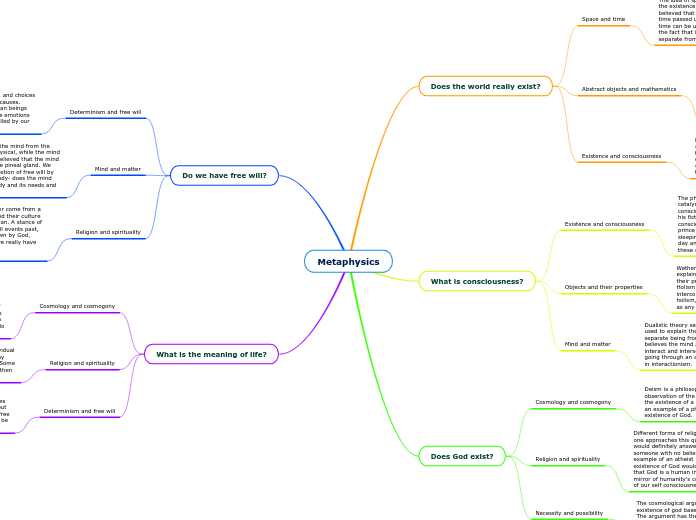
Space and time
The idea of space and time can be used to argue for or against the existence of the world. For example, Isaac Newton believed that space was was distinct from the body and that time passed uniformly no matter what. This theory of uniform time can be used to justify the existence of the world based on the fact that it adheres to a certain law, or rule, that is separate from humane consciousness.
A real life example could be when one is in a boring situation- like a particularly long math class, and it feels like the minutes are dragging by. However, for the same individual, time could feel like it is flying when they are spending time with friends. Is time actually moving very slow vs very fast, or is it just one's perception of time?
Abstract objects and mathematics
There are multiple theories that can be used to explain the existence or non existence of our world. For example, Plato introduced the idea of Platonic forms, which are abstract concepts that represent what each individual thing must have in order to be itself. This can be used to argue for the existence of the world because it grounds certain forms/ objects as "real"- and if those are existing, then everything else must exist too. Nominalism however, can be argue against the existence of the world- or at least the human interpretation of the world- because it denies the existence of certain categories like species and properties.
A real world example of nominalism is how a lot of categories humans make can easily be changed. For example, a platypus is still considered a mammal despite laying eggs.
Existence and consciousness
Locke stated that consciousness is inseparable from thought, and when we do something- wether it be hearing, smelling, tasting, or feeling, we know that we do so because of our consciousness observing and producing it's own ideas of what we are doing. This can be used to argue for the existence of the world because if we are experiencing it, then it must exist.
An example that could be used to argue for the existence of the world using Locke's theory is how we trust our senses to navigate the world. As of right now, existence is what it is and not believing that the world is real can seriously detriment ones experience in existence (if you believe that your floor is not real you might not want to get out of bed).
Existence and consciousness
The philosopher John Locke believed that consciousness is the catalyst for the idea of oneself. He believed that consciousness and soul were basically one, as seen in both of his fictional example scenarios- prince and cobbler (prince's consciousness goes into cobbler's body. The prince is still the prince despite physically being the cobbler) and waking/ sleeping socrates (socrates has two consciousness, one for day and one for night. Despite both being in the same body, these consciousnesses are two different entities).
An example of John Locke's theory on how consciousness and soul are one could be found in a book I had to read for English class once. In this novel, someone wakes up in a body that is not their own and has to navigate that other person's life while having no knowledge of their host's life or experiences. Later it turns out the main character's original body is in a coma and their consciousness/ soul had transferred to a different body.
Objects and their properties
Wether or not consciousness is separate from the body can be explained through the metaphysical abstraction of objects and their properties, and the theories surrounding this abstraction. Holism is the theory that states that the parts of a whole are interconnected and cannot be taken out of context. Using holism, one can reason that consciousness is just as physical as any other part of the body, and cannot be removed from it.
An example could be how we do not know what happens to the consciousness after death. If it is separate from a mortal body then it could pass onto some other plane of existence, but if it is just like any other part of our body then it dies when we die.
Mind and matter
Dualistic theory separates the mind from the body, and can be used to explain the mind, and therefore consciousness, as a separate being from the body. Interactionism is a theory that believes the mind and body to be separate, but that they interact and intersect with each other at times, like when going through an action like running. Descartes was a believer in interactionism.
A real life example for mind and matter is how the brain has different areas that serve different purposes. Some areas of the brain coordinate muscle movements, while other areas may control decision making, memory, and personality.
Cosmology and cosmogony
Deism is a philosophical theory that claims that reason and observation of the natural world can be used as evidence for the existence of a god. English philosopher Matthew Tindel is an example of a philosopher that used deism to justify the existence of God.
A real world example could be how there are certain events that are unexplained, such as the Ganesh drinking milk miracle of 1995. An occurrence like this one can be used to advocate for the existence of a deity.
Religion and spirituality
Different forms of religiousness and spirituality can alter how one approaches this question. Someone who believes in a God would definitely answer this question with "yes", while someone with no belief in a God would answer "no". An example of an atheist philosopher arguing against the existence of God would be Ludwig Feuerbach. Ludwig believed that God is a human invention. He explained that God is a mirror of humanity's consciousness, and is an alienated form of our self consciousness.
A real world example that could be used to argue against the existence of a God could be that a lot of deities tend to reflect the culture they are worshipped in, and often change with that culture. If ancient pantheons like the Greek or Egyptian can fall out of common worship, then chances are the same could happen to any modern religion.
Necessity and possibility
The cosmological argument is a theory that argues for the existence of god based on the fact of the existence of things. The argument has the theory that everything exists due to a cause, and that cause is a supernatural entity.
A real world example is Thomas Aquinas, who used a version of the cosmological argument to argue for the existence of God.
Determinism and free will
Determinism is the theory that all events, actions, and choices are predetermined based on previous events and causes. Spinoza was a philosopher that believed that human beings are determined. He believed that because we have emotions and a drive, we have no free will as we are controlled by our nature.
A real world example is how a lot of the time, our emotions come into play when we make decisions. Someone might get up and do their work if they are feeling productive or are panicking from procrastination. Some people make rash decisions when angry.
Mind and matter
Dualistic theory in philosophy separates the mind from the brain- stating that the brain is strictly physical, while the mind is not. However, philosopher Descartes believed that the mind could in fact control the brain through the pineal gland. We can use dualism to try to answer the question of free will by separating or conjoining the mind and body- does the mind have free will if it is controlled by the body and its needs and emotions?
Similarly to my last point, a real world example is how we need to perform certain functions to keep ourselves alive. If the choices that we make are often in response to what our physical self needs, is it really free will?
Religion and spirituality
A lot of western philosophers are monotheistic or come from a monotheistic background- meaning that they and their culture believe in one supreme God, which often Christian. A stance of predeterminism (or fatalism) would state that all events past, present, and future are predetermined and known by God, which can lead to the question of free will- do we really have free will if all of our actions are planned out and predetermined?
A real world example is how some people believe that the future is predetermined. If that is the case, then free will is unlikely to exist because if our lives are already planned out, it means that we only have one choice we can actually make and only the illusion of other choices (I hope that made sense).
Cosmology and cosmogony
Studying cosmology and the universe can help one find the meaning of life by contemplating if the universe's existence and creation has meaning or not. If one person comes to the conclusion that the world was created with a purpose by a higher being, then their meaning of life might become one of faith towards this higher power. If one decides that there was no higher being involved in the creation of the universe, then they might decide that the meaning of life is whatever they do to give it meaning.
An example could be how we do not actually know the answer to if there was a higher being involved in the creation of life. Because of this uncertainty, the meaning of life could be difficult to answer if based entirely on cosmology.
Religion and spirituality
Religion and spirituality can play a part into what an individual considers to be the meaning of life. For example, for many people the meaning of life could be found in their faiths. Some can find meaning in scholasticism, which drives to strengthen religious life and has an emphasis on traditionalism.
A real world example could be how some people's faiths drives what they believe the meaning of life is- they could decide that it is worshipping God, trying to get into heaven, etc.
Determinism and free will
Studying theories within determinism and free will can help answer the question to the meaning of life. One who believes in fatalism might believe that the meaning of life is to live out a series of predetermined events. Another who believes in free will might believe the meaning of life is to live your life and be human.