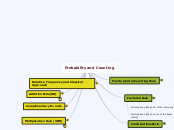
Probability and Counting

Fundamental Counting Rule

r

m*n=Number of ways that two events can occur given the first event can occur m ways and the second event can occur n ways.

Factorial Rule

r

n!=Number of different permutations(order counts/matters) of n different items when all n of them are selected

Permutations (When All of the items are Different)

r

nPr= the number of arrangements when n different items are available but only 'r are selected.

Permutations (When some of the items are identical to others)

r

n!/n1!n2!...nk!=number of different permutations (order matters) when n items are available and all n are selected without replacement but some of the items are identical to others. Ex. # of ways letters in a word can be arranged.

Combinations Rule

r

nCr= Number of different combinations (order does not count) when n different items are available, but only r of them are selected without replacement.

Relative Frequency and Classical Approach

r

P(A)= # of times A is observed/ total # of trialsp(A)=# of outcomes of A/total # of outcomes

Addition Rule(OR)

r

P(A or B)=P(A)+P(B)-P(A and B)

Mutually Exclusive Events

r

P(A or B)= P(A)+ P(B)

Complimentary Events

r

P(A)+P (compliment of A)=1P(A)=1-P(compliment of A)P(compliment of A)=1-P(A)

Multiplication Rule (AND)

r

P(A and B)=P(event occurs in a first trial and event B occurs in a second trial)P(B|A) represents the probability of event B occurring after it is assumed that event A has already occurred.

Independent

r

P(A and B) = P(A)*P(B)

Dependent

r

P(A and B) =P(A)*P(B|A)

Multiplication Rule Compliments and Conditional Probability

Probability of "At least One"

r

P(A)=1-P(compliment of A)

Conditional Probability

r

P(A and B)=P(A)*P(B|A)P(B|A)= P(A and B)/P(A)