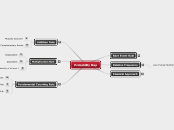
Probability Map

Rare Event Rule

r

If under a given assumption, the probability of a particular observed event is extremely small, we conclude that the assumption is probably not correct.

Relative Frequency

r

P(A)= Number of times A occurred/Total number of Trials

Law of Large Numbers

r

The more times an experiment is repeated the closer the relative frequency gets to Classical Probability.

Classical Approach

r

P(A)= Number of outcomes of A/Total number of Outcomes

Addition Rule

r

The probability that events A or B will occur.P(A or B) = P(A) + P(B)- P(A and B)Keyword: OR

Mutually Exclusive

r

P(A or B) = P(A) + P(B)

Rule of Complementary Events

r

All events that do not include AP(A) + P(Complement of A)P(A) = 1-P(Complement of A)P(Complement of A) = 1-P(A)

Multiplication Rule

r

Events happening togetherKeyword: ANDP(A and B) = P(A) * P(B)Conditional Probability-P(B given A) is read as "the probability of B given A"

Independent

r

The occurrence of A does not affect the probability of B.P(B Given A) = P(B)P(A Given B) = P(A)

Dependent

r

A and B are not IndependentP(A and B) = P(A) * P(B given A)P (A and B) = P(B) * P(A given B)

Probability of At least 1

r

P(at least 1___) = 1-P(O___)

Fundamental Counting Rule

r

The number of ways that two events can occur together of the first even can occur m ways and the second event can occur n ways is:m*n

Factorial Rule

r

The number of different permutations (order matters) of n different items when all n of them are selected is:n!

Combination Rule

r

The number of different combinations (order does not matter) when n different items are available, but only r of them are selected without replacements is:nCr

Permutation Rule

r

The number of arrangements when n different items are available but only r are selected:nPr