Rivers
Peninsular rivers
West flowing
Godavari
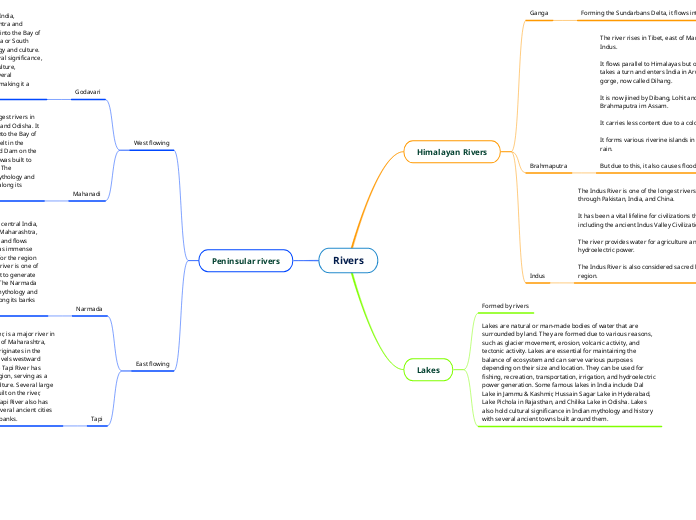
The Godavari River is one of the major rivers in India, originating from the Western Ghats in Maharashtra and flowing through several states before emptying into the Bay of Bengal. It is often referred to as Dakshina Ganga or South Ganges due to its significance in Hindu mythology and culture. The river carries enormous economic and cultural significance, serving as a source of irrigation water for agriculture, hydropower generation, and transportation. Several pilgrimage centers are located along its banks, making it a popular destination for devotees.
Mahanadi
The Mahanadi River is one of the largest and longest rivers in India, flowing through the states of Chhattisgarh and Odisha. It originates in the hills of Chhattisgarh and flows into the Bay of Bengal. The river supports a major agricultural belt in the region, providing water for irrigation. The Hirakud Dam on the river is one of the longest dams in the world and was built to control floods and generate hydroelectric power. The Mahanadi River also has significance in Hindu mythology and culture, with several pilgrimage centers located along its banks.
East flowing
Narmada
The Narmada River is one of the major rivers in central India, flowing through the states of Madhya Pradesh, Maharashtra, and Gujarat. It originates from the Maikala hills and flows westward towards the Arabian Sea. The river has immense cultural, ecological, and economic significance for the region and its people. The Sardar Sarovar Dam on the river is one of the largest dams in the world and has been built to generate hydroelectricity and irrigate agricultural lands. The Narmada River also holds spiritual significance in Hindu mythology and culture, with several pilgrimage sites located along its banks attracting thousands of devotees every year.
Tapi
The Tapi River, also known as the Tapti River, is a major river in central India that flows through the states of Maharashtra, Gujarat, and Madhya Pradesh. The river originates in the Satpura Range in Madhya Pradesh and travels westward before emptying into the Arabian Sea. The Tapi River has immense economic importance for the region, serving as a major source of irrigation water for agriculture. Several large hydroelectric power projects have been built on the river, generating electricity for the region. The Tapi River also has historical and cultural significance, with several ancient cities and archaeological sites located along its banks.
Himalayan Rivers
Ganga
The river Ganga is formed at Devprayag by the joining of Bhagirathi and Alaknanda in Uttrakhand.
At Haridwar, Ganga emerges from mountains on the plains.
It also joinsd by various tributaries such as Yamuna, Ghaghra, Gandak and Kosi.
It also recieves water from Chambal,Betwa and Son.
After receiving lots of water Ganga, bifurcates into Hoogly and Bhagirathi.
The main stream is joined hy Brahmaputra, now known as Meghna.
Forming the Sundarbans Delta, it flows into the Bay of Bengal.
Brahmaputra
The river rises in Tibet, east of Mansarovar Lake, close to Indus.
It flows parallel to Himalayas but on reaching namcha barwa it takes a turn and enters India in Arunachal Pradesh through a gorge, now called Dihang.
It is now jiined by Dibang, Lohit and other tributaries to form Brahmaputra im Assam.
It carries less content due to a cold and dry area.
It forms various riverine islands in Assam as it recieves heavy rain.
But due to this, it also causes floods and devastation.
Indus
The Indus River is one of the longest rivers in Asia, flowing through Pakistan, India, and China.
It has been a vital lifeline for civilizations throughout history, including the ancient Indus Valley Civilization.
The river provides water for agriculture and is a source of hydroelectric power.
The Indus River is also considered sacred by many in the region.
Lakes
Formed by rivers
Lakes are natural or man-made bodies of water that are surrounded by land. They are formed due to various reasons, such as glacier movement, erosion, volcanic activity, and tectonic activity. Lakes are essential for maintaining the balance of ecosystem and can serve various purposes depending on their size and location. They can be used for fishing, recreation, transportation, irrigation, and hydroelectric power generation. Some famous lakes in India include Dal Lake in Jammu & Kashmir, Hussain Sagar Lake in Hyderabad, Lake Pichola in Rajasthan, and Chilika Lake in Odisha. Lakes also hold cultural significance in Indian mythology and history with several ancient towns built around them.