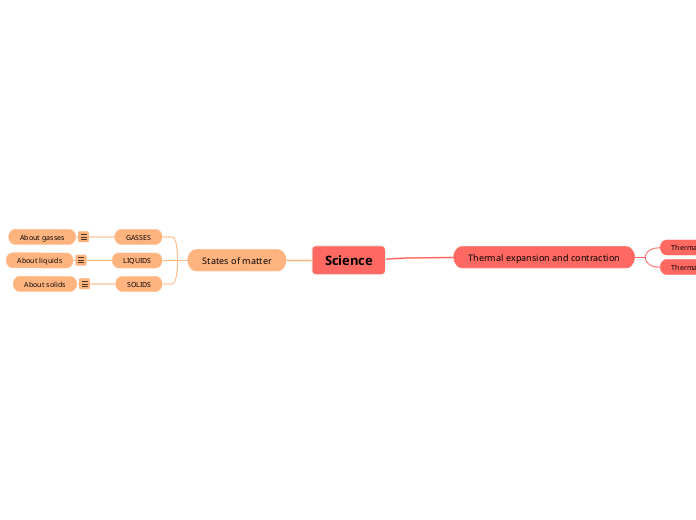
Science
Thermal expansion and contraction
Thermal contraction
Thermal contaction happens when you cool solids, liquids, and gasses, they decrease in volume because the particles traveled shorter distances by the cold.Examples of thermal contraction is..A bottle of water in the freezer will actually expand the bottle because water actually expands unlike other liquidsPower lines in the winter snap because the particles in them shrink waay too much.The air pressure in tires reduces by the winter's density.
dThermal expansion
When solids, liquids, or gasses are heated, the particles than start to speed up, than the faster moving particles take up more space, than that makes the substance increase in volume. Ways thermal expansion can happenA thermometer is an example because when it is hot, the liquid inside the thermometer expands.A tire in the summer expands by the sun radiating a lot of heat.In the summer, your front door will expand from the heats radiation causing it to expand and being hard to close.
States of matter
GASSES
About gasses
The force of attraction between the particles are very weak so they are basically free to move around by themselves.They don’t keep a definite shape or volume and instead will always fill a container as they spread out as much as possible Gasses move in straight lines so it isn’t random movement.When we heat up a gas and the particles get more energy and travel faster the gas will either expand if the container is expandable like a balloon, or if the container is fixed, then the pressure will just increase. If we cool the gas down the particles won’t have enough energy to overcome the force of attraction so than bonds will start to form between the particles condensing the gas into a liquid.
LIQUIDS
About liquids
Liquids have weaker forces of attraction so they are free to move around and are arranged randomly.The particles tend to stick together and are fairly compact (Definite volume)they can change shape to fit in a container.If we heat up the liquid it will gain more energy and it will make the particles move around faster which weakens the forces holding the particles together and once it reaches the boiling point the bonds will break and than it boils or evaporates into a gas.
SOLIDS
About solids
Solids have strong forces of attraction which holds them together (fixed position)Keeps a definite shape and volume.The particles can vibrate around.If we heat up solid particles they gain more energy and start to vibrate even more which weakens the forces between them.At a certain temperature/melting point the particles will have enough energy to break free of their bonds and the solid melts into a liquid.If we cool down a liquid the particles won’t have enough energy to overcome the attraction between the molecules and then even more bonds form fixing the particles into place, freezing the liquid into a solid. The particles in a solid that is melting move farther and farther apart because the particles have more energy and bump into each other more often.