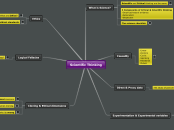
Scientific Thinking
What is Science?
Discovers the universe; how things work today, how they worked in the past, and how they will work in the future.
Scientific and Critical thinking are the same
Justifying knowledge to make it reliable is called the scientific method; Critical thinking is thinking in depth to be able to make successful decisions and come up with reliable answers to questions.
3 Components of Critical & Ccientific thinking
-Empirical/natural evidence
-Rationalism
-Skepticism
Empirical evidence is evidence that could be seen by others. This is critical as it makes experiments repeatable, making it available for others to check it when claims are being made. Rationalism is basing opinions on reason and knowledge rather on personal beliefs. Skepticism is continually doubting something, which could be a good thing because being skeptical helps a person be more aware and constantly trying to figure out the truth behind something.
The science checklist.
The Science Checklist:-Focuses on the natural world -Aims to explain the natural world -Relies on evidence-Involves the scientific community-Leads to ongoing research-Uses testable ideas-Benefits from scientific behaviour
Causality
-Linear
-Domino
-Cyclic
-Spiraling
-Relational
-Mutual
Linear: Direct link between cause and effect; effect can be linked back to one cause.Domino: an extended linear pattern that results in direct and indirect effects.Cyclic: repeating pattern. When one thing impacts another which impacts the first thing. Spiraling: One thing impacts another which in turn impacts the first thing, with amplification or de-amplification of effectsRelational: If one thing changes, so does the relationship, therefore so does the outcome.If two things change but keep the same relationship, the outcome doesn't change. Mutual: Two things impact each other, the causes and effects are often simultaneous, but can be sequential.
Direct & Proxy data
The study of past climates.
Scientists use proxy data to study past climates, these data have physical characteristics of the environment that are useful to scientists and provides information about the climate. For example, tree rings and ice cores.
Experimentation & Experimental variables
What are experiments?
Experiments are scientific procedures undertaken to test a hypothesis.For a fair experiment to be made results need to be compared, variables controlled and avoid bias.
Variables
Dependent: researcher manipulates an independent variable, to influence a dependent variableIndependent: the manipulated variableControlled: something that if changed may effect results
Double blind experiment
An experimental method ensuring that no errors arise from bias, both from the researcher and the patients. They both know less making it fair and bias free.
Ethics
What are Ethics?
Ethics are morals that affect a person's behaviour or decisions.
Five sources of ethical standards
The Utilitarian ApproachSome ethicists emphasise that the ethical action is the one that provides the most good or does the least harm. The Rights ApproachOther philosophers and ethicists suggest that the ethical action is the one that best protects and respects the moral rights of those affected. The Fairness or Justice ApproachAristotle and other Greek philosophers have contributed the idea that all equals should be treated equally. The Common Good ApproachThis approach suggests that the interlocking relationships of society are the basis of ethical reasoning and that respect and compassion for all others-especially the vulnerable-are requirements of such reasoning.The Virtue ApproachA very ancient approach to ethics is that ethical actions ought to be consistent with certain ideal virtues that provide for the full development of our humanity.
Logical Fallacies
What's a fallacy?
A fallacy is a mistaken belief or a failure in reasoning. There are various fallacies, for example the straw man fallacy which is attacking one's viewpoint instead of supporting his own. Other fallacies include: Slippery SlopeHasty GeneralizationPost hoc ergo propter hocGenetic FallacyBegging the ClaimCircular ArgumentAd hominemRed Herring
Cloning & Ethical dimensions
What is cloning, and its ethical concerns
Cloning is taking an organism and creating the same one with the same genetics. This is usually done by asexual reproduction but new and easier methods have been discovered. Ethical concerns of animal cloning: -Treating animals as commodities for human use. - Cloning animals is only a step towards cloning humans.
Human Cloning
1. Reproductive cloning – this would involve transfer of an adult nucleus with the intention of producing a child.2. Therapeutic cloning – this would involve creation of an embryo by cloning to use the totipotent stem cells in research into treatments for disability and disease.
Reproductive Cloning and why its wrong
-The ignored fact that embryos are humans. -The use of humans as if they're commodities -Production of designer babies, which devalues others.-Uncertainty about the health of anyone produced by cloning.-Interfering in the natural process of producing embryos.