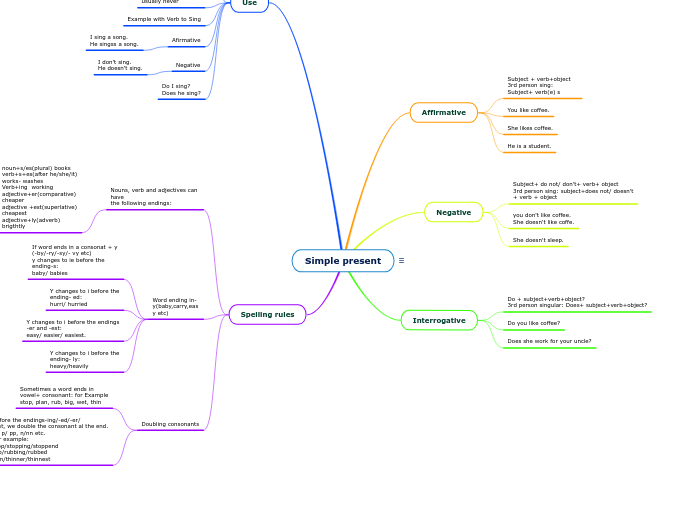
Simple present
Subject + verb+object 3rd person sing: Subject+ verb(e) s
You like coffee.
She likes coffee.
He is a student.
Subject+ do not/ don't+ verb+ object
3rd person sing: subject+does not/ doesn't
+ verb + object
you don't like coffee.
She doesn't like coffe.
She doesn't sleep.
Do + subject+verb+object?
3rd person singular: Does+ subject+verb+object?
Do you like coffee?
Does she work for your uncle?
Things That don't change
Permanet situation
Habitual or repeated
actions.
To say how often
we do things facts.
He, she, it add-(e) s
Key words
every day
once a month
Adverbs of frequency
often sometimes
usually never
Example with Verb to Sing
Afirmative
I sing a song.
He singss a song.
Negative
I don't sing.
He doesn't sing.
Do I sing?
Does he sing?
Nouns, verb and adjectives can have
the following endings:
noun+s/es(plural) books
verb+s+es(after he/she/it)
works- washes
Verb+ing working
adjective+er(comparative)
cheaper
adjective +est(superlative)
cheapest
adjective+ly(adverb)
brigthtly
Word ending in-y(baby,carry,easy etc)
If word ends in a consonat + y
(-by/-ry/-sy/- vy etc)
y changes to ie before the
ending-s:
baby/ babies
Y changes to i before the
ending- ed:
hurri/ hurried
Y changes to i before the endings
-er and -est:
easy/ easier/ easiest.
Y changes to i before the
ending- ly:
heavy/heavily
Doubling consonants
Sometimes a word ends in
vowel+ consonant: for Example
stop, plan, rub, big, wet, thin
Before the endings-ing/-ed/-er/
-est, we double the consonant al the end.
So p/ pp, n/nn etc.
For example:
stop/stopping/stoppend
rub/rubbing/rubbed
thin/thinner/thinnest