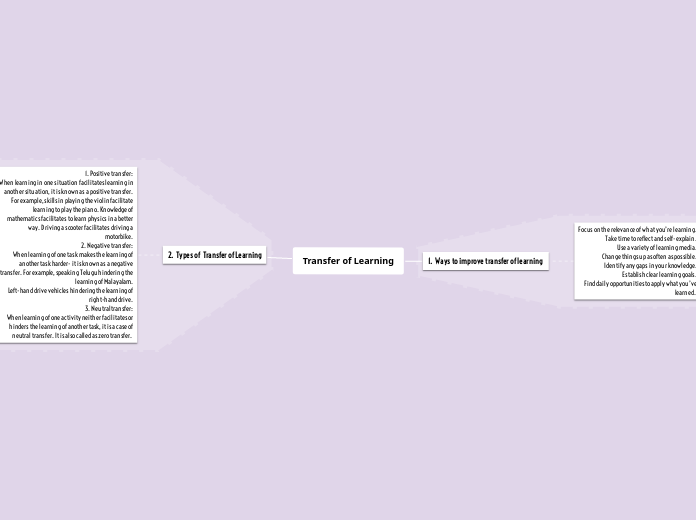
Focus on the relevance of what you’re learning.
Take time to reflect and self-explain.
Use a variety of learning media.
Change things up as often as possible.
Identify any gaps in your knowledge.
Establish clear learning goals.
Find daily opportunities to apply what you’ve
learned.
1. Positive transfer:
When learning in one situation facilitates learning in
another situation, it is known as a positive transfer.
For example, skills in playing the violin facilitate
learning to play the piano. Knowledge of
mathematics facilitates to learn physics in a better
way. Driving a scooter facilitates driving a
motorbike.
2. Negative transfer:
When learning of one task makes the learning of
another task harder- it is known as a negative
transfer. For example, speaking Telugu hindering the
learning of Malayalam.
Left-hand drive vehicles hindering the learning of
right-hand drive.
3. Neutral transfer:
When learning of one activity neither facilitates or
hinders the learning of another task, it is a case of
neutral transfer. It is also called as zero transfer.