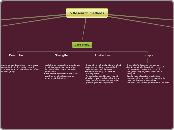
5 Research methods
Naturalistic Observation
Description
•Non-experimental approach
•Researchers carefully observe
and record phenomena and
behavior in its natural setting
•No interference with subjects
Strengths
•Observation occurs in subjects'
normal setting rather than the
artificial and limited setting of
the lab
•Using nature to prove theoretical
concepts and laboratory findings
•Studying nature for its own sake
Limitations
•Descriptive, not explanatory
method
•No controlled conditions
•Conclusions about cause and
effect relationships can't be
drawn
•Behavior can only be described,
not explained
•Takes a great amount of time
•Difficulty of observing behavior
without disrupting it
•Difficulty of coding results in a
manner appropriate for statistical
analysis
Example
•Are raptors (eagles of instance) capable
of hunting in packs?
•Dr. David Ellis describes a number of
observations in the wild in which birds
of prey were seen in cooperative hunting
•One time, two golden eagles were attacking
a fox; one of them distracted the fox while
the other attacked and killed the fox
Survey
Description
•Non-experimental, descriptive study
•Doesn't involve direct observation
•Inferences about behavior are made
from data collected via interviews
and questionnaires
•Interviews include an assortment of
forced-choice and open-ended questions
(self-report)
Strengths
•Useful when interested in collecting
data on aspects of behavior that are
difficult to observe directly (e.g. Suicide
thoughts)
•Useful when it is desirable to sample a
large number of subjects
Limitations
•Relies on a self-report method of
data collection
•Descriptive, not explanatory method
•Can't contribute to the cause and effect
reason
•Intentional deception, poor memory, or
misunderstanding of question could lead
to inaccuracies in the data
Example
•Frequence of sexual dysfunction in
"Normal" couple
•Frank, Anderson, and Rubenstein
surveyed a sample of 100 couples
to answer this question
•They were asked to report whether or
not particular sexual problems were
part of their relationship
Case Study
Description
•Non-experimental, descriptive type of study
•Involves an in-depth descriptive record
•Record is kept by an outside observer, of an
individual or group
Strengths
•Useful when researchers want to get
a detailed contextual view of an
individual's life or of a particular
phenomena
•Useful when researchers can't, for
practical or ethical reasons, do
experimental studies.
Limitations
•Descriptive, not explanatory method
•Conclusions about cause and effect
relationships can't be drawn
•Behavior can only be described,
not explained
•No controlled conditions of the lab
•Involve a single individual or just a
few, therefore can't represent the
general group or population
Example
•Huntington's disease in Venezuela
•Dr. Nancy Wexler has studied cases of
Huntington's disease in a group of
geographically adjacent venezuelan
villages
•Wexler was interested in collecting
extensive family pedigrees to determine
how the disease is transmitted
genetically from one generation to the next
Correlation
Description
•Non-experimental, descriptive method
•Described as method of research
•Described as a mathematical technique
for summarizing data
•Statistical tool
•Used to describe the degree and direction
of relationship between two or more
variables
•Variables aren't directly manipulated as in
experimental method
Strengths
•Used to determine if there is a
relationship between two variables
without having to directly manipulate
them
•It can be used when the experimental
method can't
•Used as a basis for prediction
•It can be used when it is impractical or
unethical to manipulate the variables
Limitations
•Does not tell the researchers
whether or not the relationship
is casual
•Correlation, does not, cannot,
prove causation
Example
•A close relationship: The Canadian
lynx, and the snowshoe hare
•Logic dictates that when the number
of prey animals increase, so does the
number of predators
•This relationship was clearly shown in
a population study of the numbers of
Canadian lynx's and Snowshoe hares
Experimental
Description
•Researcher manipulates a variable under
highly controlled conditions to see if this
produces any changes in the second
variable
•Manipulated variable is also called
independent variable
•Second variable, the one measured for
changes is called dependent variable
Strengths
•Allows researchers to detect the
cause and effect relationship of
nature
Limitations
•Can only be used when it's
practical and ethical to manipulate
the antecedent conditions
•Usually done in highly controlled
setting of the lab
•Conditions are artificial and may not
reflect what really happens in the
less controlled, more complex real
world
Example
•Psychology: effects of postevent information
on memory
•People were brought in and shown a movie
•Both were asked how fast the cars were going,
but half the group was told when they SMASHED
and the other when they HIT
•After a week, they were asked if they saw any
broken glass in the video
•Almost twice as many subjects who heard the word
"smashed", as opposed to "hit", reported having
seen broken glass
•There was no broken glass in the original video