Cultural anthropology - "the branch of anthropology concerned with the study of human societies and cultures and their development" (Oxford). Can be further divided.
Social anthropology (ethnology) is the study of the characteristics of various peoples and the differences and relationships between them (Oxford.)
Archaeology is the study of human history and prehistory through the excavation of sites and the analysis of artifacts and other physical remains (Oxford).
Linguistic anthropology is an interdisciplinary field dedicated to the study of language as a cultural resource and speaking as a cultural practice (Oakland University).
Physical anthropology - "the branch of anthropology concerned with the study of human biological and physiological characteristics and their development" (Oxford). Can be further divided.
Paleoanthropology is a branch of Anthro that is the study of human evolution through the fossil and archaeological records (UCDavis).
Forensic anthropology is a special sub-field that involves applying skeletal analysis and techniques in archaeology to solving criminal cases (Forensic).
Primatology is the study of the behavior, biology, evolution, and taxonomy of nonhuman primates (Central Washington University).
Some famous anthropologists include: Noam Chomksy, Charles Darwin, Jane Goodall, the Leakys, Margaret Mead, Edward Sapir, Marvin Harris, and Richard Less.
Important anthropological theories include: evolutionism, diffusionism, historical particularism, functionalism, culture and personality, structuralism, neo-evolutionism, cultural ecology, cultural materialism, postmodernist and feminist explanations (Nurazzura).
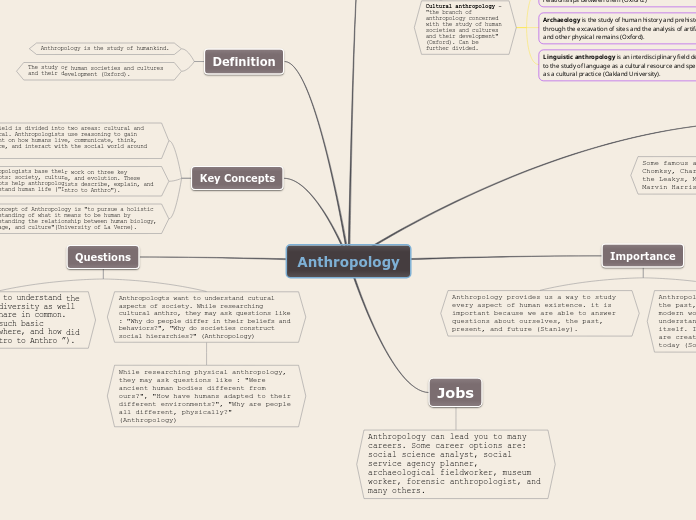
Anthropology provides us a way to study every aspect of human existence. it is important because we are able to answer questions about ourselves, the past, present, and future (Stanley).
Anthropology gives us an understanding of the past, but it is important even in the modern world because it helps us understand how our society organizes itself. It teaches us how social systems are created and how they affect our world today (Social).
Anthropology can lead you to many careers. Some career options are: social science analyst, social service agency planner, archaeological fieldworker, museum worker, forensic anthropologist, and many others.
Anthropology is the study of humankind.
The study of human societies and cultures and their development (Oxford).
The field is divided into two areas: cultural and physical. Anthropologists use reasoning to gain insight on how humans live, communicate, think, produce, and interact with the social world around them.
Anthropologists base their work on three key concepts: society, culture, and evolution. These concepts help anthropologists describe, explain, and understand human life ("Intro to Anthro").
The concept of Anthropology is "to pursue a holistic understanding of what it means to be human by understanding the relationship between human biology, language, and culture"(University of La Verne).
"Anthropologists try to understand the full range of human diversity as well as what all people share in common. Anthropologists ask such basic questions as: When, where, and how did humans evolve?" (“Intro to Anthro ”).
Anthropologts want to understand cutural aspects of society. While researching cultural anthro, they may ask questions like : "Why do people differ in their beliefs and behaviors?", "Why do societies construct social hierarchies?" (Anthropology)
While researching physical anthropology, they may ask questions like : "Were ancient human bodies different from ours?", "How have humans adapted to their different environments?", "Why are people all different, physically?" (Anthropology)