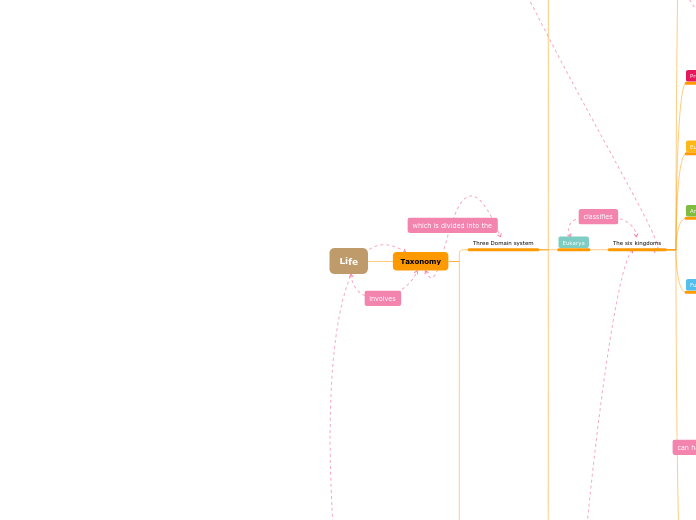
Three Domain system
Bacteria
Eukarya
The six kingdoms
Plants
Can be vascular or non-vascular
Vascular
Roots
- Absorbs water and nutrients and serves as a pantry of left over food. Keeps plant anchored in the ground.
Stem
- Contains structures that transport fluids from nutrients and also is home to specialized cells called meristems.
Leaf
- Plant exchanges gases with the atmosphere and collects sunlight to manufacture food.
Ground Tissue
Parenchyma, collenchyma, sclerenchyma
Dermal Tissue
Epidermal Cells, Stomata, Trichomes
Vascular Tissue
Phloem
- Conducts food from leaves to all parts of the plant.
- Contains sieve tubes which contains companion cells.
- Transports dissolved sugars from the leaves to the other parts of the plant.
- This requires, diffusion, active transport, and osmosis
Xylem
- Xylem tissue transports water and dissolved minerals to leaves.
- Contains tracheids and vessel elements only found in the angiosperm.
- reproduce asexually and sexually
- use specialized tissue for transporting food and water to different areas of the plant
- Have a root system, shoot system, and vascular system
Non-Vascular
- Do not contain vascular system
- Do not have phloem or xylem or the vessel that aids in transporting food
- Reproduce sexually by creating spores and asexually by vegetative propagation
-they must be located in damp areas.
- Instead of using roots to draw up moisture, each cell obtains its water through osmosis directly from the environment.
- Since they don’t have phloem, sugars cannot be transported around the plant.
-Each cell needs the ability to undergo photosynthesis to create the sugars it requires. For this reason, these plants don’t have leaves.
Algae
Bryophyta (moss)
- Eukaryotic
- Autotrophs
- Are multicellular
- Plant tissue can be meristematic or permanent
- They can reproduce both sexually and asexually through the transference of seeds/pollen
Magnoliophyta (flowering plants)
Bryophyta (moss)
tracheophyta (fern)
Photosynthesis
Photosynthesis is a process used by plants and other organisms to convert light energy into chemical energy that can later be released to fuel the organisms' activities.
6CO2 + 6H20 + (energy) → C6H12O6 + 6O2 Carbon dioxide + water + energy from light produces glucose and oxygen.
Gas Exchange
Gases diffuse into the intercellular spaces of the leaf through pores called the stomata
Stomata
Stomata are small pores on the surfaces of leaves and stems, that control the exchange of gases between the interior of the leaf and the atmosphere.
Guard Cells
Guard cells have a very important job because by opening and closing stomata, they facilitate gas exchange for photosynthesis and help minimize water loss
Protists
- Can be unicellular or multicellular
- Both autotrophs and heterotroph
- Eukaryotes
- some have a cell wall and cholorplast
- Characterized through 3 types of protists : animal like, fungi like, plant like
- Have no tissues and metabolisms can either be phototrophs or organotrophs
- Reproduce asexually through binary fission but also reproduce sexually
- Can be photosynthetic
Amoeba
Sea Lettuce (Ulva species) (in group phylum chlorophytha)
Eubacteria
- Prokaryotes with a cell wall
- Can be autotrophic or heterotrophic
- reproduce asexually through binary fission
- many different shapes and sizes
- bacterial shapes such as Spirillum, Staphylo, Strepto, Diplo, Coccus, and Bacillus
Escherichia coli
Archaea bacteria
- Prokaryotes with a cell wall
- Autotrophs
- Unicellular
- reproduce through binary fission
- able to survive in extreme conditions
- can be Methanogens, Thermophiles, Psychrophiles, Halophiles
- Cell membranes have a unique structure
- Are small
Extreme Thermophiles
Fungi
- Can be classified as Zygomycota, Ascomycota, and, basidiomycota
- Some are unicellular while others are multicellular
- Eukaryotic
- Reproduce asexually by budding, spores, or fragmentation and sexually
- All of them are heterotrophic
- are free-living in soil or water while others form parasitic or symbiotic relationships with plants or animals
Agaricus bisporus (mushrooms)
Saccharomyces cerevisiae (yeast)
Lycoperdon peralatum (puffballs)
Animals
Circulatory Systems
Double Closed
Blood always stays entirely inside the vessels
Tissue fluid allows heart to pump blood at a higher pressure meaning it can deliver oxygen and nutrients more quickly and remove waste products quicker.
Spheniscidae (a penguin)
Single Closed
Blood flows through the heart once during each circulation of the body
Amphiprioninae (clownfish)
Open
The blood is not always held within blood vessels
Instead, the blood fluid circulates through the body cavity, so the tissues and cells of the animal are bathed directly in blood
Bombus Polaris (arctic bumble bee)
There is a muscular pumping organ much like a heart. Lies just under the dorsal surface of the insect.
- Eukaryotic
- All are multicellular
- Heterotrophs
- Reproduce through sexual reproduction
- Cells do not have cell walls or chloroplasts
- Have different tissues including, connective, nervous, muscular, epithelial which can then be further broken down
- Have 1 of 3 circulatory systems
- Perform cellular respiration
- Have a respiratory system in order to help with gas exchange through the alveoli
Loxodonta (elephant)
Felis catus (cat)
Canis lupus familiaris (dog)
Gas exchange
Mammals, bird, and reptiles gas exchange through their lungs using the respiratory system
The Respiratory System
mouth and nose
Trachea
Branches of the left and right bronchi
Bronchioles
Alveoli
air is in very close proximity to the vessels that surround the alveoli, allowing diffusion between the small air sacs and the blood to occur.
Oxygenated blood within the blood vessel gets diffused in the bloodstream to be taken to cells for cellular respiration
Cell blood vessel interface occurs
Capilaries allows the O2 from the red blood cells to diffuse across the semipermeable membrane of the vessels, through the cell membrane, and into the cell for cellular respiration
Cellular Respiration occurs
processes that take place in the cells of organisms to convert chemical energy from oxygen molecules or nutrients into adenosine triphosphate, and then release waste products
C6H12O6 + 6O2 --> 6CO2 + 6H2O + ATP
Amphibians
Exchange gas through skin
Fish
Exchange gas through gills
Diffusion
Diffusion is the movement of a substance from an area of high concentration to an area of low concentration. Plays a role in how gas exchange occurs
This process is what enables oxygen from the environment to enter the blood in more complex animals and ultimately, the cells. It also allows for the waste gas CO2 to be removed from the body.
Archaea
Binomial nomenclature
a formal system of naming species of living things by giving each a name composed of two parts, both of which use Latin grammatical forms