Globally
-carbon pricing to reduce the use of fossil fuel and gas
-educate everyone about the world's outcome is noting is done to reduce climate change
-plant more trees around the world to replace the extreme deforestation
-Countries with better economies should help the developing countries to transition to green energy
Nationally
-create laws that protect the land from deforestation
-Assist large companies and businesses to lower carbon emissions
-setting energy-efficient appliance standards and programs
-supporting home and building retrofit programs across Canada, such as the Low Carbon Economy Fund and the Climate Action Incentive Fund
-developing cleaner fuels for vehicles
-increasing investment in renewable energy
Provincally
-build green infrastructure
-help businesses transition to becoming energy efficient
-create incentive programs to lower emissions
-zero-emissions vehicle actions
-research more energy-efficient technology
Indivisually
-reduce food waste
-consume a lesser amount of dairy products
-not buying food that has to be transported using planes (buy local)
-use lesser electricity and water
-walking, biking or taking the bus instead of using the car to get to places
Natural causes
Volcanic activity
Releases carbon dioxide into the atmosphere and may destroy nature surrounding it.
Solar output
The Sun produces different amounts of energy and this gradually changes over time. Currently the Sun has been producing more heat now compared to the past.
Human activity
Deforestation
Forests are carbon sinks and when they are cut down they release carbon dioxide into the air.
Burning fossil fuels
Humans burn fossil fuels such as coal, gas and gas for electricity, heat and transportation.
Farming livestock
cattle, buffalo, sheep, and cows are major emitters of methane. Food production has been increasing and so has the number of livestock being farmed.
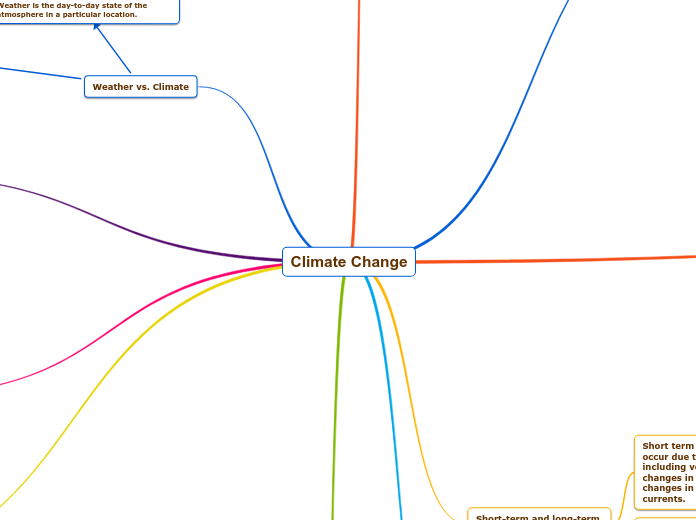
Short term variation in climate occur due to a variety of factors, including volcanic eruptions, small changes in the Sun's radiation, changes in the air and ocean currents.
Some long-term effects that scientists have predicted are that sea ice will decrease and permafrost thawing will increase. There will be an increase in heat waves and heavy precipitation. As well as decreases water resources in semi-arid regions.
Climate change is changing weather conditions. There has been an increase in super storms, floods, heavy rain etc. Greenland has been losing sheets 5x more than it was 25 years ago.
Animals are struggling to adapt and many are becoming endangered. An example of this are that hundreds of bats were found dead in Australia because of the temperature increase. The bat's previous methods for dealing with heat waves were ineffective.
Earth's hotter temperature is creating more droughts, heat waves and wild fires. In 2018 more than 1.8 million acres of California was burned by wild fires and in 2019, 7,860 fires were recorded in California.
Ocean acidification
The amount of carbon dioxide that is being absorbed by the upper layer of the oceans is increasing by about 2 billion tons per year.
Extreme events such as hurricanes and intense rainfall
The world has been facing an increase in extreme events such as droughts, heavy rainfall, hurricanes, floods and many more because of climate change and the increase in global temperature.
Declining arctic sea ice
The arctic sea ice has been rapidly declining over the past several decades.
Seal level rise
The rate of global sea level rise has nearly doubled in the last two decades compared to the last century and it is still accelerating every year.
Glacial retreat
Glaciers all over the world have been retreating. Glaciers in the Alps, Himalayas, Andes Rockies etc. have been retreating.
Warming oceans
The temperature of the upper few meters of the ocean has only increased about 0.13 degrees Celsius per decade over the last 100 years but the IPCC's 2013 report has predicted that the global ocean temperature will increase by 1-4 degrees by 2100.
Increase in global temperature
The planet's average surface temperature has risen about 1.62 degrees Fahrenheit or 0.9 degrees Celsius since the late 19th century.
Shrinking ice sheets
Data from NASA's Gravity Recovery and Climate Experiment has shown that Greenland has lost on average 286 billion tons of ice per year between 1993 and 2016. Antarctica has lost about 127 billion tons of ice between the same period.
Decreased snow cover
Satellite observations by NASA have revealed that snow cover in the Northern Hemisphere has decreased over the past fiver decades. The snow has also been melting earlier.
Weather is the day-to-day state of the atmosphere in a particular location.
The weather can be described using temperature, precipitation, humidity, fog, cloud cover, atmospheric pressure, wind speed.
Climate refers to the long-term atmospheric conditions of a region. This data is typically averaged over a period of 30 years.
Climate zones are areas with a
distinct climate.
The four main climate zones are:
-arctic
-temperate
-subtropical
-tropical
Ecoregions are climate zones which
focus on the ecology of a region.
Based on landforms, soil, plants, animals and climate.
Ozone
The ozone is a layer in the stratosphere that blocks UV radiation from the Sun from reaching the Earth's surface.
Lithosphere
The Earth's crust it is the part of the climate system that is made of solid rock, soil and minerals. It largely absorbs the heat from the sun and can also reflect a small amount.
Hydrosphere
All the water on Earth. This includes, liquid water, water vapor,and ice. The water absorbs heat and also reflects some. Ice largely reflects the heat.
Atmosphere
Layer of gases surrounding Earth, also contain aerosols that absorb and reflect energy form the Sun.
living things (biosphere)
All organism are apart of the climate system. Plants and animals can change the relative amounts of gases in the atmosphere.
Negative feedback loop
A negative feedback loop reduces the effect of change and helps maintain balance.
An example of negative feedback is increased cloud cover. As warming increases more water evaporates and increases cloudiness. The clouds then reflect the solar radiation and decrease warming.
Positive feedback loop
A positive feedback loop occurs in nature when the product of a reaction leads to an increase in that reaction
An example of this loop is the albedo effect. As snow melts more dark ground is exposed, which in turn causes more heat to be absorbed and makes more snow to melt.
The greenhouse effect occurs when the greenhouse gases cause more energy to be kept near the Earth instead of being emitted back into space.
Warmer conditions will probably lead to more evaporation and precipitation overall, however different regions may vary and some may become wetter while others become dryer.
Overall, Earth will become warmer and cause some places to become hotter than they already are and other places that are usually cooler will become warmer as well.
A stronger greenhouse effect will warm the oceans and partially melt glaciers and other ice, increasing sea level. Ocean water also will expand if it warms, contributing further to sea level rise.
Some crops and other plants may respond favorably to increased atmospheric carbon dioxide, they will grow more vigorously and use water more efficiently.
The rising temperature will affect ecosystem and cause many plants and animals to go extinct.