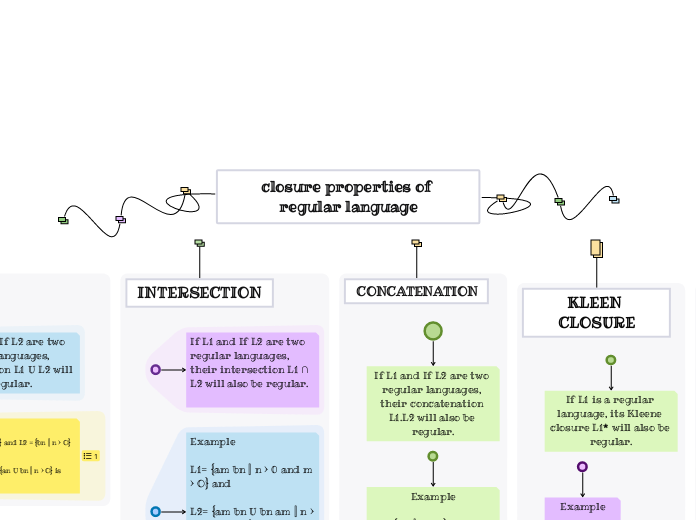
UNION
If L1 and If L2 are two regular languages, their union L1 U L2 will also be regular.
Example
L1 = {an | n > O} and L2 = {bn | n > O}
L3 = L1 U L2 = {an U bn | n > O} is also regular.
INTERSECTION
If L1 and If L2 are two regular languages, their intersection L1 ∩ L2 will also be regular.
Example
L1= {am bn | n > 0 and m > O} and
L2= {am bn U bn am | n > 0 and m > O}
L3 = L1 ∩ L2 = {am bn | n > 0 and m > O} are also regular.
CONCATENATION
If L1 and If L2 are two regular languages, their concatenation L1.L2 will also be regular.
Example
L1 = {an | n > 0} and L2 = {bn | n > O}
L3 = L1.L2 = {am . bn | m > 0 and n > O} is also regular.
KLEEN CLOSURE
Example
L1 = (a U b )
L1* = (a U b)*
If L1 is a regular language, its Kleene closure L1* will also be regular.
COMPLEMENT
Example
L(G) = {an | n > 3} L'(G) = {an | n <= 3}
If L(G) is a regular language, its complement L'(G) will also be regular. Complement of a language can be found by subtracting strings which are in L(G) from all possible strings.