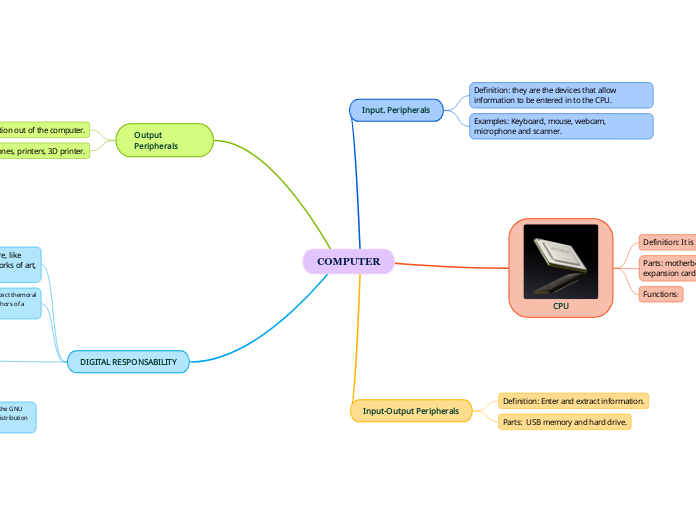
COMPUTER
Input. Peripherals
Definition: they are the devices that allow information to be entered in to the CPU.
Examples: Keyboard, mouse, webcam, microphone and scanner.
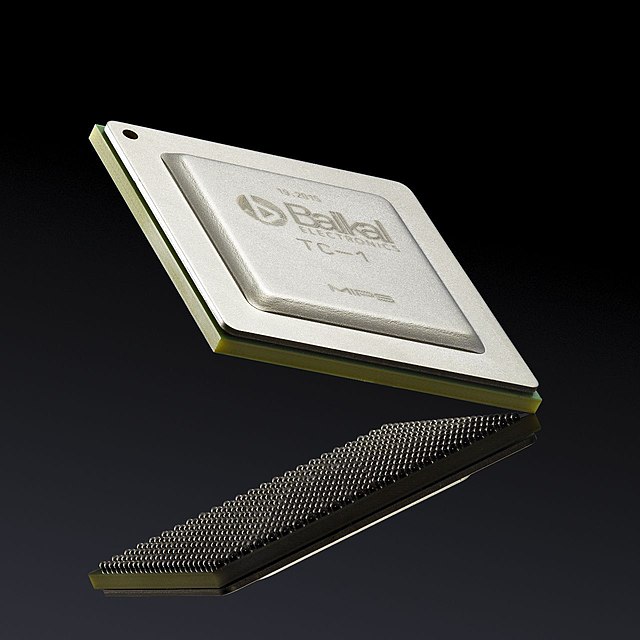
CPU
Definition: It is the "brain" of the computer .
Parts: motherboard, microphone, main memory, expansion cards.
Functions:
Input-Output Peripherals
Definition: Enter and extract information.
Parts: USB memory and hard drive.
Output Peripherals
Definitions: Take information out of the computer.
Parts: Screen, headphones, printers, 3D printer.
DIGITAL RESPONSABILITY
It is very important to know that software, like other artistic creations (books, songs, works of art, etc.), is protected by copyright law.
Copyright means the rules and principles that protect themoral and economic rights recognised by law for the authors of a published or unpublished work.
TYPES OF SOFTWERE
FREE SOFTWERE
Can be freely used, copied, modified and redistributed.
EX: LibreOffice, gimp, Audacity.
COMMERCIAL SOFTWERE
Companys softwere sold for profit. Sometimes called propietary softwere.
EX: microsoft Office, windows 10.
COPYLEFT
User licence that accompanies free software so it can be modified or redistribuated.
FREEWARE
Software with no monetary cost but which is not free. It is proprietary ry software.
EX: Avast, Adobe Flash Player.
GNU/GPL (general public license)
Licence that accompanies packages distribuyed by the GNU proyect. Author reserves the rights and permits redistribution and modification under the same licence.