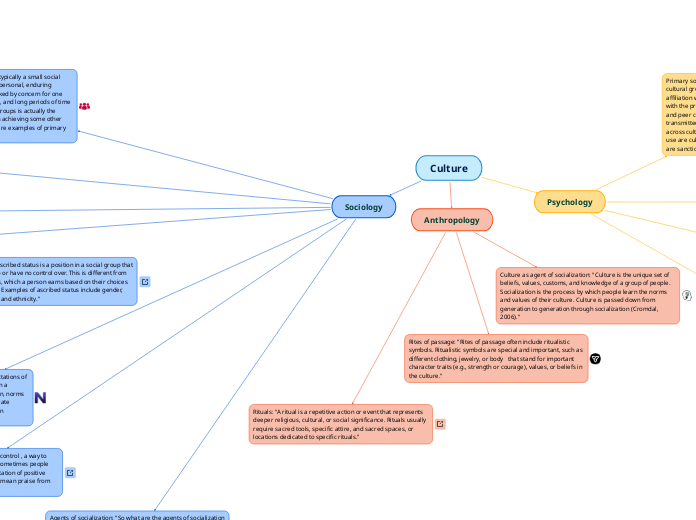
Culture
Sociology
Primary groups: "A primary group is typically a small social group whose members share close, personal, enduring relationships. These groups are marked by concern for one another, shared activities and culture, and long periods of time spent together. The goal of primary groups is actually the relationships themselves rather than achieving some other purpose. Families and close friends are examples of primary groups."
Secondary groups: "Secondary groups are large groups whose relationships are impersonal and goal oriented; their relationships are temporary." (I could not find any connections to culture in secondary groups.)
Roles: "Social roles exist and have existed in all known cultures around the world and throughout history. They provide each individual person with certain tasks and responsibilities that allow the collective unit, whether it be family, country, etc. to function effectively."
Status
Achieved: "Achieved status is a term often seen in sociological contexts and describes an individual's role in society. Although it is not a strictly business concept, it has far-reaching implications in the business hierarchy and work environment. Learning about achieved status may help you understand more about company work culture, which may influence your job choices and be useful as you progress in your career." Example: A Bat Mitzvah is achieved once a young individual becomes of age.
Ascribed: "An ascribed status is a position in a social group that one is born into or have no control over. This is different from achieved status, which a person earns based on their choices or their efforts. Examples of ascribed status include gender, eye color, race, and ethnicity."
Norms: "Social and cultural norms are rules or expectations of behavior and thoughts based on shared beliefs within a specific cultural or social group. While often unspoken, norms offer social standards for appropriate and inappropriate behavior that govern what is (and is not) acceptable in interactions among people."
Sanctions: "Sanctions are a form of social control , a way to encourage conformity to cultural norms. Sometimes people conform to norms in anticipation or expectation of positive sanctions: good grades, for instance, may mean praise from parents and teachers."
Agents of socialization: "So what are the agents of socialization specifically? The primary agents are family, schools and daycares, peers, and media. Other agents of socialization include religion and ethnicity, political groups, work, neighborhoods, social activities, and institutions."
Anthropology
Rituals: "A ritual is a repetitive action or event that represents deeper religious, cultural, or social significance. Rituals usually require sacred tools, specific attire, and sacred spaces, or locations dedicated to specific rituals."
Rites of passage: "Rites of passage often include ritualistic symbols. Ritualistic symbols are special and important, such as different clothing, jewelry, or body that stand for important character traits (e.g., strength or courage), values, or beliefs in the culture."
Culture as agent of socialization: "Culture is the unique set of beliefs, values, customs, and knowledge of a group of people. Socialization is the process by which people learn the norms and values of their culture. Culture is passed down from generation to generation through socialization (Cromdal, 2006)."
Psychology
Primary socialization: "Ethnicity, perceived membership in a cultural group, and cultural identification, the strength of one's affiliation with a group, develop primarily through interactions with the primary socialization sources, the family, the school, and peer clusters. Cultural norms for substance use are also transmitted as part of these interactions. Substance use differs across cultures; in different cultures some forms of substance use are culturally required, others are tolerated, and others are sanctioned."
Secondary socialization: "Secondary socialisation takes place when a child learns the values, beliefs and attitudes of their culture through those outside of the family, such as teachers, friends and the media." (I chose this quote because it explains how you can learn a culture outside of your primary group.)
Anticipatory socialization: "Anticipatory Socialization Examples.
Students taking an internship at their desired workplace: Students often take internships with companies that they want to work at in the future. As they work in the role, they learn the culture of the company and how they fit in there." There is a whole other culture that is part of what they want to join that they will need to learn to be able to learn how things work there.
Resocialization: "With the exception of tattoos, any representations of material culture such as piercings or jewelry, is removed. The resocialization process continues as one learns the systems of value and social norms necessary for survival in this type of total institution."