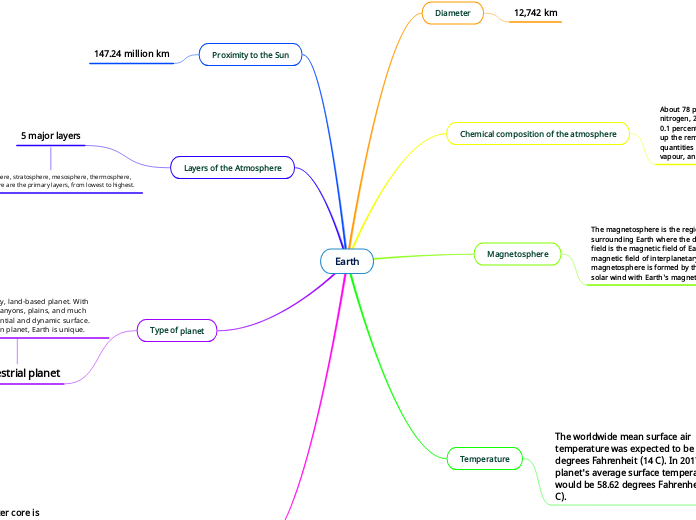
12,742 km
About 78 percent of the atmosphere contains nitrogen, 21% is oxygen, 0.9 percent is argon, and 0.1 percent is other gases. Other gases that make up the remaining 0.1 percent include trace quantities of carbon dioxide, methane, water vapour, and neon.
The magnetosphere is the region of space surrounding Earth where the dominant magnetic field is the magnetic field of Earth, rather than the magnetic field of interplanetary space. The magnetosphere is formed by the interaction of the solar wind with Earth's magnetic field.
The worldwide mean surface air temperature was expected to be 57 degrees Fahrenheit (14 C). In 2017, the planet's average surface temperature would be 58.62 degrees Fahrenheit (14.9 C).
147.24 million km
5 major layers
The troposphere, stratosphere, mesosphere, thermosphere, and exosphere are the primary layers, from lowest to highest.
Terrestrial planet
Planet Earth is a rocky, land-based planet. With mountains, valleys, canyons, plains, and much more, it has a substantial and dynamic surface. Because it is an ocean planet, Earth is unique.
The inner core is solid, the outer core is liquid, and the mantle is solid/plastic.
This is owing to the distinct layers' respective melting points (nickel–iron core, silicate crust, and mantle), as well as the rise in temperature and pressure as depth rises.