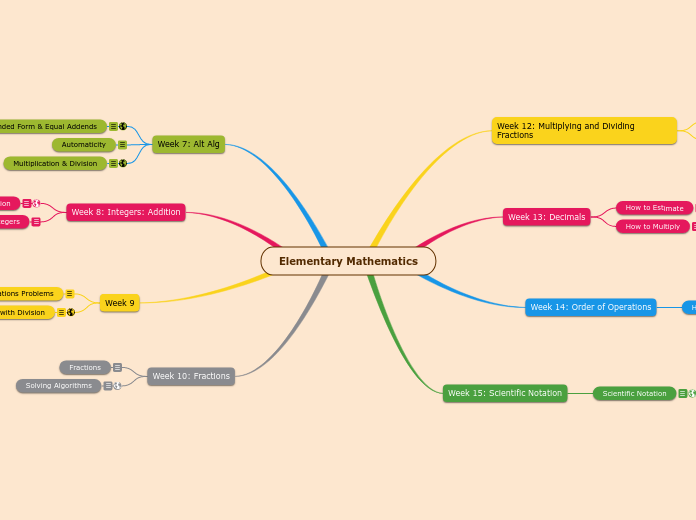
Multiplying Fractions
Multiplication is simple when it comes to basic fractions.Say we have 1/4 multiplied by 2/5. We would multiply 1 x 2 in order to solve for the numerator. This would be 2. Then we would multiply 4 x 5 to get the denominator. this would be 20. Our new fraction is 2/20, which could be simplified to 1/10.Another problem we can try is 9/13 multiplied by 4/7. First we do 9 x 4 which is 36. Next we do 13 x 7 which is 91. Our new fraction is 36/91. I have also provided a video which shows how to multiply fractions with whole numbers since it is difficult to show on a power point.
Dividing Fractions
I have provided a video for this one as well because the fractions kept getting jumbled when i would exit out of the notes and it just became confusing. I am also linking a few videos here since I can only do one hyper link.https://www.youtube.com/watch?v=uMTqaEbXQ6khttps://www.mathsisfun.com/fractions_division.htmlhttps://www.khanacademy.org/math/cc-sixth-grade-math/cc-6th-arithmetic-operations/cc-6th-dividing-fractions/v/dividing-fractions-example#:~:text=Dividing%20two%20fractions%20is%20the,Then%2C%20multiply%20the%20two%20denominators.
aHow to Estimate
EstimatingWhen we estimate decimals, we are essentially rounding the numbers to see what the closest whole number will be.We round so that way it is easier to determine whether or not our answer is corrects. Ex: 40.85 + 22.20Estimate: 41 + 22= 634 0. 8 52 2. 2 0-----------6 3. 0 5Now we can try one where we don't have the same amount of whole numbers. Instead of lining up the decimals, we will line up whole numbers first so there is no confusion.Ex: 35.70 + 4.50 Estimate: 36 + 5 = 413 5. 7 00 4. 5 0-----------4 0. 2 0
How to Multiply
Multiplying decimals is almost the same as multiplying regular numbers. Say we have (3.45)(1.2). We are going to arrange the problem as if the decimal points are not there and then add the decimal point to the solution at the end.3 4 51 2-----------6 9 03 4 5 0------------4 1 4 0Then we add the decimal which would give us 4.14.The decimal goes in the same place that the numbers we are multiplying go.*this way of multiplying only applies to numbers greater than 1.
How to do Order of Operations
What is Order of Operations?Order of operations is the correct way in which someone solves a problem that has multiple steps. This means if there is more than one step, such as a problem that has addition, subtraction, and division. Ex: 12 + 8 (4 + 2 x 6) - 18First we solve the parenthesis ( 4 + 2 x 6)Within the parenthesis we will do multiplication first. 2 x 6 = 12Then, we will add 4 + 12 which is 16. Now our new equation is 12 + 8 (16) - 18We will do the multiplication first again, which is 8 x 16 = 128.Finally, we have 12 + 128 - 18.12 + 128 = 140140 - 18 = 122Our solution is 122!
Scientific Notation
Why do we use scientific notation?Scientific notation is used for when writing really big or really small numbers. For example instead of writing 0.00000000032 we would write 3.2 x 10 ^-10.3 different components to scientific notation Number always has to be between 1 and 10Exponent is positive for big numbers, negative for small numbersAlways multiplying by 10 RulesAny number bigger than 1 will always have a positive exponent.Any number between 0 & 1 will have negative exponent.A negative exponent means the number will be a decimal.A positive exponent means the number will be large.
Subtraction: Expanded Form & Equal Addends
Expanded Form: Breaking down Equation to make simpler.Ex: 758- 241(700+50+8)-(200+40+1)First step: 700-200= 500Second Step: 50-40= 10Third Step: 8-1= 7Finally, you would put the 500+10+7 together, which gives us a final answer of 517.Equal Addends: Adding on to each given number in order to make it simpler to subtract. You must add the same number to each given number in order to maintain the correct answer.Ex: 828- 325For this example I am going to add 5 to both 828 and 325. The equation is now 833- 330. For this we could use expanded form in order to easily solve the equation.833-330(800+30+3)- (300+ 30+0)800-300= 50030-30= 03-0=3=503
Automaticity
What is automaticity?Automaticity is the ability to learn and retain information.How do we teach automaticity?First we teach 1,2,5, 10. These are the simplest numbers and are easiest ti find numbers that are divisible by these numbers.Any number is divisible by 1.Any number that ends in 0,2,4,6, or 8 is divisible by 2.Any number that ends in 0 or 5 is divisible by 5Any number that ends in 0 is divisible by 10.Next we teach 3, 9, & doubles.You know any number is divisible by 3 or 9 if the sum of all the digits in the number added together equal a number that is divisible by 3 or 9.Ex: 342, 3 + 4+ 2 = 9, which is divisible by 3 and it is also divisible by 9.Finally, we teach 4, 6, 7, & 8.Any number is divisible by 4 if the last two numbers are divisible by 4. Ex: 5436 is divisible by 4 because 36, the last two numbers are divisible by 4....36/4=8If a number is divisible by 6 then the rules for 2 & 3 must work. If the three digits divide by 8 then the number is divisible by 8.
Multiplication & Division
Expanded Form: break apart the numbers to see a simpler way of multiplyingEx:32x2230 + 220 + 2-----------First: 2 x 2 = 4Then: 2 x 30 = 60Next: 20 x 2 = 40Finally: 20 x 30 = 600After, all the steps are complete for the multiplication, you will add the sums of each number to get the final answer.600 + 60 + 40 + 4 = 704Left-to-Right: This is a simplified form of Expanded form. You will multiply with out breaking apart each number.Ex: 55 x 925 59 2------2 x 5 = 102 x 5 = 109 x 5 = 450*here we add a 0 because we are filling the ones place9 x 5 =4500* here we add another 0 because it must fill the ones places.So we have,5 59 2------10104504500+______4,970
Build Integers with Addition
Building integers using tilesIn order to solve the problems we will use tiles or symbols to represent each number. For example the number 5 would be represented by +++++ or another example is negative 5 would be represented by - - - - -Let's Solve.5 + (-4)+ + + + +- - - -With the symbols, for every negative and positive that overlap, they will be cancelled out. With that problem we only have one single + sign remaining, which means the answer to the problem is 1.Let's try another(-2) - (-7)- -- - - - - - -This problem is a bit different because of the double negative. This means subtracting from numbers that are already negative. Because of the double negative, they cancel out and the answer will become positive - - - - - - - - -Here we have 5 remaining negative symbols, but as shown previously, those will become positive because of the double negatives in the equation, leaving us with an answer of 5. Last problem5 + 8+ + + + + + + + + + + + +In this problem, since we are adding both positive numbers, our answer will always be positive. We would count all the positive signs to get the sum of 5 + 8 which is 13.
Solve Integers
Another way to solve equations is a simpler way of the + or - symbols.For this time we will be using the + and - signs for each number as a whole. So, for example, if we have the equation 35 + 27 we will put two + signs for the 35 and one + sign for the 27. This tells us 35 is the larger number but since both numbers are positive we will end up with a positive sum. Ex: 55 + 30 = 85++ +Ex:85 + (-20) = 65++ -This tells us that the sum will be positive because the larger of the two numbers is positive.
Building Multiplications Problems
Zero bank: When we borrow from something that we don't have, this leads to negatives.Ex:2 (- 5)This means 2 groups of negative 5this would look like:- - - - -- - - - -2 groups of negative 5 is -10Ex:8 (3)This would get be 8 groups of three++++++++++++++++++++++++8 groups of three would give you a sum of 24Ex:-5(-3)This is 5 negative groups of negative 3... Remember double negatives cancel out to give a positive answer---------------This would give us a sum of positive 15
Practice with Division
Division!Now that we've looked over divisibility rules and positive and negative rules, division is much simpler.Ex:25/5These have the same signs so the answer will be positive.How many groups of 5 makes 25?+++++++++++++++++++++++++5 groups of five gives us 25, so25 divided by 5 equals 5.Ex:30/-10This one will automatically have a negative answer because only one of the numbers is negative. So now we see how many groups of 10 will give us 30.(remember the answer will be negative)------------------------------So, three groups of 10 give us 30. Our answer for 30 divided by -10 equals -3.Ex:-15/-3This one will have a positive answer because the two negatives cancel out. How many groups of 3 make 15?---------------We have 5 groups of -3 that make -15, so our answer will be 5, because of the double negatives.
Fractions
What is a fraction?A fraction is a number that is less than a whole number. Not a negative. for example, 1/2. that is half of one. or we could have 3 3/4, which is three and three fourths, so not quite four.When we typically write fractions we would have the numerator over the denominator.Ex: 3---- this shows 3 over for or three4 fourthsWhat is the numerator? The numerator goes on top of the fraction. It represents how many pieces there are in the fraction so if we had the fraction 3/4 then we would have 3 of the 4 or 3 pieces of the pie.What is the denominator? The denominator shows the size of the pieces we have. so the smaller the denominator, the bigger the piece of your pie is.
Solving Algorithms
Solving fractionsIn order to solve fractions you must know the divisibility rules. This is because when solving equations with fractions, the denominators must be the same! In order to do this we have to know what numbers the denominators are divisible by in order to get them to be the same. For example if we have the two fractions of 2/8 and 4/12 then we must figure out what same number these fractions are divisible by. 8 and 12 are both divisible by 4. 2 x 4 = 8 and 3 x 4 = 12. Then you would multiple each fraction by the other number. So we would do 2/8 x 3/3 = 6/24 and then we would so 4/12 x 2/2 = 8/24. Now we have our new fractions of 6/24 and 8/24 which have the same denominators.Ex: 3 + 4---- ----10 205 x 2 = 10(4 ) 3 125 x 4= 20 --- x --- = ----(4) 10 40(2) 4 8--- x --- = ---(2) (20) 40Now we have:12 + 8 20 1--- --- = --- = ---40 40 40 2Im putting a video with this because the fractions in the text keep getting messed up every time I exit the notes and when I come back they are all jumbled.