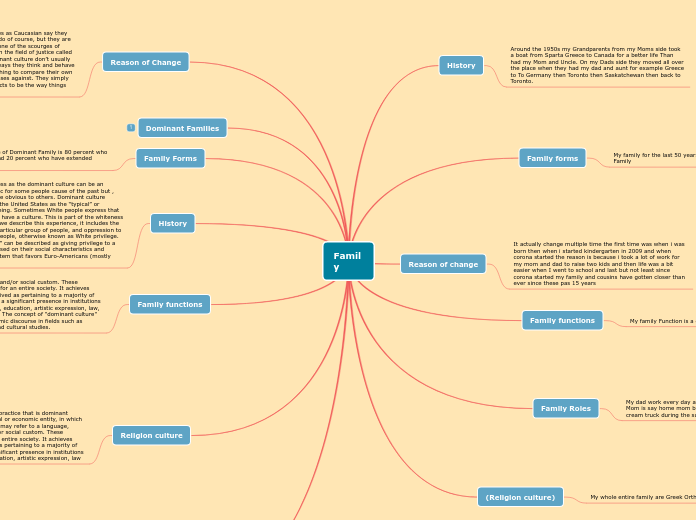
Around the 1950s my Grandparents from my Moms side took a boat from Sparta Greece to Canada for a better life Than had my Mom and Uncle. On my Dads side they moved all over the place when they had my dad and aunt for example Greece to To Germany then Toronto then Saskatchewan then back to Toronto.
My family for the last 50 years have always been a Nuclear Family
It actually change multiple time the first time was when i was born then when i started kindergarten in 2009 and when corona started the reason is because i took a lot of work for my mom and dad to raise two kids and then life was a bit easier when I went to school and last but not least since corona started my family and cousins have gotten closer than ever since these pas 15 years
My family Function is a economic maintenance
My dad work every day at work sometimes has days off my Mom is say home mom but helps my grandpa with the ice cream truck during the summer
My whole entire family are Greek Orthodox Christian
Many people who identify themselves as Caucasian say they don’t really have any culture. They do of course, but they are just not aware of what it is. This is one of the scourges of being born into what professionals in the field of justice called dominant culture. People from dominant culture don’t usually experience much push back in the ways they think and behave in their daily lives, so they have nothing to compare their own traditions, thoughts, beliefs, and biases against. They simply consider all of these important aspects to be the way things are.
hose from dominant culture, without really considering the ramifications, often want others to adapt to their way of thinking and being. For example, if they are traveling in a foreign land they might expect locals to speak English to them and will get frustrated when they don’t. While coming from a minority certainly has many unfair things in our society, one of the positive things is that people automatically get the opportunity to look good on themselves and come to terms with all of the dark history of their culture, facets that make them different and bar them from the hidden and not so hidden advantages that those from dominant culture enjoy. The end of this long struggle is usually great pride in traditions and ways of life, a better grasp on how reality is changed by perception, and has different ways of being and relating.
The average percentage of Dominant Family is 80 percent who have nuclear families and 20 percent who have extended families
he topic of whiteness as the dominant culture can be an uncomfortable topic for some people cause of the past but , while seeming quite obvious to others. Dominant culture expresses itself in the United States as the “typical” or “regular” way of being. Sometimes White people express that they don’t actually have a culture. This is part of the whiteness experience. When we describe this experience, it includes the power given to a particular group of people, and oppression to another group of people, otherwise known as White privilege. “White-washed art” can be described as giving privilege to a group of people based on their social characteristics and perpetuating a system that favors Euro-Americans (mostly White people).
Ken Monkman is a North American artist well known for his paintings that reexamine the past. He frames his work by noting that these past experiences significantly influence the present. Monkman describes his use of visual art to examine the experience of Indigenous people in North America, both during the period of colonization and the effects on the present day families. His paintings depict the violence that European settlers acted to Indigenous people, and the cultural beliefs that have been past history. He creates works of art that tell the story from the perspective of those who were harmed and emphasizes the heroism of Indigenous families, the nonbinary aspect of gender they expressed, and other cultural aspects.
eligion/ritual, social value and/or social custom. These features are often a norm for an entire society. It achieves dominance by being perceived as pertaining to a majority of the population and having a significant presence in institutions relating to communication, education, artistic expression, law, government and business. The concept of "dominant culture" is generally used in academic discourse in fields such as sociology, anthropology and cultural studies.
A dominant culture is a cultural practice that is dominant within a particular political, social or economic entity, in which multiple cultures are present. It may refer to a language, religion/ritual, social value and/or social custom. These features are often a norm for an entire society. It achieves dominance by being perceived as pertaining to a majority of the population and having a significant presence in institutions relating to communication, education, artistic expression, law