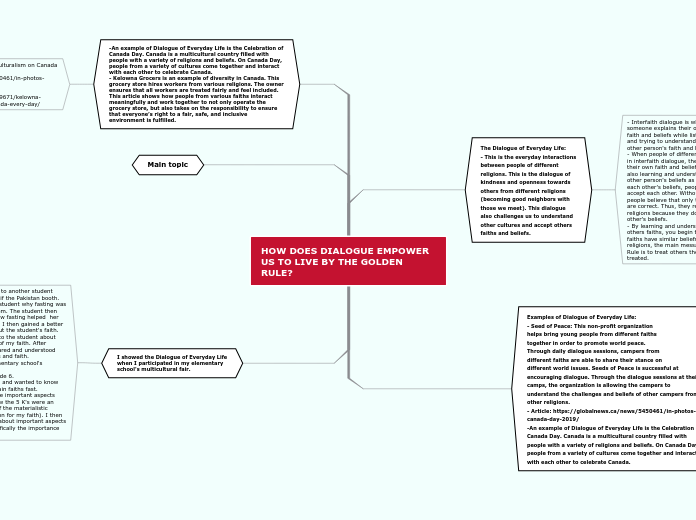
- Interfaith dialogue is when
someone explains their own
faith and beliefs while listening
and trying to understand the
other person's faith and beliefs as well.
- When people of different religions engage
in interfaith dialogue, they are not only sharing
their own faith and beliefs with others, they are
also learning and understanding about the
other person's beliefs as well. By understanding
each other's beliefs, people are able to religiously
accept each other. Without interfaith dialogue,
people believe that only their faith and beliefs
are correct. Thus, they religiously tolerate other
religions because they don't try to understand
other's beliefs.
- By learning and understanding your own and
others faiths, you begin to realize that many
faiths have similar beliefs. For instance, in most
religions, the main message of the Golden
Rule is to treat others the way you want to be
treated.
- On July, 2018, Lila Khan hosted a panel about the water theft crisis that was going on in Jordan. Through dialogue, the people in the Seed Program were able to discuss the different viewpoints of the sensitive issue. Through discussion, the people in the program were able to better understand the issue of the water theft crisis.
- “Seeds of Peace gave me hope that one day we’ll be able to live in peace—a just peace based on the elements of respect, dignity, and basic human rights and values for every Israeli and Palestinian.” — Adham (Palestinian Seed)
This is an article showing Canada's multiculturalism on Canada Day
- Article: https://globalnews.ca/news/5450461/in-photos-canada-day-2019/
This is the article about Kelowna Grocers:
- Article: https://globalnews.ca/news/5449671/kelowna-grocers-diversity-reflects-the-face-of-canada-every-day/
Who: I was talking to another student
who was in charge if the Pakistan booth.
What: I asked the student why fasting was
so important to them. The student then
explained to me how fasting helped her
be closer with God. I then gained a better
understanding about the student's faith.
In return, I talked to the student about
important aspects of my faith. After
talking we both shared and understood
each other's beliefs and faith.
Where: At my elementary school's
multicultural fair.
When: I was in grade 6.
Why: I was curious and wanted to know
why people of certain faiths fast.
How: I shared some important aspects
of my faith (ex. how the 5 K's were an
important aspect of the materialistic
dimension of religion for my faith). I then
asked the student about important aspects
of their faith (specifically the importance
of fasting).