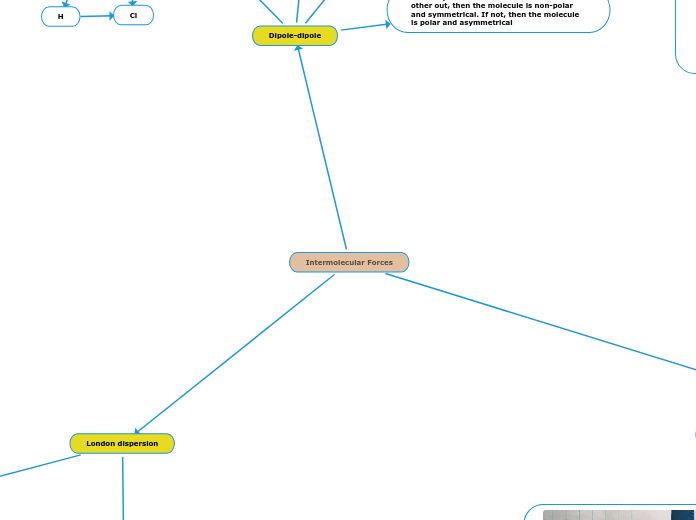
Intermolecular Forces
London dispersion
weakest, causing only temporary dipoles
N
N
Electrons in the nitrogen move around, and if they move around to one side of the atom the other side will be temporarily positive pulling close another atom making its one side more positive. causing a temporary dipole
−195.795°C
Because this is a weak and temporary reaction due to the delta EN. it requires the least amount heat energy making its boiling point the least
When a temporary dipole in one atom can make another atom dipole temporarily because electrons keep moving around
Hydrogen bonding
Strongest force
H
F
19.5 °C
The strongest force due to difference in electronegatively. We need a lot of energy to boil this.
The difference in electronegatively between fluorine and Hydrogen is very high. Fluorine having a higher one hence resulting in it having the negative charge
A hydrogen atom is attracted to a highly electronegative atom. To make a hydrogen bond, hydrogen has to be bonded to only (F,O,N) for hydrogen bonding.
**joke to remember hydrogen bonds**
"Hydrogen just wants to have FON"
Dipole-dipole
Strong but less than hydrogen bonding
H
Cl
These interact due to the the difference of electronegatively . Cl has a greater electronegativity.
attraction between a positive end of one polar molecule to the negative end of another. (neutral polar molecules)
-85.05 °C
Less diference in electronegatively than Hydrogen bonds meaning it will not take as much heat energy to boil and break the bonds/ forces
If the dipoles of a molecule cancel each other out, then the molecule is non-polar and symmetrical. If not, then the molecule is polar and asymmetrical