LANGUAGE ACQUISITION
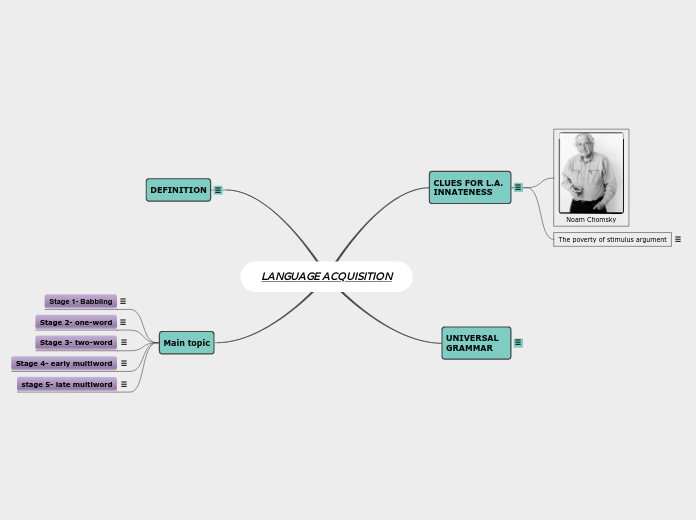
CLUES FOR L.A. INNATENESS
Noam Chomsky was first to argue that first language acquisition human infants proceeds the way it does because we are cognitively predisposed to acquire language.Some clues of language innateness are the overgeneralizing rules that children apply to form past tense verbs and plurals Example:goed, bringed / mouses
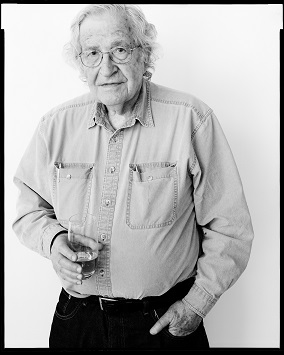
Noam Chomsky
The poverty of stimulus argument
According to Chomsky, the input available to children does not provide enough information alone for the child to learn the complex set of grammatical rules to produce and understand a language. This is called the poverty of stimulus argument and supports the idea of language innateness and universal grammar.
UNIVERSAL GRAMMAR
Universal grammar is the set of grammatical rules and principles common to all languages.Clues of universal grammar are the overgeneralizing rules explained before, the fact that children don't learn by imitation or through correction since they are able to produce words and sentences they have not heard before.
DEFINITION
Language Acquisition is the unconscious process by which humans develop language without instruction
Main topic
Stage 1- Babbling
Age: 4 to 8 monthsPatterns: Babies in the babbling stage tend to produce the same consonants no matter what language they are exposed to: /p.b.t.m.d.n.k.g.s.h.w.j/.Babies produce consonants-vowel patterns: ma ma ma, pa pa pa, da da da, ba ba ba.
Stage 2- one-word
Age: 9 to 18 monthsPatterns: This is the one-word stage. Babies produce their own words mainly nouns and verbsThey produce around 50 or more words that are common to their environment.There is a big variability in pronunciation. Some kids may produce the words with adult- like pronunciation while other more difficult to understand.
Stage 3- two-word
Age: 18 to 24 monthsPatterns: This is the two-word stageBabies combine words into two-words utterancesShow consistent word order.Some examples are:agent-actions (mama sleep, dada work)action + thing (kick ball)action + location (sit couch)thing + location (kitty bed)possessor + possessionthing + attributedeterminer + thing
Stage 4- early multiword
Age: 24 to 30 monthsPatterns: This is the Early Multi-word Stage:Children acquire different grammatical rules and apply the generalization principles explained previouslyChildren use more complex syntactic patterns.Children start using question words mainly with "where" and "what"They create negative sentences with the use of no at the beginning of a more complex. Examples: No eat, No porta bien
stage 5- late multiword
Age: 30 months and older Patterns: The Later Multi-Word Stage: Children produce longer and more complex senences. Use more question words like how, why. intonation rather than inversion More complex negative structures with no, not, and models (cant)