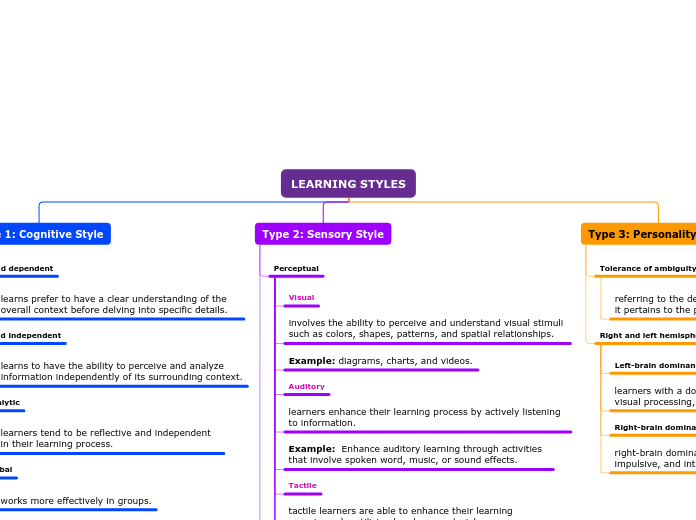
Field dependent
learns prefer to have a clear understanding of the overall context before delving into specific details.
Field independent
learns to have the ability to perceive and analyze information independently of its surrounding context.
Analytic
learners tend to be reflective and independent in their learning process.
Global
works more effectively in groups.
Reflective
learns to prefer to have ample time to reflect on and consider new information or ideas.
Impulsive
learners excel in their learning when they have the ability to promptly react to fresh information.
Perceptual
Visual
involves the ability to perceive and understand visual stimuli such as colors, shapes, patterns, and spatial relationships.
Example: diagrams, charts, and videos.
Auditory
learners enhance their learning process by actively listening to information.
Example: Enhance auditory learning through activities that involve spoken word, music, or sound effects.
Tactile
tactile learners are able to enhance their learning experience by utilizing hands-on materials.
Example: play with sensory rich materials such as play dough, slime, goop, clay, and finger paint.
Kinesthic
grasp information more efficiently when it is accompanied by physical activity or movement.
Example: using gestures to represent key vocabulary words.
Environmental
Physical
responsive to the conditions in the learning environment, including factors like illumination, temperature, and furniture.
Sociological
sensitive to the connections and interactions within the educational setting.
Tolerance of ambiguity
referring to the degree of comfort a learner has in dealing with uncertainty, it pertains to the performance of students in different scenarios.
Right and left hemisphere dominance
Left-brain dominance
learners with a dominant left-brain hemisphere inclination generally exhibit a preference for visual processing, analytical thinking, introspection, and a tendency to rely on their own abilities.
Right-brain dominance
right-brain dominant learners tend to be more auditory, global, impulsive, and interactive.