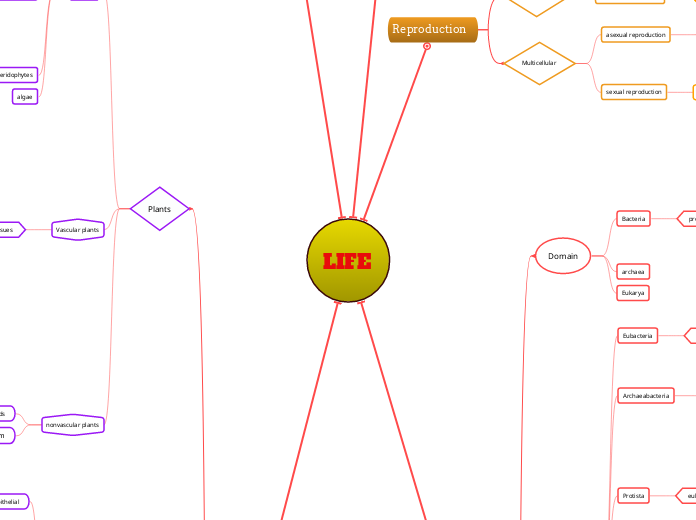
Autotroph
photosynthesis
requirements
sunlight
palisade mesophyll
carbon dioxide
stomata
water
vascular bundle/xylem
products
glucose
oxygen
pigments
chlorophyll
carotene
xanthophyll
anthocyanin
Heterotroph
eats other plants and animals for energy and nutrients
Unicellular
Asexual reproduction
binary fission
genetically identical
Multicellular
asexual reproduction
Single parent
genetically identical
sexual reproduction
meiosis
gametes
female parent
Egg
Male parent
Sperm
hermaphrodite
an organism has both
male and female reproductive organs
no new genetic material
Domain
Bacteria
prokaryotic
unicellular
obligate areobes
cannot survive without oxygen
obligate aneorobes
die if oxygen is present
facultative areobes
lives with or without oxygen
archaea
Eukarya
Kingdom
Eubacteria
prokaryotic
asexual reproduction
binary fission
unicellular
Archaeabacteria
prokaryotic
asexual reproduction
unicellular
oldest group of organisms on Earth
Protista
eukaryotic
unicellular or multicellular
sexual and asexual reproduction
some have chloroplast and cell walls
autotrophic
plant-like protists/algae
heterotrophic
animal-like protists/protozoans
fungi-like protists/molds
Fungi
eukaryotic
most are multicellular
heterotrophic
saprophytes
sexual and asexual reproduction
spores
phyla
zygomycota
ascomycota
basidiomycota
Plantae
eukaryotic
autotrophic
cell wall, cellulose, chloroplast
multicellular
sexual and asexual reproduction
Animalia
eukaryotic
multicellular
heterotrophic
sexual and asexual reproduction
phylum
class
Order
Family
Genus
Species
Cell
Tissue
Organ system
Organ
Plants
types
bryophytes
gymnosperm
Angiosperm
monocot
single cotelydon
parallel veins
vascular bundles scattered
dicot
two cotelydons
network of veins
vascular bundles in a ring
pteridophytes
algae
Vascular plants
tissues
meristematic
apical meristem
primary growth,
vertical growth
lateral meristem
secondary growth,
horizontal growth
intercalary meristem
permanent
dermal tissue system
protection,
prevention of water loss
epidermis
ground tissue system
photosynthesis, food storage, regeneration,
protection, support
parenchyma tissue
collenchyma tissue
sclerenchyma tissue
vascular tissue system
transport of water, minerals,
and other nutrients
xylem tissue
vessel element
tracheids
phloem tissue
sieve tube cells
nonvascular plants
phyllids
no cuticle, stomata, xylem, or phloem
animals
tissues
epithelial
simple squamous
stratified squamous
cuboidal
columnar
nervous
dendrites
cell body
axon
muscle
skeletal muscle cell
smooth muscle cell
cardiac muscle cell
connective
adipose
cartilage
ligament
bone
areolar
blood
gas exchange
lungs
bronchi
bronchioles
alveoli
gills
capillaries
trachea
mucosa
circulatory systems
complete double closed system
4 heart chambers:2 atriums, 2 ventricles
two loops of vessels in which blood circulates
incomplete double closed system
3 heart chambers: 2 atriums, 1 ventricle
oxygen rich and oxygen low blood gets mixed up in
the single ventricle
single closed
2 heart chambers: 1 atrium, 1 ventricle
single loop of vessel
open system
blood is pumped into body cavities
monera
bacteria
asexual reproduction
mitosis
prokaryotes
unicellular